

Internet users, and with a national Internet penetration rate of 42 percent was third in Southeast
Asia behind Hong Kong and Singapore.
5
The
state, recognizing the opportunities for e-commerce and for individuals to exchange ideas and
information, 6 has strongly encouraged adoption
of broadband Internet throughout the country.
7
Nevertheless, uptake has been slow as dial-up
remains the method by which most Malaysians
access the Internet.
8
Broadband penetration
reached a mere 2 percent in 2006, far behind
other Southeast Asian regional leaders such as
Singapore and Hong Kong, which had broadband penetrations of nearly 16 and 24 percent,
respectively. 9
Legal and regulatory frameworks
Malaysia’s constitution guarantees every citizen
the right of free speech and expression, but also
sets significant limitations on that freedom, as
Parliament may by law effect “such restrictions
[on free speech] as it deems necessary or expedient in the interest of the security of the
Federation ….” 10 Parliament has enacted numerous laws enabling broad state control over the
media. Notable print and broadcast media regulations include the Printing Presses and
Publications Act, which requires all print publishers to seek annual renewal of a publication
license granted at the state’s discretion, and the
Sedition Act, which criminalizes the expression or
publication of words that tend to incite hatred or
contempt against any government.
The Communications and Multimedia Act of
1998 (CMA) and the Communications and
Multimedia Commission Act of 1998 (CMCA)
together directly govern Malaysia’s telecommunications, broadcasting, and Internet sectors,
including related facilities, services, and content. 11 The CMCA establishes the Malaysian
Communications and Multimedia Commission,
which is empowered to regulate the information
technology and communications industries. The
commission takes the position that Internet content must be regulated and controlled for “reasons of access, privacy and security and protection of individual rights.” 12 The CMA empowers
the commission with broad authority to regulate
online speech, providing that “no content applications service provider, or other person using a
content applications service, shall provide content which is indecent, obscene, false, menacing,
or offensive in character with intent to annoy,
abuse, threaten or harass any person.” 13
326
Country Summaries
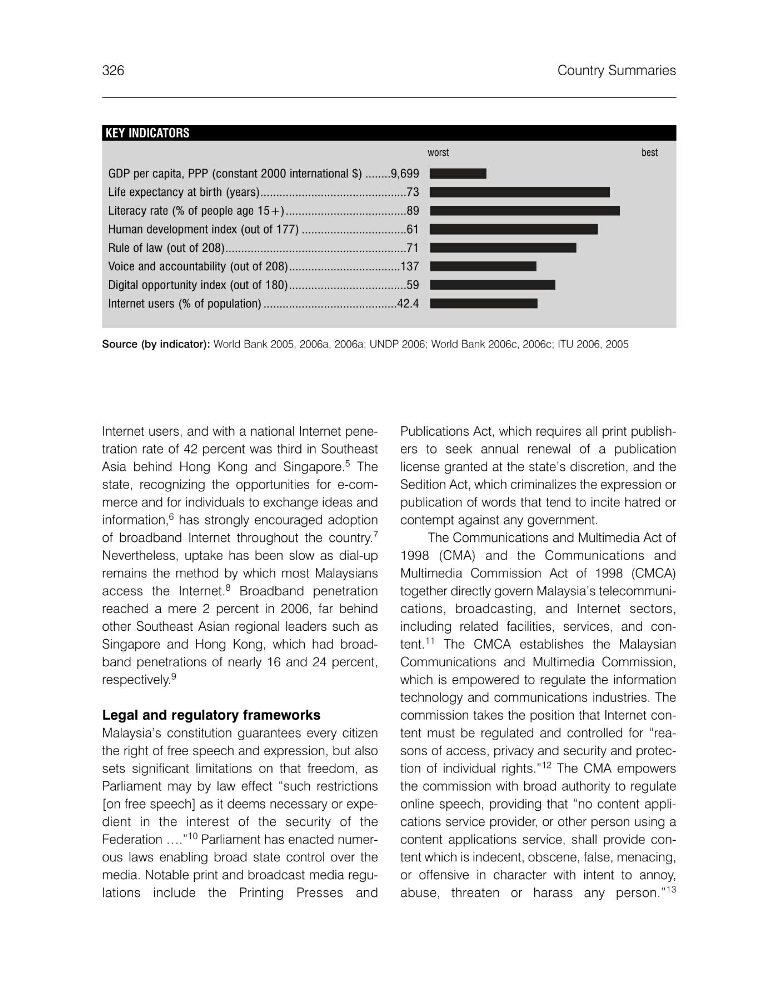
KEY INDICATORS
worst
best
GDP per capita, PPP (constant 2000 international $) ........9,699 5.08
Life expectancy at birth (years)..............................................73 6.12
Literacy rate (% of people age 15+)......................................89 5.90
Human development index (out of 177) .................................61 6.06
Rule of law (out of 208).........................................................71 6.16
Voice and accountability (out of 208)...................................137 4.19
Digital opportunity index (out of 180).....................................59 5.89
Internet users (% of population) ..........................................42.4 7.04
Source (by indicator): World Bank 2005, 2006a, 2006a; UNDP 2006; World Bank 2006c, 2006c; ITU 2006, 2005
Asia behind Hong Kong and Singapore.
5
The
state, recognizing the opportunities for e-commerce and for individuals to exchange ideas and
information, 6 has strongly encouraged adoption
of broadband Internet throughout the country.
7
Nevertheless, uptake has been slow as dial-up
remains the method by which most Malaysians
access the Internet.
8
Broadband penetration
reached a mere 2 percent in 2006, far behind
other Southeast Asian regional leaders such as
Singapore and Hong Kong, which had broadband penetrations of nearly 16 and 24 percent,
respectively. 9
Legal and regulatory frameworks
Malaysia’s constitution guarantees every citizen
the right of free speech and expression, but also
sets significant limitations on that freedom, as
Parliament may by law effect “such restrictions
[on free speech] as it deems necessary or expedient in the interest of the security of the
Federation ….” 10 Parliament has enacted numerous laws enabling broad state control over the
media. Notable print and broadcast media regulations include the Printing Presses and
Publications Act, which requires all print publishers to seek annual renewal of a publication
license granted at the state’s discretion, and the
Sedition Act, which criminalizes the expression or
publication of words that tend to incite hatred or
contempt against any government.
The Communications and Multimedia Act of
1998 (CMA) and the Communications and
Multimedia Commission Act of 1998 (CMCA)
together directly govern Malaysia’s telecommunications, broadcasting, and Internet sectors,
including related facilities, services, and content. 11 The CMCA establishes the Malaysian
Communications and Multimedia Commission,
which is empowered to regulate the information
technology and communications industries. The
commission takes the position that Internet content must be regulated and controlled for “reasons of access, privacy and security and protection of individual rights.” 12 The CMA empowers
the commission with broad authority to regulate
online speech, providing that “no content applications service provider, or other person using a
content applications service, shall provide content which is indecent, obscene, false, menacing,
or offensive in character with intent to annoy,
abuse, threaten or harass any person.” 13
326
Country Summaries
KEY INDICATORS
worst
best
GDP per capita, PPP (constant 2000 international $) ........9,699 5.08
Life expectancy at birth (years)..............................................73 6.12
Literacy rate (% of people age 15+)......................................89 5.90
Human development index (out of 177) .................................61 6.06
Rule of law (out of 208).........................................................71 6.16
Voice and accountability (out of 208)...................................137 4.19
Digital opportunity index (out of 180).....................................59 5.89
Internet users (% of population) ..........................................42.4 7.04
Source (by indicator): World Bank 2005, 2006a, 2006a; UNDP 2006; World Bank 2006c, 2006c; ITU 2006, 2005