

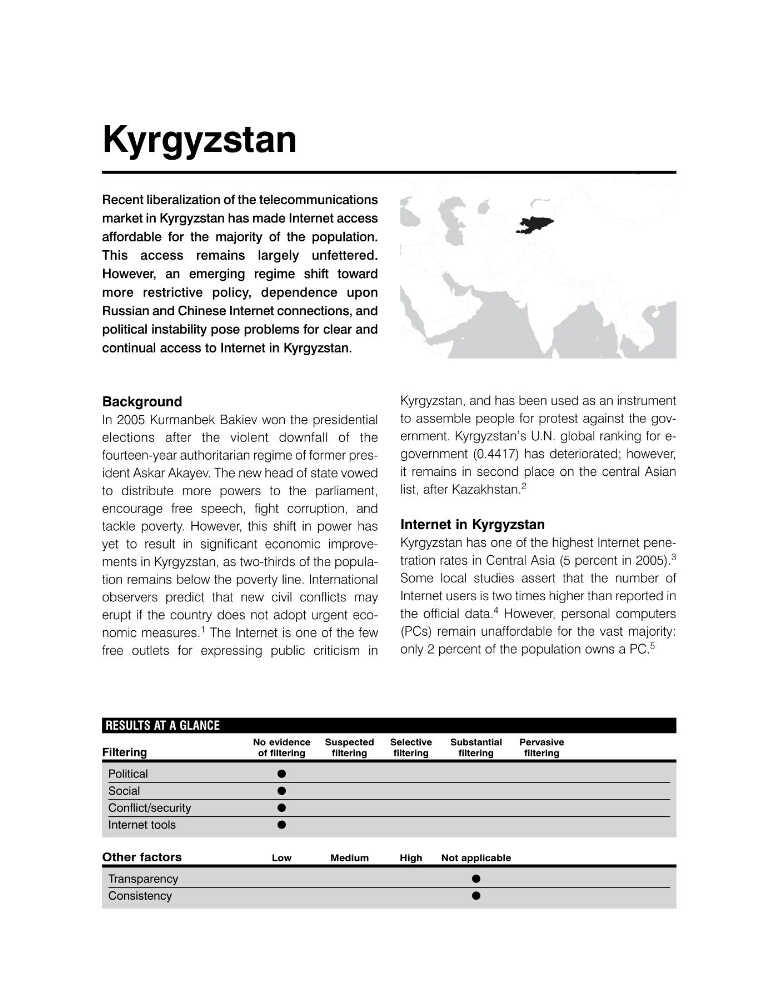
Recent liberalization of the telecommunications
market in Kyrgyzstan has made Internet access
affordable for the majority of the population.
This access remains largely unfettered.
However, an emerging regime shift toward
more restrictive policy, dependence upon
Russian and Chinese Internet connections, and
political instability pose problems for clear and
continual access to Internet in Kyrgyzstan.
Background
In 2005 Kurmanbek Bakiev won the presidential
elections after the violent downfall of the
fourteen-year authoritarian regime of former president Askar Akayev. The new head of state vowed
to distribute more powers to the parliament,
encourage free speech, fight corruption, and
tackle poverty. However, this shift in power has
yet to result in significant economic improvements in Kyrgyzstan, as two-thirds of the population remains below the poverty line. International
observers predict that new civil conflicts may
erupt if the country does not adopt urgent economic measures. 1 The Internet is one of the few
free outlets for expressing public criticism in
Kyrgyzstan, and has been used as an instrument
to assemble people for protest against the government. Kyrgyzstan’s U.N. global ranking for egovernment (0.4417) has deteriorated; however,
it remains in second place on the central Asian
list, after Kazakhstan. 2
Internet in Kyrgyzstan
Kyrgyzstan has one of the highest Internet penetration rates in Central Asia (5 percent in 2005).
3
Some local studies assert that the number of
Internet users is two times higher than reported in
the official data. 4 However, personal computers
(PCs) remain unaffordable for the vast majority:
only 2 percent of the population owns a PC. 5
RESULTS AT A GLANCE
No evidence
Suspected
Selective
Substantial
Pervasive
Filtering
of filtering
filtering
filtering
filtering
filtering
Political
●
Social
●
Conflict/security
●
Internet tools
●
Other factors
Low
Medium
High
Not applicable
Transparency
●
Consistency
●
Kyrgyzstan
market in Kyrgyzstan has made Internet access
affordable for the majority of the population.
This access remains largely unfettered.
However, an emerging regime shift toward
more restrictive policy, dependence upon
Russian and Chinese Internet connections, and
political instability pose problems for clear and
continual access to Internet in Kyrgyzstan.
Background
In 2005 Kurmanbek Bakiev won the presidential
elections after the violent downfall of the
fourteen-year authoritarian regime of former president Askar Akayev. The new head of state vowed
to distribute more powers to the parliament,
encourage free speech, fight corruption, and
tackle poverty. However, this shift in power has
yet to result in significant economic improvements in Kyrgyzstan, as two-thirds of the population remains below the poverty line. International
observers predict that new civil conflicts may
erupt if the country does not adopt urgent economic measures. 1 The Internet is one of the few
free outlets for expressing public criticism in
Kyrgyzstan, and has been used as an instrument
to assemble people for protest against the government. Kyrgyzstan’s U.N. global ranking for egovernment (0.4417) has deteriorated; however,
it remains in second place on the central Asian
list, after Kazakhstan. 2
Internet in Kyrgyzstan
Kyrgyzstan has one of the highest Internet penetration rates in Central Asia (5 percent in 2005).
3
Some local studies assert that the number of
Internet users is two times higher than reported in
the official data. 4 However, personal computers
(PCs) remain unaffordable for the vast majority:
only 2 percent of the population owns a PC. 5
RESULTS AT A GLANCE
No evidence
Suspected
Selective
Substantial
Pervasive
Filtering
of filtering
filtering
filtering
filtering
filtering
Political
●
Social
●
Conflict/security
●
Internet tools
●
Other factors
Low
Medium
High
Not applicable
Transparency
●
Consistency
●
Kyrgyzstan