

points to online media and bloggers practicing
self-censorship for fear of prosecution by the
state under highly restrictive defamation laws.
Internet in Kazakhstan
The Kazakh Internet community is growing rapidly.
Internet usage increased from 0.7 percent of the
population in 2000 to 2.7 percent of the population in 2004. 3 Computer penetration is around fifteen to seventeen computers per 100 residents.
Because of its size and internal regional disparities (especially between rural and urban
dwellers), Internet access remains beyond the
reach of most Kazakhs, except for those living in
major cities. Internet access is most popular
among young urban dwellers, with a surprisingly
high percentage of female users (44.1 percent).
Russian is the most popular language used
on the Internet (94.1 percent), followed by Kazakh
(4.5 percent) and English (1.4 percent), which may
account for the high percentage of Kazakh Web
sites hosted in Russia (including those on the
“.kz” domain). Six percent of “.kz” Web sites are
hosted in Kazakhstan, with the remainder hosted
in Russia and elsewhere. Kazakhs use a wide
range of search engines, including Russian, U.S.,
and Kazakh (www.rambler.ru, www.yandex.ru,
www.yahoo.com, www.google.kz, www.site.kz).
Recent liberalization of the telecommunications market increased competition among the
five licensed operators. These are Kazakhtelecom (the former state monopoly), Transtelecom,
Kaztranscom, Arna [DUCAT], and Astel.
Kazakstan also has five first-tier Internet service
providers (ISPs) that possess independent channels to the Internet. These are Kaztelecom,
Nursat, Astel, Telcom, and NIT. Some 100 second-tier providers lease access from the five firsttier ISPs. 4
Kazakhtelecom is the operator of the national data transfer network, which connects the
major cities of Kazakhstan with a total bandwidth
of 665Mbit/s, 5 and carrying capacity of separate
local segments of up to 10 GB/s.
6
Other leading
first-tier ISPs (Nursat and Astel) also operate
significant terrestrial and satellite based infrastructure.
Legal and regulatory frameworks
The Kazakh government exhibits an ambiguous
and at times contradictory approach to the
Internet. On one hand the “Development Strategy
of Kazakhstan until 2030” demonstrates the govCountry Summaries
313
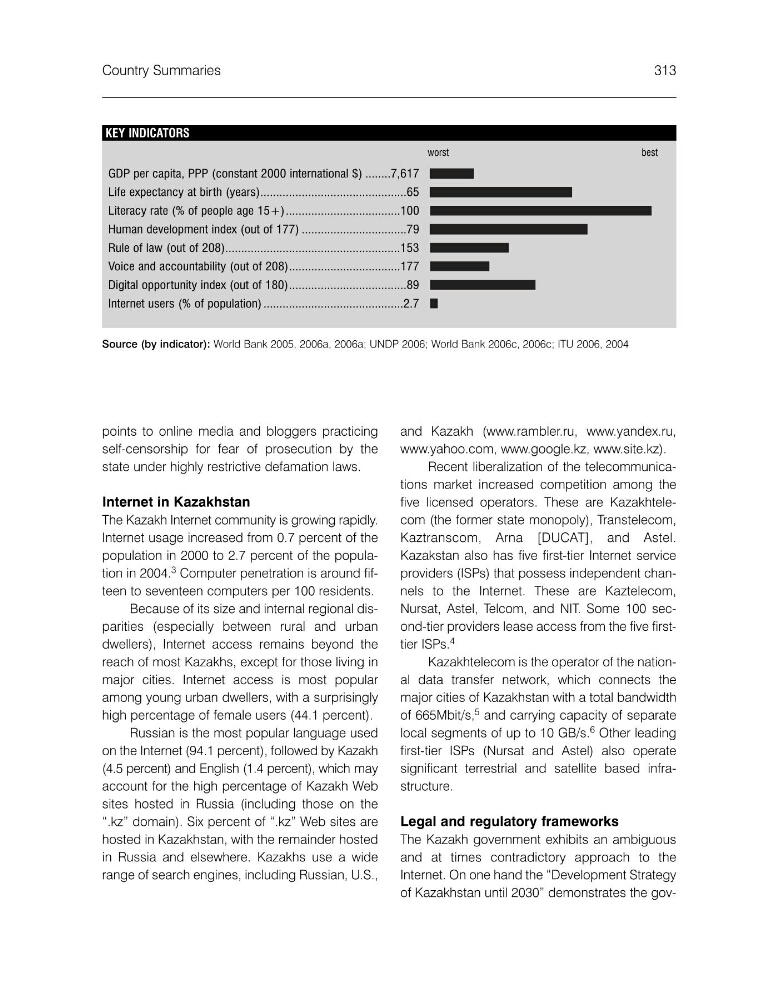
KEY INDICATORS
worst
best
GDP per capita, PPP (constant 2000 international $) ........7,617 4.68
Life expectancy at birth (years)..............................................65 4.83
Literacy rate (% of people age 15+)....................................100 6.97
Human development index (out of 177) .................................79 5.70
Rule of law (out of 208).......................................................153 3.43
Voice and accountability (out of 208)...................................177 2.63
Digital opportunity index (out of 180).....................................89 5.11
Internet users (% of population) ............................................2.7 3.31
Source (by indicator): World Bank 2005, 2006a, 2006a; UNDP 2006; World Bank 2006c, 2006c; ITU 2006, 2004
self-censorship for fear of prosecution by the
state under highly restrictive defamation laws.
Internet in Kazakhstan
The Kazakh Internet community is growing rapidly.
Internet usage increased from 0.7 percent of the
population in 2000 to 2.7 percent of the population in 2004. 3 Computer penetration is around fifteen to seventeen computers per 100 residents.
Because of its size and internal regional disparities (especially between rural and urban
dwellers), Internet access remains beyond the
reach of most Kazakhs, except for those living in
major cities. Internet access is most popular
among young urban dwellers, with a surprisingly
high percentage of female users (44.1 percent).
Russian is the most popular language used
on the Internet (94.1 percent), followed by Kazakh
(4.5 percent) and English (1.4 percent), which may
account for the high percentage of Kazakh Web
sites hosted in Russia (including those on the
“.kz” domain). Six percent of “.kz” Web sites are
hosted in Kazakhstan, with the remainder hosted
in Russia and elsewhere. Kazakhs use a wide
range of search engines, including Russian, U.S.,
and Kazakh (www.rambler.ru, www.yandex.ru,
www.yahoo.com, www.google.kz, www.site.kz).
Recent liberalization of the telecommunications market increased competition among the
five licensed operators. These are Kazakhtelecom (the former state monopoly), Transtelecom,
Kaztranscom, Arna [DUCAT], and Astel.
Kazakstan also has five first-tier Internet service
providers (ISPs) that possess independent channels to the Internet. These are Kaztelecom,
Nursat, Astel, Telcom, and NIT. Some 100 second-tier providers lease access from the five firsttier ISPs. 4
Kazakhtelecom is the operator of the national data transfer network, which connects the
major cities of Kazakhstan with a total bandwidth
of 665Mbit/s, 5 and carrying capacity of separate
local segments of up to 10 GB/s.
6
Other leading
first-tier ISPs (Nursat and Astel) also operate
significant terrestrial and satellite based infrastructure.
Legal and regulatory frameworks
The Kazakh government exhibits an ambiguous
and at times contradictory approach to the
Internet. On one hand the “Development Strategy
of Kazakhstan until 2030” demonstrates the govCountry Summaries
313
KEY INDICATORS
worst
best
GDP per capita, PPP (constant 2000 international $) ........7,617 4.68
Life expectancy at birth (years)..............................................65 4.83
Literacy rate (% of people age 15+)....................................100 6.97
Human development index (out of 177) .................................79 5.70
Rule of law (out of 208).......................................................153 3.43
Voice and accountability (out of 208)...................................177 2.63
Digital opportunity index (out of 180).....................................89 5.11
Internet users (% of population) ............................................2.7 3.31
Source (by indicator): World Bank 2005, 2006a, 2006a; UNDP 2006; World Bank 2006c, 2006c; ITU 2006, 2004