

Like many of the governments in the
Commonwealth of Independent States (CIS),
Kazakhstan has a conflicted position with
regard to the Internet. The Kazakh government
aims to make Kazakhstan the main IT portal in
Central Asia. In this regard, the government
has harnessed efforts to liberalize the IT sector,
promote Internet use, and encourage
e-government in order to spur social development. However, the government has also
implemented a complex system that allows for
state surveillance of Internet traffic that can be
used to filter or suppress Internet content.
Current rules require all Internet traffic to pass
through state-owned channels, politically sensitive Internet content is selectively filtered, and
opposition media and bloggers are said to
practice self-censorship for fear of government
reprisal.
Background
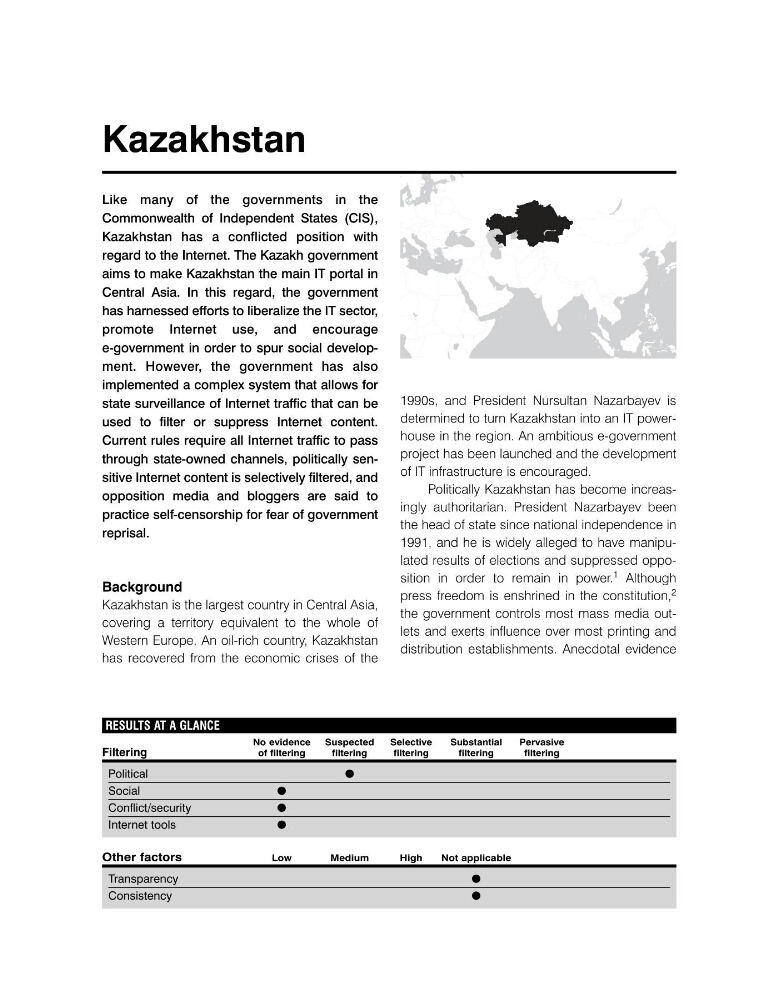
Kazakhstan is the largest country in Central Asia,
covering a territory equivalent to the whole of
Western Europe. An oil-rich country, Kazakhstan
has recovered from the economic crises of the
1990s, and President Nursultan Nazarbayev is
determined to turn Kazakhstan into an IT powerhouse in the region. An ambitious e-government
project has been launched and the development
of IT infrastructure is encouraged.
Politically Kazakhstan has become increasingly authoritarian. President Nazarbayev been
the head of state since national independence in
1991, and he is widely alleged to have manipulated results of elections and suppressed opposition in order to remain in power. 1 Although
press freedom is enshrined in the constitution,
2
the government controls most mass media outlets and exerts influence over most printing and
distribution establishments. Anecdotal evidence
RESULTS AT A GLANCE
No evidence
Suspected
Selective
Substantial
Pervasive
Filtering
of filtering
filtering
filtering
filtering
filtering
Political
●
Social
●
Conflict/security
●
Internet tools
●
Other factors
Low
Medium
High
Not applicable
Transparency
●
Consistency
●
Kazakhstan
Commonwealth of Independent States (CIS),
Kazakhstan has a conflicted position with
regard to the Internet. The Kazakh government
aims to make Kazakhstan the main IT portal in
Central Asia. In this regard, the government
has harnessed efforts to liberalize the IT sector,
promote Internet use, and encourage
e-government in order to spur social development. However, the government has also
implemented a complex system that allows for
state surveillance of Internet traffic that can be
used to filter or suppress Internet content.
Current rules require all Internet traffic to pass
through state-owned channels, politically sensitive Internet content is selectively filtered, and
opposition media and bloggers are said to
practice self-censorship for fear of government
reprisal.
Background
Kazakhstan is the largest country in Central Asia,
covering a territory equivalent to the whole of
Western Europe. An oil-rich country, Kazakhstan
has recovered from the economic crises of the
1990s, and President Nursultan Nazarbayev is
determined to turn Kazakhstan into an IT powerhouse in the region. An ambitious e-government
project has been launched and the development
of IT infrastructure is encouraged.
Politically Kazakhstan has become increasingly authoritarian. President Nazarbayev been
the head of state since national independence in
1991, and he is widely alleged to have manipulated results of elections and suppressed opposition in order to remain in power. 1 Although
press freedom is enshrined in the constitution,
2
the government controls most mass media outlets and exerts influence over most printing and
distribution establishments. Anecdotal evidence
RESULTS AT A GLANCE
No evidence
Suspected
Selective
Substantial
Pervasive
Filtering
of filtering
filtering
filtering
filtering
filtering
Political
●
Social
●
Conflict/security
●
Internet tools
●
Other factors
Low
Medium
High
Not applicable
Transparency
●
Consistency
●
Kazakhstan