

there were only 45,000 Internet users, many of
them state officials, in Iraq.
6
But after the U.S.
invasion Internet cafés spread throughout the
country. There are no recent studies that enumerate Internet users in Iraq, but the ITU estimated the number to have reached 50,000 users by
the end of 2004. 7
The U.S. Defense Department spent more
than USD165 million to set up cybercafés in Iraq.
In 2004, Iraq contained 36 cafés, and by July
2006 it had more than 170. 8 According to a report
from the London-based pan-Arab daily Al-Sharq
al-Awsat, approximately 45 percent of those who
frequent Internet cafés are women, and both
male and female users use matchmaking Web
sites to find future spouses from outside Iraq so
that they can get out of the country. 9
Iraq’s primary ISP, uruklink, provides dialup,
DSL, and wireless connection services,
10
and it
also provides wireless high-capacity data and
voice communications to government sites
through the Baghdad Wireless Broadband
Network in Baghdad. 11
There is a very active Iraqi blogging community that blogs mostly about the experience of
living in a war zone and the effects of the conflict
on citizens’ lives. Several Iraqi bloggers have
caught the attention of international media. The
blog Baghdad Burning, for example, was adapted for stage 12 and a book.
13
The blog was started
in 2003 by a twenty-four-year-old Iraqi girl using
the pseudonym Riverbend.
In November 2005, Iraq secured the .iq
ccTLD, and entrusted its administration to Iraq’s
National Communications and Media Commission (NCMC). 14
Legal and regulatory frameworks
The new Iraqi government has placed few restrictions or regulations on the Internet in Iraq. Article
36 of the Iraqi constitution guarantees freedom of
expression. The sweeping powers Prime Minister
al-Maliki granted to the military in the name of
security did not place unusual restrictions on the
right to free expression, but they did circumscribe
the corollary rights to privacy and assembly. 15
Provisions of the penal code restricting freedom
of the press remain on the books; these provisions have been used to sentence journalists to
long prison sentences in recent years. 16
Iraqi security forces detained at least thirty
reporters over the course of 2006, with four still
held without charge at year’s end. 17 The
Committee to Protect Journalists reports that
Country Summaries
301
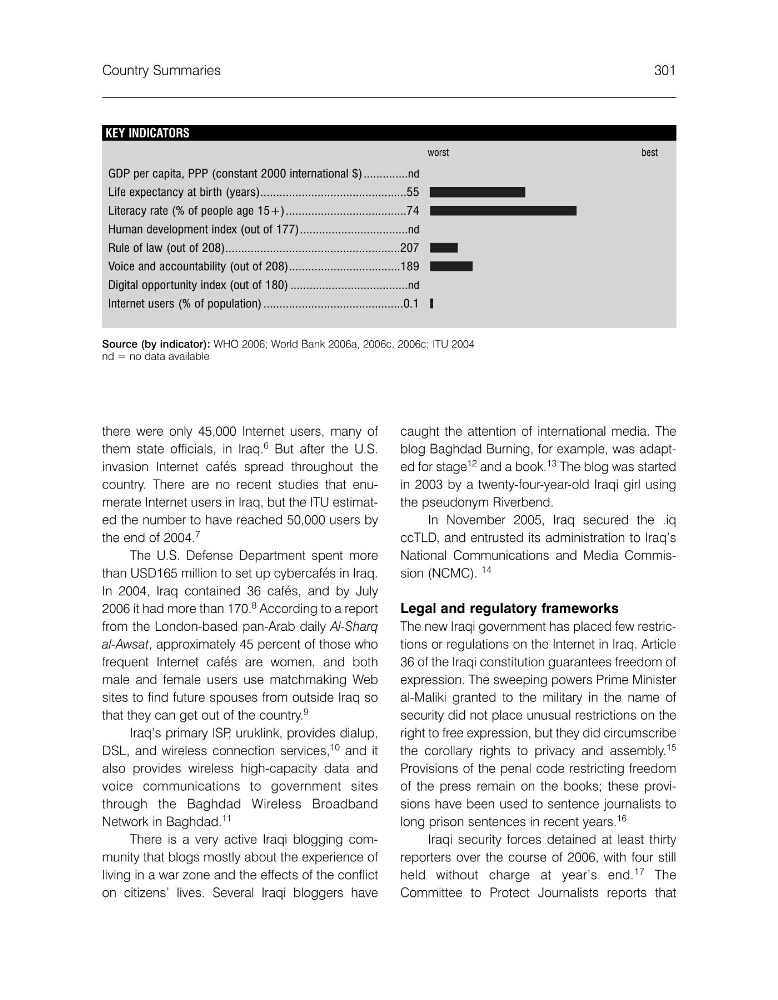
KEY INDICATORS
worst
best
GDP per capita, PPP (constant 2000 international $)..............nd —
Life expectancy at birth (years)..............................................55 3.22
Literacy rate (% of people age 15+)......................................74 4.44
Human development index (out of 177)..................................nd —
Rule of law (out of 208).......................................................207 1.37
Voice and accountability (out of 208)...................................189 2.07
Digital opportunity index (out of 180) .....................................nd —
Internet users (% of population) ............................................0.1 3.07
Source (by indicator): WHO 2006; World Bank 2006a, 2006c, 2006c; ITU 2004
nd = no data available
them state officials, in Iraq.
6
But after the U.S.
invasion Internet cafés spread throughout the
country. There are no recent studies that enumerate Internet users in Iraq, but the ITU estimated the number to have reached 50,000 users by
the end of 2004. 7
The U.S. Defense Department spent more
than USD165 million to set up cybercafés in Iraq.
In 2004, Iraq contained 36 cafés, and by July
2006 it had more than 170. 8 According to a report
from the London-based pan-Arab daily Al-Sharq
al-Awsat, approximately 45 percent of those who
frequent Internet cafés are women, and both
male and female users use matchmaking Web
sites to find future spouses from outside Iraq so
that they can get out of the country. 9
Iraq’s primary ISP, uruklink, provides dialup,
DSL, and wireless connection services,
10
and it
also provides wireless high-capacity data and
voice communications to government sites
through the Baghdad Wireless Broadband
Network in Baghdad. 11
There is a very active Iraqi blogging community that blogs mostly about the experience of
living in a war zone and the effects of the conflict
on citizens’ lives. Several Iraqi bloggers have
caught the attention of international media. The
blog Baghdad Burning, for example, was adapted for stage 12 and a book.
13
The blog was started
in 2003 by a twenty-four-year-old Iraqi girl using
the pseudonym Riverbend.
In November 2005, Iraq secured the .iq
ccTLD, and entrusted its administration to Iraq’s
National Communications and Media Commission (NCMC). 14
Legal and regulatory frameworks
The new Iraqi government has placed few restrictions or regulations on the Internet in Iraq. Article
36 of the Iraqi constitution guarantees freedom of
expression. The sweeping powers Prime Minister
al-Maliki granted to the military in the name of
security did not place unusual restrictions on the
right to free expression, but they did circumscribe
the corollary rights to privacy and assembly. 15
Provisions of the penal code restricting freedom
of the press remain on the books; these provisions have been used to sentence journalists to
long prison sentences in recent years. 16
Iraqi security forces detained at least thirty
reporters over the course of 2006, with four still
held without charge at year’s end. 17 The
Committee to Protect Journalists reports that
Country Summaries
301
KEY INDICATORS
worst
best
GDP per capita, PPP (constant 2000 international $)..............nd —
Life expectancy at birth (years)..............................................55 3.22
Literacy rate (% of people age 15+)......................................74 4.44
Human development index (out of 177)..................................nd —
Rule of law (out of 208).......................................................207 1.37
Voice and accountability (out of 208)...................................189 2.07
Digital opportunity index (out of 180) .....................................nd —
Internet users (% of population) ............................................0.1 3.07
Source (by indicator): WHO 2006; World Bank 2006a, 2006c, 2006c; ITU 2004
nd = no data available