

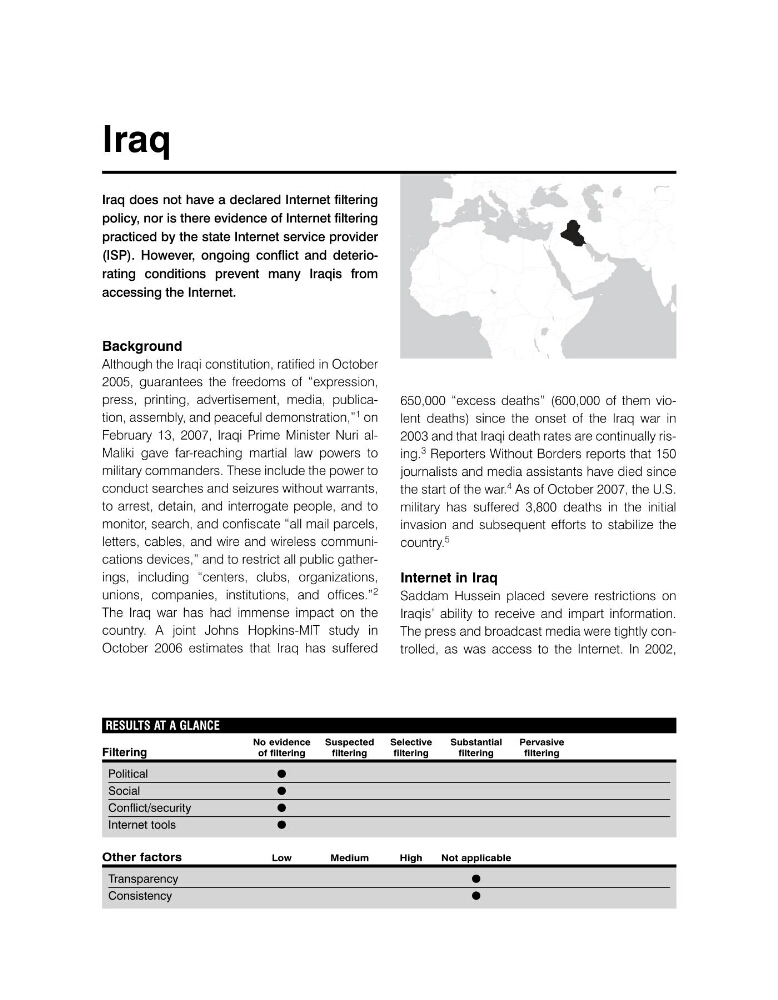
Iraq does not have a declared Internet filtering
policy, nor is there evidence of Internet filtering
practiced by the state Internet service provider
(ISP). However, ongoing conflict and deteriorating conditions prevent many Iraqis from
accessing the Internet.
Background
Although the Iraqi constitution, ratified in October
2005, guarantees the freedoms of “expression,
press, printing, advertisement, media, publication, assembly, and peaceful demonstration,” 1 on
February 13, 2007, Iraqi Prime Minister Nuri alMaliki gave far-reaching martial law powers to
military commanders. These include the power to
conduct searches and seizures without warrants,
to arrest, detain, and interrogate people, and to
monitor, search, and confiscate “all mail parcels,
letters, cables, and wire and wireless communications devices,” and to restrict all public gatherings, including “centers, clubs, organizations,
unions, companies, institutions, and offices.” 2
The Iraq war has had immense impact on the
country. A joint Johns Hopkins-MIT study in
October 2006 estimates that Iraq has suffered
650,000 “excess deaths” (600,000 of them violent deaths) since the onset of the Iraq war in
2003 and that Iraqi death rates are continually rising. 3 Reporters Without Borders reports that 150
journalists and media assistants have died since
the start of the war. 4 As of October 2007, the U.S.
military has suffered 3,800 deaths in the initial
invasion and subsequent efforts to stabilize the
country. 5
Internet in Iraq
Saddam Hussein placed severe restrictions on
Iraqis’ ability to receive and impart information.
The press and broadcast media were tightly controlled, as was access to the Internet. In 2002,
RESULTS AT A GLANCE
No evidence
Suspected
Selective
Substantial
Pervasive
Filtering
of filtering
filtering
filtering
filtering
filtering
Political
●
Social
●
Conflict/security
●
Internet tools
●
Other factors
Low
Medium
High
Not applicable
Transparency
●
Consistency
●
Iraq
policy, nor is there evidence of Internet filtering
practiced by the state Internet service provider
(ISP). However, ongoing conflict and deteriorating conditions prevent many Iraqis from
accessing the Internet.
Background
Although the Iraqi constitution, ratified in October
2005, guarantees the freedoms of “expression,
press, printing, advertisement, media, publication, assembly, and peaceful demonstration,” 1 on
February 13, 2007, Iraqi Prime Minister Nuri alMaliki gave far-reaching martial law powers to
military commanders. These include the power to
conduct searches and seizures without warrants,
to arrest, detain, and interrogate people, and to
monitor, search, and confiscate “all mail parcels,
letters, cables, and wire and wireless communications devices,” and to restrict all public gatherings, including “centers, clubs, organizations,
unions, companies, institutions, and offices.” 2
The Iraq war has had immense impact on the
country. A joint Johns Hopkins-MIT study in
October 2006 estimates that Iraq has suffered
650,000 “excess deaths” (600,000 of them violent deaths) since the onset of the Iraq war in
2003 and that Iraqi death rates are continually rising. 3 Reporters Without Borders reports that 150
journalists and media assistants have died since
the start of the war. 4 As of October 2007, the U.S.
military has suffered 3,800 deaths in the initial
invasion and subsequent efforts to stabilize the
country. 5
Internet in Iraq
Saddam Hussein placed severe restrictions on
Iraqis’ ability to receive and impart information.
The press and broadcast media were tightly controlled, as was access to the Internet. In 2002,
RESULTS AT A GLANCE
No evidence
Suspected
Selective
Substantial
Pervasive
Filtering
of filtering
filtering
filtering
filtering
filtering
Political
●
Social
●
Conflict/security
●
Internet tools
●
Other factors
Low
Medium
High
Not applicable
Transparency
●
Consistency
●
Iraq