

Because 71 percent of the population lives in
rural areas, and because the gap between rural
and urban teledensity is increasing, the majority
of Indians are shut out of the Internet. 5 In
decreasing order of popularity, points of access
are cybercafés, home, work or business, and
schools, with cybercafés remaining the most
popular option. 6 An estimated 38 percent of all
Internet users in India are “heavy users” and
spend an average of 8.2 hours per week on the
Internet. 7 A Windows Live Spaces report on a
thriving blogging community in India, estimated
at 14 percent of Internet users, found that a vast
majority of bloggers are men under the age of
thirty-five; this conforms to the demographic
snapshot of Internet users as predominantly
male, middle class, and young. 8
There are 153 ISPs in operation today,
although the majority market share (62 percent)
remains with the public-sector corporations
Bharat Sanchar Nigam Limited (BSNL) (43 percent) and Mahanagar Telephone Nigam Limited
(MTNL) (19 percent). 9 In the mid-1980s two stateowned corporations were formed to provide limited telecom services—Videsh Sanchar Nigam
Limited (VSNL) for international long distance,
and Mahanagar Telephone Nigam Limited
(MTNL) for Mumbai and Delhi. In 1995 VSNL was
the first to provide Internet services in India, and
it was privatized in 2002. The first Action Plan of
the National Task Force on Information
Technology and Software Development, created
in May 1998, sought to create Internet access
nodes in all district headquarters by January
2000. The government began allowing ISPs to
legally handle Voice-over Internet Protocol (VoIP)
in April 2002. As of March 2006, 134 ISPs
were authorized to offer Internet-based telephony
services, but only 32 were actually providing the
service. 10
In January 2007 the Department of
Telecommunications (DOT) announced that it
would be installing filtering mechanisms at
India’s international gateways. The head of the
Internet Service Providers Association of India
(ISPAI) stated that these new “landing stations”
would be able to both engage in centralized filtering of Web sites and blocking of VoIP telephony services such as Yahoo, MSN, and Skype
(and many more) that have not technically been
approved to provide these services in India. 11
Country Summaries
287
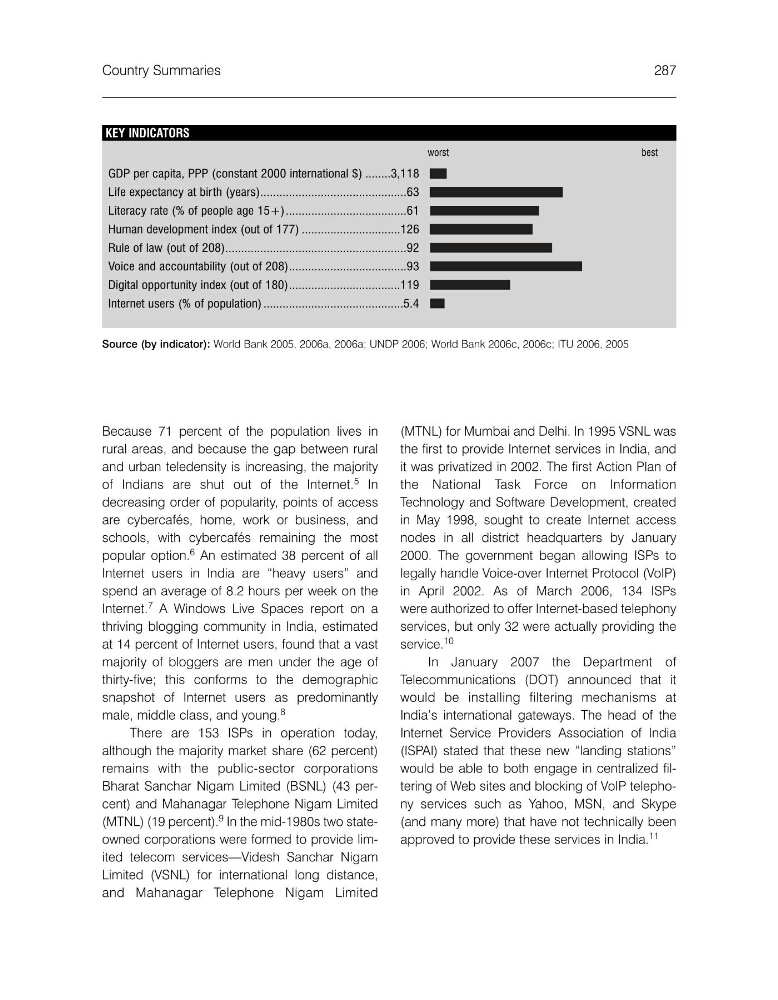
KEY INDICATORS
worst
best
GDP per capita, PPP (constant 2000 international $) ........3,118 3.82
Life expectancy at birth (years)..............................................63 4.51
Literacy rate (% of people age 15+)......................................61 3.17
Human development index (out of 177) ...............................126 3.86
Rule of law (out of 208).........................................................92 5.17
Voice and accountability (out of 208).....................................93 5.71
Digital opportunity index (out of 180)...................................119 4.12
Internet users (% of population) ............................................5.4 3.57
Source (by indicator): World Bank 2005, 2006a, 2006a; UNDP 2006; World Bank 2006c, 2006c; ITU 2006, 2005
rural areas, and because the gap between rural
and urban teledensity is increasing, the majority
of Indians are shut out of the Internet. 5 In
decreasing order of popularity, points of access
are cybercafés, home, work or business, and
schools, with cybercafés remaining the most
popular option. 6 An estimated 38 percent of all
Internet users in India are “heavy users” and
spend an average of 8.2 hours per week on the
Internet. 7 A Windows Live Spaces report on a
thriving blogging community in India, estimated
at 14 percent of Internet users, found that a vast
majority of bloggers are men under the age of
thirty-five; this conforms to the demographic
snapshot of Internet users as predominantly
male, middle class, and young. 8
There are 153 ISPs in operation today,
although the majority market share (62 percent)
remains with the public-sector corporations
Bharat Sanchar Nigam Limited (BSNL) (43 percent) and Mahanagar Telephone Nigam Limited
(MTNL) (19 percent). 9 In the mid-1980s two stateowned corporations were formed to provide limited telecom services—Videsh Sanchar Nigam
Limited (VSNL) for international long distance,
and Mahanagar Telephone Nigam Limited
(MTNL) for Mumbai and Delhi. In 1995 VSNL was
the first to provide Internet services in India, and
it was privatized in 2002. The first Action Plan of
the National Task Force on Information
Technology and Software Development, created
in May 1998, sought to create Internet access
nodes in all district headquarters by January
2000. The government began allowing ISPs to
legally handle Voice-over Internet Protocol (VoIP)
in April 2002. As of March 2006, 134 ISPs
were authorized to offer Internet-based telephony
services, but only 32 were actually providing the
service. 10
In January 2007 the Department of
Telecommunications (DOT) announced that it
would be installing filtering mechanisms at
India’s international gateways. The head of the
Internet Service Providers Association of India
(ISPAI) stated that these new “landing stations”
would be able to both engage in centralized filtering of Web sites and blocking of VoIP telephony services such as Yahoo, MSN, and Skype
(and many more) that have not technically been
approved to provide these services in India. 11
Country Summaries
287
KEY INDICATORS
worst
best
GDP per capita, PPP (constant 2000 international $) ........3,118 3.82
Life expectancy at birth (years)..............................................63 4.51
Literacy rate (% of people age 15+)......................................61 3.17
Human development index (out of 177) ...............................126 3.86
Rule of law (out of 208).........................................................92 5.17
Voice and accountability (out of 208).....................................93 5.71
Digital opportunity index (out of 180)...................................119 4.12
Internet users (% of population) ............................................5.4 3.57
Source (by indicator): World Bank 2005, 2006a, 2006a; UNDP 2006; World Bank 2006c, 2006c; ITU 2006, 2005