

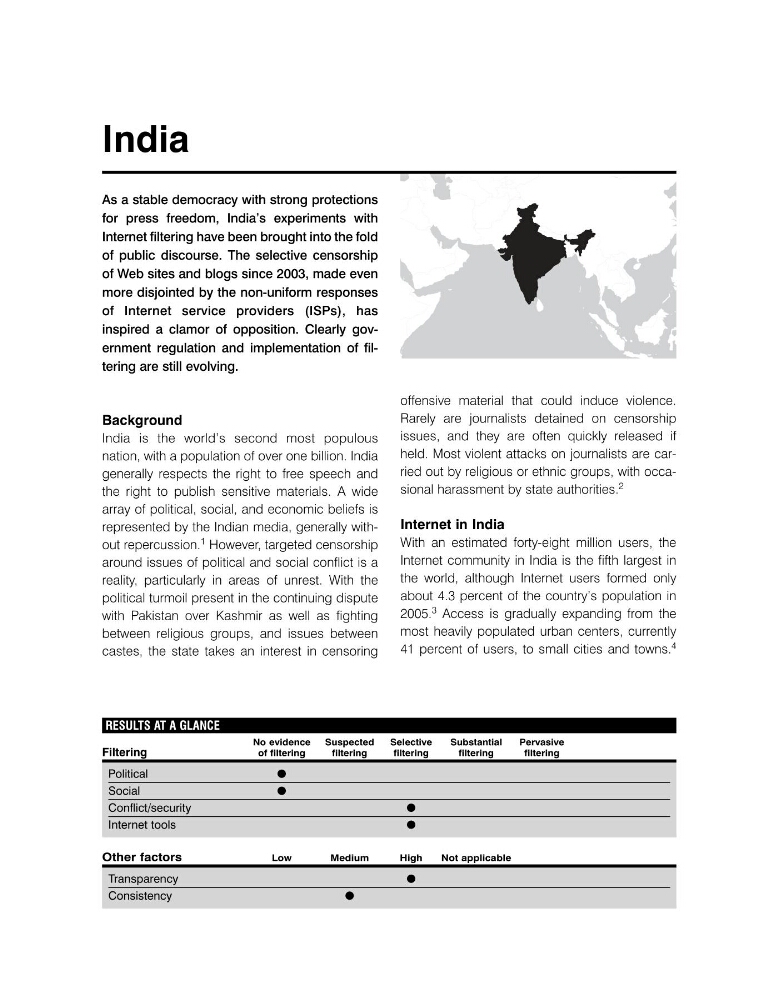
As a stable democracy with strong protections
for press freedom, India’s experiments with
Internet filtering have been brought into the fold
of public discourse. The selective censorship
of Web sites and blogs since 2003, made even
more disjointed by the non-uniform responses
of Internet service providers (ISPs), has
inspired a clamor of opposition. Clearly government regulation and implementation of filtering are still evolving.
Background
India is the world’s second most populous
nation, with a population of over one billion. India
generally respects the right to free speech and
the right to publish sensitive materials. A wide
array of political, social, and economic beliefs is
represented by the Indian media, generally without repercussion. 1 However, targeted censorship
around issues of political and social conflict is a
reality, particularly in areas of unrest. With the
political turmoil present in the continuing dispute
with Pakistan over Kashmir as well as fighting
between religious groups, and issues between
castes, the state takes an interest in censoring
offensive material that could induce violence.
Rarely are journalists detained on censorship
issues, and they are often quickly released if
held. Most violent attacks on journalists are carried out by religious or ethnic groups, with occasional harassment by state authorities. 2
Internet in India
With an estimated forty-eight million users, the
Internet community in India is the fifth largest in
the world, although Internet users formed only
about 4.3 percent of the country’s population in
2005. 3 Access is gradually expanding from the
most heavily populated urban centers, currently
41 percent of users, to small cities and towns. 4
RESULTS AT A GLANCE
No evidence
Suspected
Selective
Substantial
Pervasive
Filtering
of filtering
filtering
filtering
filtering
filtering
Political
●
Social
●
Conflict/security
●
Internet tools
●
Other factors
Low
Medium
High
Not applicable
Transparency
●
Consistency
●
India
for press freedom, India’s experiments with
Internet filtering have been brought into the fold
of public discourse. The selective censorship
of Web sites and blogs since 2003, made even
more disjointed by the non-uniform responses
of Internet service providers (ISPs), has
inspired a clamor of opposition. Clearly government regulation and implementation of filtering are still evolving.
Background
India is the world’s second most populous
nation, with a population of over one billion. India
generally respects the right to free speech and
the right to publish sensitive materials. A wide
array of political, social, and economic beliefs is
represented by the Indian media, generally without repercussion. 1 However, targeted censorship
around issues of political and social conflict is a
reality, particularly in areas of unrest. With the
political turmoil present in the continuing dispute
with Pakistan over Kashmir as well as fighting
between religious groups, and issues between
castes, the state takes an interest in censoring
offensive material that could induce violence.
Rarely are journalists detained on censorship
issues, and they are often quickly released if
held. Most violent attacks on journalists are carried out by religious or ethnic groups, with occasional harassment by state authorities. 2
Internet in India
With an estimated forty-eight million users, the
Internet community in India is the fifth largest in
the world, although Internet users formed only
about 4.3 percent of the country’s population in
2005. 3 Access is gradually expanding from the
most heavily populated urban centers, currently
41 percent of users, to small cities and towns. 4
RESULTS AT A GLANCE
No evidence
Suspected
Selective
Substantial
Pervasive
Filtering
of filtering
filtering
filtering
filtering
filtering
Political
●
Social
●
Conflict/security
●
Internet tools
●
Other factors
Low
Medium
High
Not applicable
Transparency
●
Consistency
●
India