

access the Internet for the price of a local phone
call, has led to a sharp rise in Internet use and
has served as a model for other developing
countries. 3 As only 3.78 percent of people own
personal computers,
4
most users gain access
through one of Egypt’s four hundred
5
Internet
cafés, a Mobile Internet Unit,
6
or nearly 1,300
public information technology clubs.
7
These
clubs allow users to access the Internet for a
small fee; they are affiliated with the Ministry of
Communication and are located in public buildings such as schools. 8 In 2004 the “PC for Every
Home” initiative helped 120,000 people obtain a
personal computer through a combination of
low-cost hardware and government financing. 9
The government is experimenting with WiMax
technology that could provide vast areas of the
countryside with high-speed, wireless access.
10
Despite all of these efforts, Internet access
remains most prevalent in the cities.
11
Egypt boasts the largest fixed-line communications network in the Arab world. Where many
nations in the region are serviced by state-owned
companies or monopolies, Egypt has licensed
four Internet carriers and eight data service
providers, along with hundreds of Internet service
providers (ISPs). 12 Service is currently provided
by 211 ISPs, the largest of which are
LINKdotNET, a private company founded in 1992,
and TEData, the Internet arm of the giant Telecom
Egypt, slated for privatization in 2007 whose
shares are 80 percent owned by the Egyptian
government and 20 percent free float. In 2004,
the government, along with nine companies,
introduced ADSL service to Egypt. As of 2006,
the service had approximately 130,000 subscribers at an average monthly cost of 95
Egyptian pounds (USD17). 13 In 2007, the
National
Telecommunications
Regulatory
Authority (NTRA) is expected to issue two new
licenses for international telecommunications
services, and the country has recently liberalized
the Voice-over Internet Protocol (VoIP) market. 14
Legal and regulatory frameworks
Despite Egypt’s progressive attitude toward
industry regulation, the Egyptian government
continues to rely on legal and extralegal measures to restrict the flow of information. Egypt’s
Emergency Law allows authorities to detain
individuals without charge or trial for prolonged
periods of time and to censor, confiscate, and
close down any publication that the Ministry of
Interior sees fit. 15 This law has been renewed for
Country Summaries
277
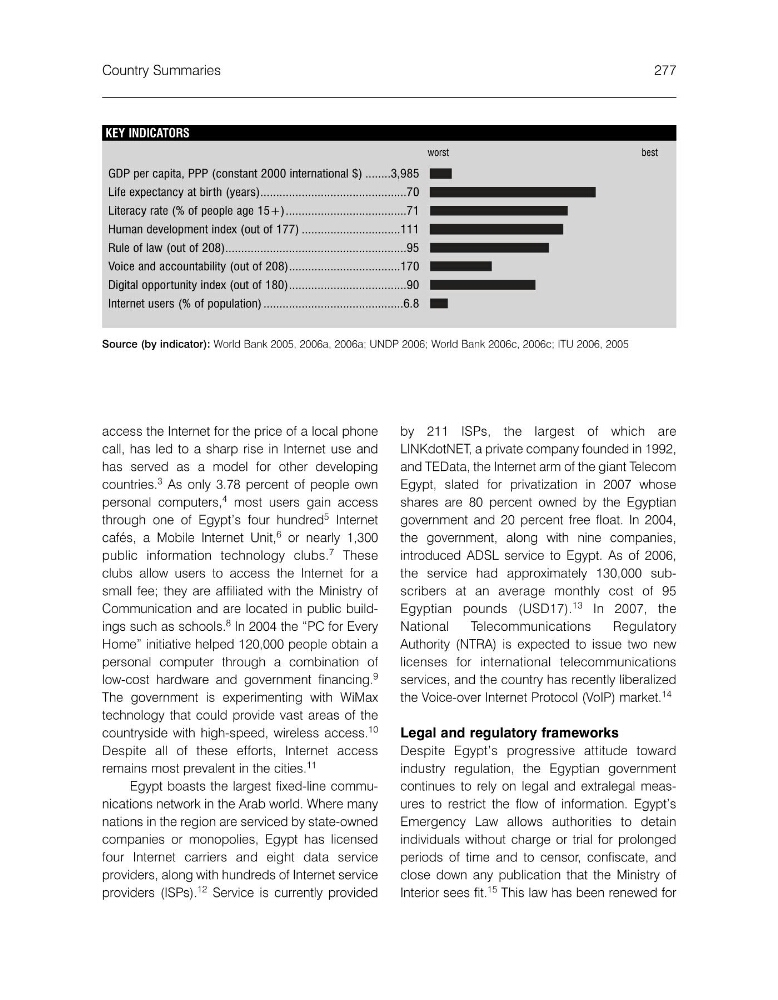
KEY INDICATORS
worst
best
GDP per capita, PPP (constant 2000 international $) ........3,985 3.99
Life expectancy at birth (years)..............................................70 5.64
Literacy rate (% of people age 15+)......................................71 4.14
Human development index (out of 177) ...............................111 4.89
Rule of law (out of 208).........................................................95 5.05
Voice and accountability (out of 208)...................................170 2.71
Digital opportunity index (out of 180).....................................90 5.11
Internet users (% of population) ............................................6.8 3.69
Source (by indicator): World Bank 2005, 2006a, 2006a; UNDP 2006; World Bank 2006c, 2006c; ITU 2006, 2005
call, has led to a sharp rise in Internet use and
has served as a model for other developing
countries. 3 As only 3.78 percent of people own
personal computers,
4
most users gain access
through one of Egypt’s four hundred
5
Internet
cafés, a Mobile Internet Unit,
6
or nearly 1,300
public information technology clubs.
7
These
clubs allow users to access the Internet for a
small fee; they are affiliated with the Ministry of
Communication and are located in public buildings such as schools. 8 In 2004 the “PC for Every
Home” initiative helped 120,000 people obtain a
personal computer through a combination of
low-cost hardware and government financing. 9
The government is experimenting with WiMax
technology that could provide vast areas of the
countryside with high-speed, wireless access.
10
Despite all of these efforts, Internet access
remains most prevalent in the cities.
11
Egypt boasts the largest fixed-line communications network in the Arab world. Where many
nations in the region are serviced by state-owned
companies or monopolies, Egypt has licensed
four Internet carriers and eight data service
providers, along with hundreds of Internet service
providers (ISPs). 12 Service is currently provided
by 211 ISPs, the largest of which are
LINKdotNET, a private company founded in 1992,
and TEData, the Internet arm of the giant Telecom
Egypt, slated for privatization in 2007 whose
shares are 80 percent owned by the Egyptian
government and 20 percent free float. In 2004,
the government, along with nine companies,
introduced ADSL service to Egypt. As of 2006,
the service had approximately 130,000 subscribers at an average monthly cost of 95
Egyptian pounds (USD17). 13 In 2007, the
National
Telecommunications
Regulatory
Authority (NTRA) is expected to issue two new
licenses for international telecommunications
services, and the country has recently liberalized
the Voice-over Internet Protocol (VoIP) market. 14
Legal and regulatory frameworks
Despite Egypt’s progressive attitude toward
industry regulation, the Egyptian government
continues to rely on legal and extralegal measures to restrict the flow of information. Egypt’s
Emergency Law allows authorities to detain
individuals without charge or trial for prolonged
periods of time and to censor, confiscate, and
close down any publication that the Ministry of
Interior sees fit. 15 This law has been renewed for
Country Summaries
277
KEY INDICATORS
worst
best
GDP per capita, PPP (constant 2000 international $) ........3,985 3.99
Life expectancy at birth (years)..............................................70 5.64
Literacy rate (% of people age 15+)......................................71 4.14
Human development index (out of 177) ...............................111 4.89
Rule of law (out of 208).........................................................95 5.05
Voice and accountability (out of 208)...................................170 2.71
Digital opportunity index (out of 180).....................................90 5.11
Internet users (% of population) ............................................6.8 3.69
Source (by indicator): World Bank 2005, 2006a, 2006a; UNDP 2006; World Bank 2006c, 2006c; ITU 2006, 2005