

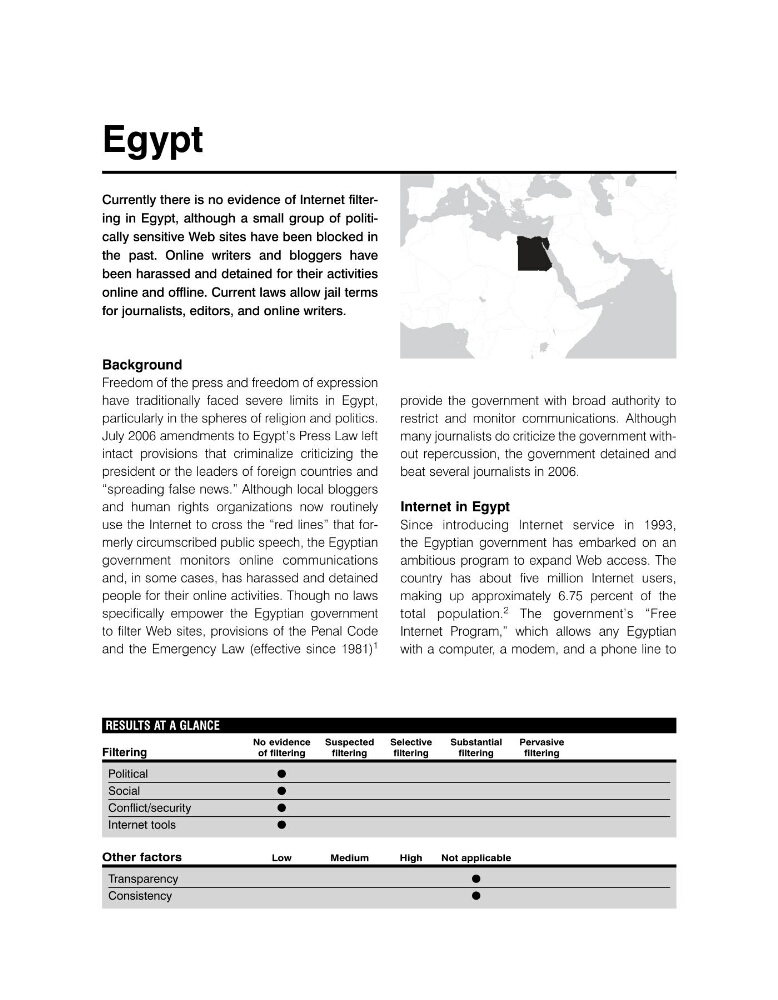
Currently there is no evidence of Internet filtering in Egypt, although a small group of politically sensitive Web sites have been blocked in
the past. Online writers and bloggers have
been harassed and detained for their activities
online and offline. Current laws allow jail terms
for journalists, editors, and online writers.
Background
Freedom of the press and freedom of expression
have traditionally faced severe limits in Egypt,
particularly in the spheres of religion and politics.
July 2006 amendments to Egypt’s Press Law left
intact provisions that criminalize criticizing the
president or the leaders of foreign countries and
“spreading false news.” Although local bloggers
and human rights organizations now routinely
use the Internet to cross the “red lines” that formerly circumscribed public speech, the Egyptian
government monitors online communications
and, in some cases, has harassed and detained
people for their online activities. Though no laws
specifically empower the Egyptian government
to filter Web sites, provisions of the Penal Code
and the Emergency Law (effective since 1981) 1
provide the government with broad authority to
restrict and monitor communications. Although
many journalists do criticize the government without repercussion, the government detained and
beat several journalists in 2006.
Internet in Egypt
Since introducing Internet service in 1993,
the Egyptian government has embarked on an
ambitious program to expand Web access. The
country has about five million Internet users,
making up approximately 6.75 percent of the
total population. 2 The government’s “Free
Internet Program,” which allows any Egyptian
with a computer, a modem, and a phone line to
RESULTS AT A GLANCE
No evidence
Suspected
Selective
Substantial
Pervasive
Filtering
of filtering
filtering
filtering
filtering
filtering
Political
●
Social
●
Conflict/security
●
Internet tools
●
Other factors
Low
Medium
High
Not applicable
Transparency
●
Consistency
●
Egypt
the past. Online writers and bloggers have
been harassed and detained for their activities
online and offline. Current laws allow jail terms
for journalists, editors, and online writers.
Background
Freedom of the press and freedom of expression
have traditionally faced severe limits in Egypt,
particularly in the spheres of religion and politics.
July 2006 amendments to Egypt’s Press Law left
intact provisions that criminalize criticizing the
president or the leaders of foreign countries and
“spreading false news.” Although local bloggers
and human rights organizations now routinely
use the Internet to cross the “red lines” that formerly circumscribed public speech, the Egyptian
government monitors online communications
and, in some cases, has harassed and detained
people for their online activities. Though no laws
specifically empower the Egyptian government
to filter Web sites, provisions of the Penal Code
and the Emergency Law (effective since 1981) 1
provide the government with broad authority to
restrict and monitor communications. Although
many journalists do criticize the government without repercussion, the government detained and
beat several journalists in 2006.
Internet in Egypt
Since introducing Internet service in 1993,
the Egyptian government has embarked on an
ambitious program to expand Web access. The
country has about five million Internet users,
making up approximately 6.75 percent of the
total population. 2 The government’s “Free
Internet Program,” which allows any Egyptian
with a computer, a modem, and a phone line to
RESULTS AT A GLANCE
No evidence
Suspected
Selective
Substantial
Pervasive
Filtering
of filtering
filtering
filtering
filtering
filtering
Political
●
Social
●
Conflict/security
●
Internet tools
●
Other factors
Low
Medium
High
Not applicable
Transparency
●
Consistency
●
Egypt