

Legal and regulatory frameworks
The Cuban executive branch controls governmental power, the law criminalizes dissent and
permits imprisonment and surveillance without
cause, and the court system lacks independence, preventing fair trials with adequate
defense. 12
Upon the arrival of a Cuban Internet connection, the government declared Internet
access a “fundamental right” of the Cuban people. 13 However, Cuban Internet use also has
been restricted since its beginning, with the 1996
Decree-Law 209 requiring accreditation for
Internet use and outlawing Internet use “in violation of Cuban society’s moral principles or the
country’s laws” as well as e-mail messages that
“jeopardize national security.” 14 All Internet
access requires government authorization, and
the Cuban Ministry of Computer Technology and
Communications has overseen Internet and
computer use since January 2000. 15
In 1998 the Centro Nacional de Intercambio
Automatizado de Información (CENIAI) was the
only Cuban Internet service provider (ISP). 16 By
2000 the International Telecommunication Union
reported full competition in the Cuban ISP market. 17 This level of competition is a contrast to the
monopolies in the various telephone, data, and
television markets;
18
however, all ISPs were
under government control and oversight, and of
the ISPs, only CENIAI provided personal Internet
access to Cuban citizens. 19 All services, including ISPs, are subject to licensing.
20
In terms of hardware restrictions, purchases
of computers were limited to foreign nationals
and government officials in 1998.
21
Since 2002,
purchases by private individuals of computers,
printers, and other hardware have been banned
by a ministry of domestic commerce decree, and
modem sales were banned earlier. 22
Reporters Without Borders considers Cuba
“one of the world’s 10 most repressive countries
[in regard to] online free expression” because of
the highly limited access and the severe punishment of illegal Internet use, including “counterrevolutionary” usage. 23 The restrictions stem
from the strong desire of the Cuban government
to prevent attacks upon its political ideology from
broad access to contrary views. 24
The restriction of access to the Internet as a
whole is the most significant governmental control. In addition to government prohibition of private computer sales, the Cuban police have
seized numerous already-owned private computCountry Summaries
273
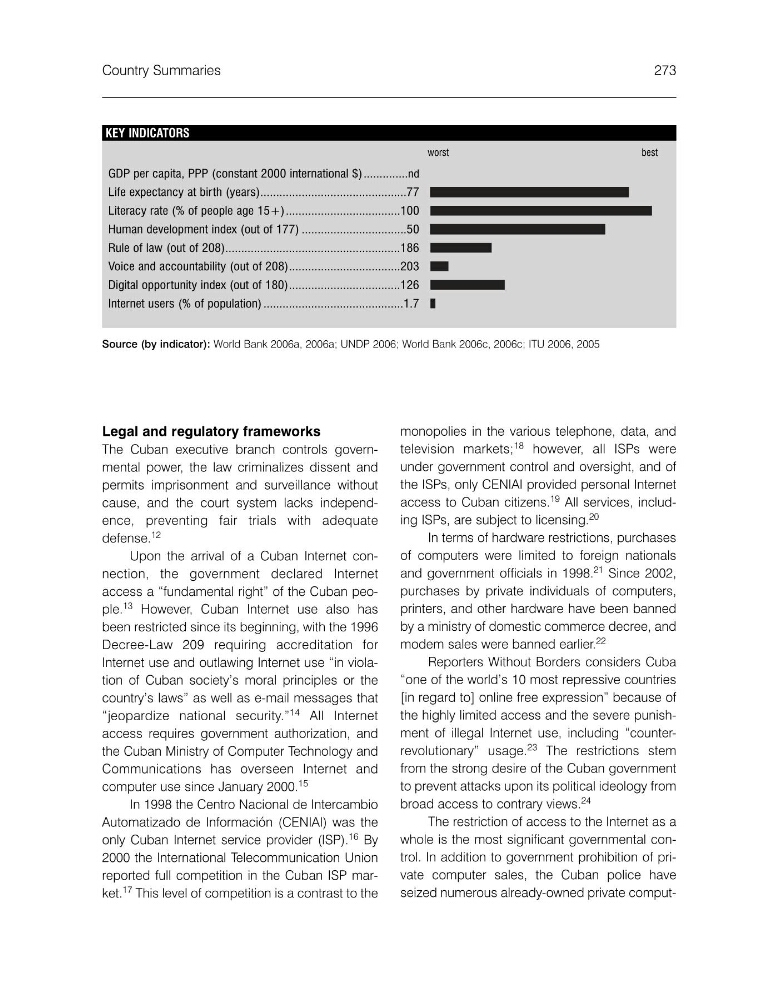
KEY INDICATORS
worst
best
GDP per capita, PPP (constant 2000 international $)..............nd
Life expectancy at birth (years)..............................................77 6.76
Literacy rate (% of people age 15+)....................................100 6.97
Human development index (out of 177) .................................50 6.29
Rule of law (out of 208).......................................................186 2.72
Voice and accountability (out of 208)...................................203 1.26
Digital opportunity index (out of 180)...................................126 3.90
Internet users (% of population) ............................................1.7 3.22
Source (by indicator): World Bank 2006a, 2006a; UNDP 2006; World Bank 2006c, 2006c; ITU 2006, 2005
The Cuban executive branch controls governmental power, the law criminalizes dissent and
permits imprisonment and surveillance without
cause, and the court system lacks independence, preventing fair trials with adequate
defense. 12
Upon the arrival of a Cuban Internet connection, the government declared Internet
access a “fundamental right” of the Cuban people. 13 However, Cuban Internet use also has
been restricted since its beginning, with the 1996
Decree-Law 209 requiring accreditation for
Internet use and outlawing Internet use “in violation of Cuban society’s moral principles or the
country’s laws” as well as e-mail messages that
“jeopardize national security.” 14 All Internet
access requires government authorization, and
the Cuban Ministry of Computer Technology and
Communications has overseen Internet and
computer use since January 2000. 15
In 1998 the Centro Nacional de Intercambio
Automatizado de Información (CENIAI) was the
only Cuban Internet service provider (ISP). 16 By
2000 the International Telecommunication Union
reported full competition in the Cuban ISP market. 17 This level of competition is a contrast to the
monopolies in the various telephone, data, and
television markets;
18
however, all ISPs were
under government control and oversight, and of
the ISPs, only CENIAI provided personal Internet
access to Cuban citizens. 19 All services, including ISPs, are subject to licensing.
20
In terms of hardware restrictions, purchases
of computers were limited to foreign nationals
and government officials in 1998.
21
Since 2002,
purchases by private individuals of computers,
printers, and other hardware have been banned
by a ministry of domestic commerce decree, and
modem sales were banned earlier. 22
Reporters Without Borders considers Cuba
“one of the world’s 10 most repressive countries
[in regard to] online free expression” because of
the highly limited access and the severe punishment of illegal Internet use, including “counterrevolutionary” usage. 23 The restrictions stem
from the strong desire of the Cuban government
to prevent attacks upon its political ideology from
broad access to contrary views. 24
The restriction of access to the Internet as a
whole is the most significant governmental control. In addition to government prohibition of private computer sales, the Cuban police have
seized numerous already-owned private computCountry Summaries
273
KEY INDICATORS
worst
best
GDP per capita, PPP (constant 2000 international $)..............nd
Life expectancy at birth (years)..............................................77 6.76
Literacy rate (% of people age 15+)....................................100 6.97
Human development index (out of 177) .................................50 6.29
Rule of law (out of 208).......................................................186 2.72
Voice and accountability (out of 208)...................................203 1.26
Digital opportunity index (out of 180)...................................126 3.90
Internet users (% of population) ............................................1.7 3.22
Source (by indicator): World Bank 2006a, 2006a; UNDP 2006; World Bank 2006c, 2006c; ITU 2006, 2005