

achieving greater success and efficacy, largely
as a result of self-censorship and monitoring
controls placed at every point of access. As one
commentator noted, “while China is the world’s
biggest jailer of journalists, China is also writing
the manual on how to control your press and
citizen media—and hence your national
discourse—while jailing a minimum number of
people.” 4
Internet in China
From 2005 to the end of 2006, the number of
Internet users grew from 94 million to 137 million. 5 The countrywide Internet penetration rate is
now 10.5 percent, but this rate varies regionally—
while a quarter or more of residents in major
cities such as Tianjin are online, in poorer and
western provinces the rate is usually less than 10
percent. 6 Gender and age are also important
demographic factors, with male users significantly outnumbering women (58.3 percent to 41.7
percent) and eighteen- to twenty-four-year-olds
comprising over 35 percent of all Internet users. 7
While 76 percent of users in China connect from
home, 30 percent of users also use Internet cafés
as a main access location. 8 Not only do Chinese
users cite the Internet as the most important
source for information, more important than television and newspapers, but they also have
access to a wide variety of well-developed
Internet services such as search engines, Bulletin
Board Services (BBS), online video, blogging,
and booming business-to-customer e-commerce. 9 China has the largest number of Voiceover Internet Protocol (VoIP) users in the world.
10
In March 2006, Tom Online (which formed a joint
venture with Skype), announced that the government would issue no licenses for paid computerto-telephone service (known as SkypeOut) for
two years, 11 reportedly because of concerns
about the financial losses to the core businesses
of the major telecom carriers.
12
Only China
Netcom and China Telecom were permitted to
offer pilot commercial VoIP services in selected
cities. 13
Physical access to the Internet is controlled
by the Ministry of Information Industry (MII), the
main regulatory organ of the telecommunications
sector, and is provided by seven state-licensed
Internet access providers (IAPs) (with three IAPs
under construction), each of which has at least
one connection to a foreign Internet backbone. 14
IAPs peer at three Internet exchange points
(IXPs) run by the state. IAPs grant regional
264
Country Summaries
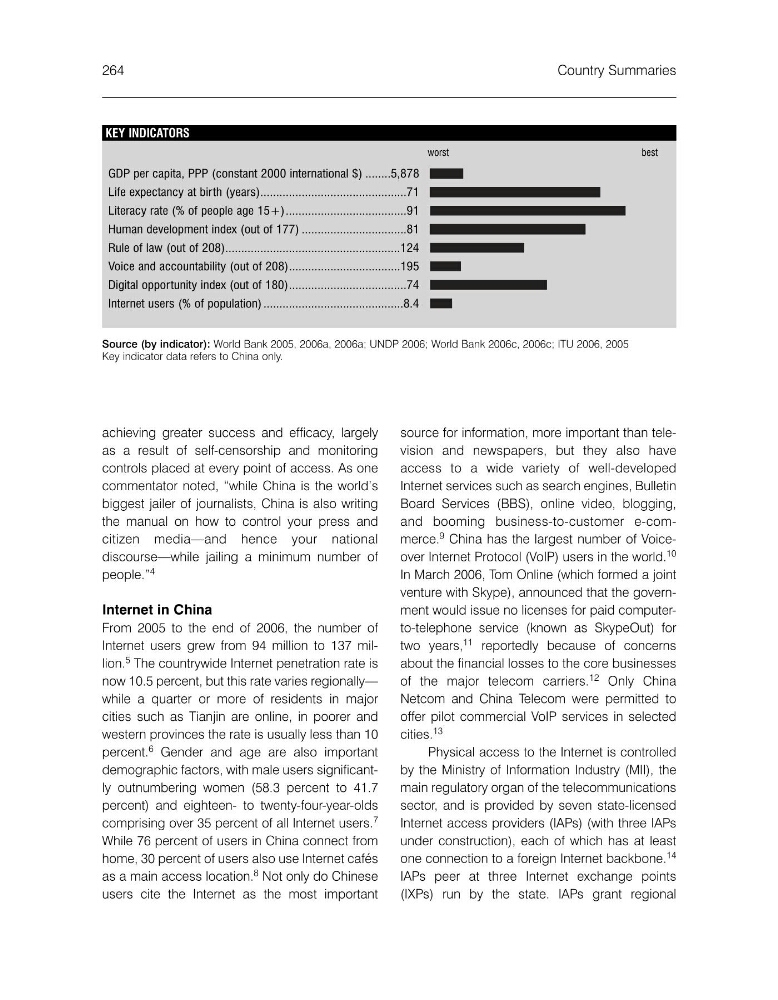
KEY INDICATORS
worst
best
GDP per capita, PPP (constant 2000 international $) ........5,878 4.35
Life expectancy at birth (years)..............................................71 5.80
Literacy rate (% of people age 15+)......................................91 6.09
Human development index (out of 177) .................................81 5.64
Rule of law (out of 208).......................................................124 4.05
Voice and accountability (out of 208)...................................195 1.68
Digital opportunity index (out of 180).....................................74 5.56
Internet users (% of population) ............................................8.4 3.85
Source (by indicator): World Bank 2005, 2006a, 2006a; UNDP 2006; World Bank 2006c, 2006c; ITU 2006, 2005
Key indicator data refers to China only.
as a result of self-censorship and monitoring
controls placed at every point of access. As one
commentator noted, “while China is the world’s
biggest jailer of journalists, China is also writing
the manual on how to control your press and
citizen media—and hence your national
discourse—while jailing a minimum number of
people.” 4
Internet in China
From 2005 to the end of 2006, the number of
Internet users grew from 94 million to 137 million. 5 The countrywide Internet penetration rate is
now 10.5 percent, but this rate varies regionally—
while a quarter or more of residents in major
cities such as Tianjin are online, in poorer and
western provinces the rate is usually less than 10
percent. 6 Gender and age are also important
demographic factors, with male users significantly outnumbering women (58.3 percent to 41.7
percent) and eighteen- to twenty-four-year-olds
comprising over 35 percent of all Internet users. 7
While 76 percent of users in China connect from
home, 30 percent of users also use Internet cafés
as a main access location. 8 Not only do Chinese
users cite the Internet as the most important
source for information, more important than television and newspapers, but they also have
access to a wide variety of well-developed
Internet services such as search engines, Bulletin
Board Services (BBS), online video, blogging,
and booming business-to-customer e-commerce. 9 China has the largest number of Voiceover Internet Protocol (VoIP) users in the world.
10
In March 2006, Tom Online (which formed a joint
venture with Skype), announced that the government would issue no licenses for paid computerto-telephone service (known as SkypeOut) for
two years, 11 reportedly because of concerns
about the financial losses to the core businesses
of the major telecom carriers.
12
Only China
Netcom and China Telecom were permitted to
offer pilot commercial VoIP services in selected
cities. 13
Physical access to the Internet is controlled
by the Ministry of Information Industry (MII), the
main regulatory organ of the telecommunications
sector, and is provided by seven state-licensed
Internet access providers (IAPs) (with three IAPs
under construction), each of which has at least
one connection to a foreign Internet backbone. 14
IAPs peer at three Internet exchange points
(IXPs) run by the state. IAPs grant regional
264
Country Summaries
KEY INDICATORS
worst
best
GDP per capita, PPP (constant 2000 international $) ........5,878 4.35
Life expectancy at birth (years)..............................................71 5.80
Literacy rate (% of people age 15+)......................................91 6.09
Human development index (out of 177) .................................81 5.64
Rule of law (out of 208).......................................................124 4.05
Voice and accountability (out of 208)...................................195 1.68
Digital opportunity index (out of 180).....................................74 5.56
Internet users (% of population) ............................................8.4 3.85
Source (by indicator): World Bank 2005, 2006a, 2006a; UNDP 2006; World Bank 2006c, 2006c; ITU 2006, 2005
Key indicator data refers to China only.