

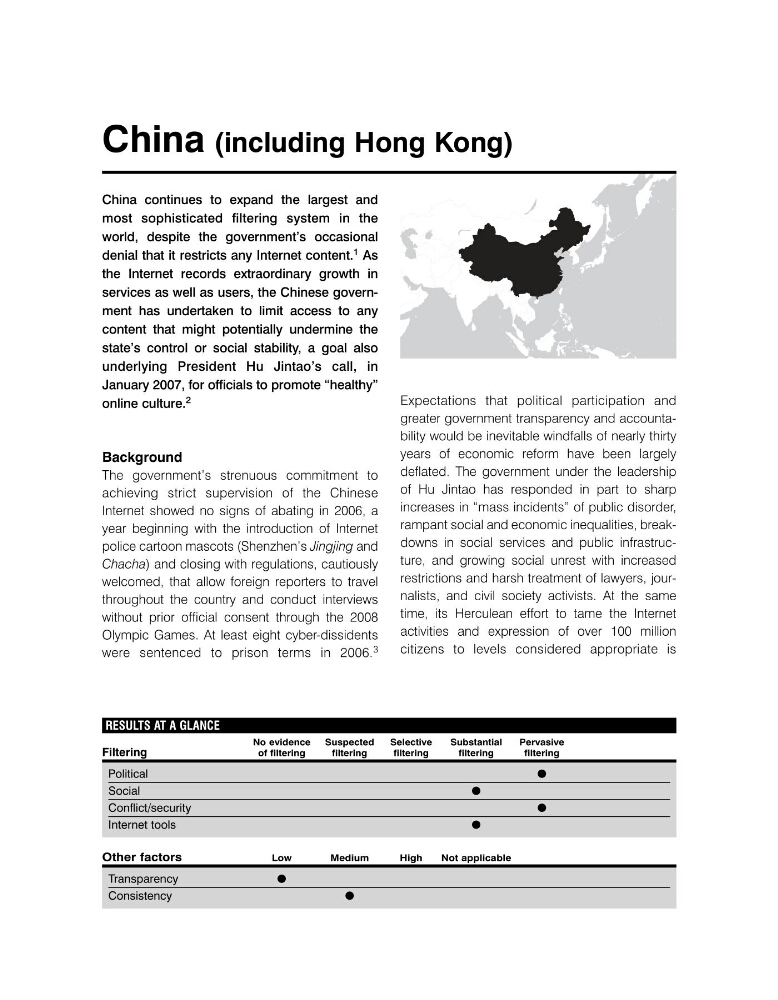
China continues to expand the largest and
most sophisticated filtering system in the
world, despite the government’s occasional
denial that it restricts any Internet content.
1 As
the Internet records extraordinary growth in
services as well as users, the Chinese government has undertaken to limit access to any
content that might potentially undermine the
state’s control or social stability, a goal also
underlying President Hu Jintao’s call, in
January 2007, for officials to promote “healthy”
online culture.
2
Background
The government’s strenuous commitment to
achieving strict supervision of the Chinese
Internet showed no signs of abating in 2006, a
year beginning with the introduction of Internet
police cartoon mascots (Shenzhen’s Jingjing and
Chacha) and closing with regulations, cautiously
welcomed, that allow foreign reporters to travel
throughout the country and conduct interviews
without prior official consent through the 2008
Olympic Games. At least eight cyber-dissidents
were sentenced to prison terms in 2006. 3
Expectations that political participation and
greater government transparency and accountability would be inevitable windfalls of nearly thirty
years of economic reform have been largely
deflated. The government under the leadership
of Hu Jintao has responded in part to sharp
increases in “mass incidents” of public disorder,
rampant social and economic inequalities, breakdowns in social services and public infrastructure, and growing social unrest with increased
restrictions and harsh treatment of lawyers, journalists, and civil society activists. At the same
time, its Herculean effort to tame the Internet
activities and expression of over 100 million
citizens to levels considered appropriate is
RESULTS AT A GLANCE
No evidence
Suspected
Selective
Substantial
Pervasive
Filtering
of filtering
filtering
filtering
filtering
filtering
Political
●
Social
●
Conflict/security
●
Internet tools
●
Other factors
Low
Medium
High
Not applicable
Transparency
●
Consistency
●
China (including Hong Kong)
most sophisticated filtering system in the
world, despite the government’s occasional
denial that it restricts any Internet content.
1 As
the Internet records extraordinary growth in
services as well as users, the Chinese government has undertaken to limit access to any
content that might potentially undermine the
state’s control or social stability, a goal also
underlying President Hu Jintao’s call, in
January 2007, for officials to promote “healthy”
online culture.
2
Background
The government’s strenuous commitment to
achieving strict supervision of the Chinese
Internet showed no signs of abating in 2006, a
year beginning with the introduction of Internet
police cartoon mascots (Shenzhen’s Jingjing and
Chacha) and closing with regulations, cautiously
welcomed, that allow foreign reporters to travel
throughout the country and conduct interviews
without prior official consent through the 2008
Olympic Games. At least eight cyber-dissidents
were sentenced to prison terms in 2006. 3
Expectations that political participation and
greater government transparency and accountability would be inevitable windfalls of nearly thirty
years of economic reform have been largely
deflated. The government under the leadership
of Hu Jintao has responded in part to sharp
increases in “mass incidents” of public disorder,
rampant social and economic inequalities, breakdowns in social services and public infrastructure, and growing social unrest with increased
restrictions and harsh treatment of lawyers, journalists, and civil society activists. At the same
time, its Herculean effort to tame the Internet
activities and expression of over 100 million
citizens to levels considered appropriate is
RESULTS AT A GLANCE
No evidence
Suspected
Selective
Substantial
Pervasive
Filtering
of filtering
filtering
filtering
filtering
filtering
Political
●
Social
●
Conflict/security
●
Internet tools
●
Other factors
Low
Medium
High
Not applicable
Transparency
●
Consistency
●
China (including Hong Kong)