

and administered by the Belarus equivalent of
the U.S. National Security Agency. Taking into
account both the increase in Internet users and
the potential of the Internet to spread political
ideas, the government is adopting restrictive policies, monitoring content, and placing temporary
limitations on access to politically sensitive Web
sites. During the February 2006 presidential elections, ONI documented the use of just-in-time
methods against opposition Web sites, which
included domain name system tampering, network disconnection, and allegations of DoS
attacks. 1
Internet in Belarus
The cost of access in Belarus has recently
decreased dramatically. This has seen a stark
rise in usage and a growing Internet service
provider (ISP) market. As of 2005, Belarus had an
Internet penetration rate of approximately 30 percent. Nevertheless, prices remain higher than
those of neighboring countries, and home
access is not affordable for most of the population. In 2005 the cost of Internet access through
the state-owned provider Beltelecom was
USD0.68 per hour, while an ADSL connection
cost USD340 per month—placing the latter
beyond the reach of most citizens, given that the
average salary was around USD230 in 2005. 2
The most active Internet users in Belarus are
in the twelve- to thirty-four-year-old age range,
although some 30 percent of Belarusians in this
age group have never used the Internet. 3 The
level of computer penetration in the country
remains low. In 2005, 58 percent of schools in
Belarus had computers and only 25 percent of
the schools had Internet access. The popularity
of cybercafés has fallen in recent years, as most
users prefer to access the Internet from home or
work. Russian is the most widely used language
by Belarussians on the Internet, followed by
Belarusian and then English.
As Internet usage has risen, related services
have developed into fast-growing and profitable
businesses in Belarus. In 2005 there were thirtytwo ISPs active in the country. 4 The state-controlled ISP Beltelecom holds the biggest market
share, with 187 public Internet access points in
the country. All ISPs are required to connect
through Belpak, Beltelecom’s Internet subsidiary.
Beltelcom has a legal monopoly on the external
channels of communications. As a consequence, all other ISPs run their traffic through
Country Summaries
259
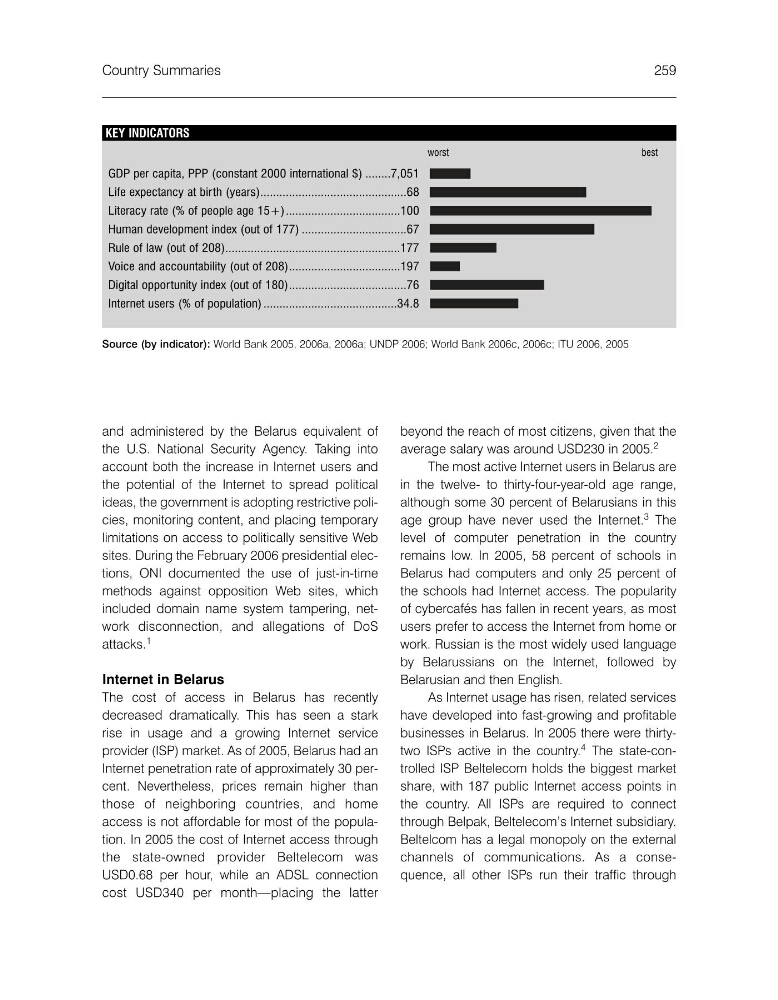
KEY INDICATORS
worst
best
GDP per capita, PPP (constant 2000 international $) ........7,051 4.57
Life expectancy at birth (years)..............................................68 5.32
Literacy rate (% of people age 15+)....................................100 6.97
Human development index (out of 177) .................................67 5.93
Rule of law (out of 208).......................................................177 2.93
Voice and accountability (out of 208)...................................197 1.64
Digital opportunity index (out of 180).....................................76 5.44
Internet users (% of population) ..........................................34.8 6.33
Source (by indicator): World Bank 2005, 2006a, 2006a; UNDP 2006; World Bank 2006c, 2006c; ITU 2006, 2005
the U.S. National Security Agency. Taking into
account both the increase in Internet users and
the potential of the Internet to spread political
ideas, the government is adopting restrictive policies, monitoring content, and placing temporary
limitations on access to politically sensitive Web
sites. During the February 2006 presidential elections, ONI documented the use of just-in-time
methods against opposition Web sites, which
included domain name system tampering, network disconnection, and allegations of DoS
attacks. 1
Internet in Belarus
The cost of access in Belarus has recently
decreased dramatically. This has seen a stark
rise in usage and a growing Internet service
provider (ISP) market. As of 2005, Belarus had an
Internet penetration rate of approximately 30 percent. Nevertheless, prices remain higher than
those of neighboring countries, and home
access is not affordable for most of the population. In 2005 the cost of Internet access through
the state-owned provider Beltelecom was
USD0.68 per hour, while an ADSL connection
cost USD340 per month—placing the latter
beyond the reach of most citizens, given that the
average salary was around USD230 in 2005. 2
The most active Internet users in Belarus are
in the twelve- to thirty-four-year-old age range,
although some 30 percent of Belarusians in this
age group have never used the Internet. 3 The
level of computer penetration in the country
remains low. In 2005, 58 percent of schools in
Belarus had computers and only 25 percent of
the schools had Internet access. The popularity
of cybercafés has fallen in recent years, as most
users prefer to access the Internet from home or
work. Russian is the most widely used language
by Belarussians on the Internet, followed by
Belarusian and then English.
As Internet usage has risen, related services
have developed into fast-growing and profitable
businesses in Belarus. In 2005 there were thirtytwo ISPs active in the country. 4 The state-controlled ISP Beltelecom holds the biggest market
share, with 187 public Internet access points in
the country. All ISPs are required to connect
through Belpak, Beltelecom’s Internet subsidiary.
Beltelcom has a legal monopoly on the external
channels of communications. As a consequence, all other ISPs run their traffic through
Country Summaries
259
KEY INDICATORS
worst
best
GDP per capita, PPP (constant 2000 international $) ........7,051 4.57
Life expectancy at birth (years)..............................................68 5.32
Literacy rate (% of people age 15+)....................................100 6.97
Human development index (out of 177) .................................67 5.93
Rule of law (out of 208).......................................................177 2.93
Voice and accountability (out of 208)...................................197 1.64
Digital opportunity index (out of 180).....................................76 5.44
Internet users (% of population) ..........................................34.8 6.33
Source (by indicator): World Bank 2005, 2006a, 2006a; UNDP 2006; World Bank 2006c, 2006c; ITU 2006, 2005