

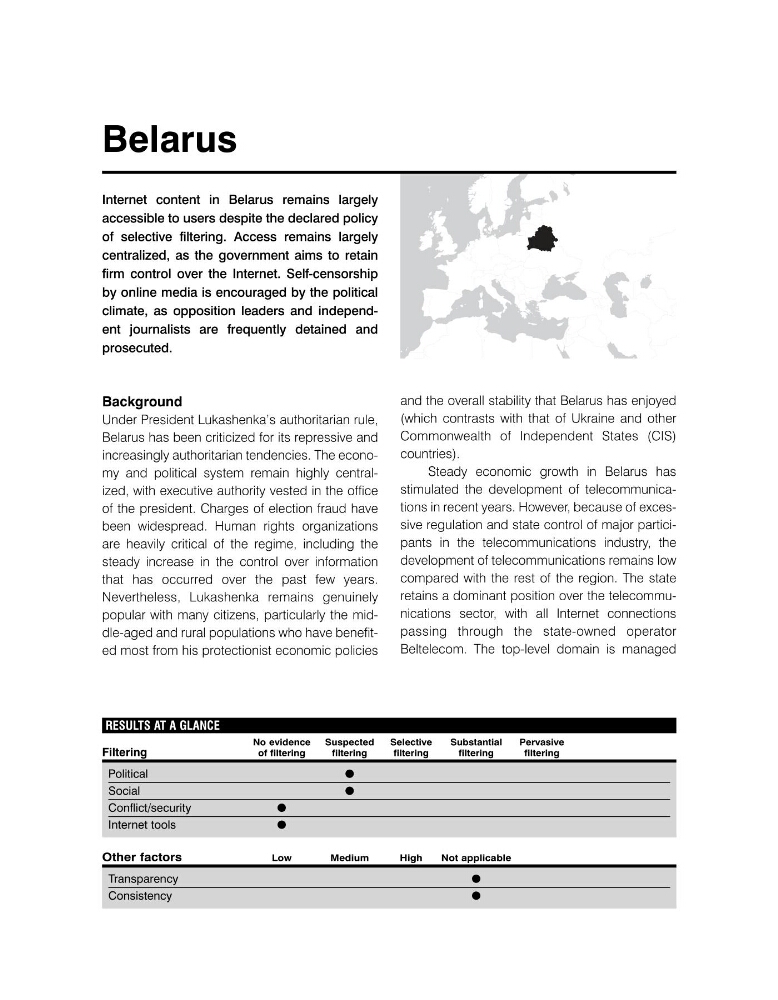
Internet content in Belarus remains largely
accessible to users despite the declared policy
of selective filtering. Access remains largely
centralized, as the government aims to retain
firm control over the Internet. Self-censorship
by online media is encouraged by the political
climate, as opposition leaders and independent journalists are frequently detained and
prosecuted.
Background
Under President Lukashenka’s authoritarian rule,
Belarus has been criticized for its repressive and
increasingly authoritarian tendencies. The economy and political system remain highly centralized, with executive authority vested in the office
of the president. Charges of election fraud have
been widespread. Human rights organizations
are heavily critical of the regime, including the
steady increase in the control over information
that has occurred over the past few years.
Nevertheless, Lukashenka remains genuinely
popular with many citizens, particularly the middle-aged and rural populations who have benefited most from his protectionist economic policies
and the overall stability that Belarus has enjoyed
(which contrasts with that of Ukraine and other
Commonwealth of Independent States (CIS)
countries).
Steady economic growth in Belarus has
stimulated the development of telecommunications in recent years. However, because of excessive regulation and state control of major participants in the telecommunications industry, the
development of telecommunications remains low
compared with the rest of the region. The state
retains a dominant position over the telecommunications sector, with all Internet connections
passing through the state-owned operator
Beltelecom. The top-level domain is managed
RESULTS AT A GLANCE
No evidence
Suspected
Selective
Substantial
Pervasive
Filtering
of filtering
filtering
filtering
filtering
filtering
Political
●
Social
●
Conflict/security
●
Internet tools
●
Other factors
Low
Medium
High
Not applicable
Transparency
●
Consistency
●
Belarus
accessible to users despite the declared policy
of selective filtering. Access remains largely
centralized, as the government aims to retain
firm control over the Internet. Self-censorship
by online media is encouraged by the political
climate, as opposition leaders and independent journalists are frequently detained and
prosecuted.
Background
Under President Lukashenka’s authoritarian rule,
Belarus has been criticized for its repressive and
increasingly authoritarian tendencies. The economy and political system remain highly centralized, with executive authority vested in the office
of the president. Charges of election fraud have
been widespread. Human rights organizations
are heavily critical of the regime, including the
steady increase in the control over information
that has occurred over the past few years.
Nevertheless, Lukashenka remains genuinely
popular with many citizens, particularly the middle-aged and rural populations who have benefited most from his protectionist economic policies
and the overall stability that Belarus has enjoyed
(which contrasts with that of Ukraine and other
Commonwealth of Independent States (CIS)
countries).
Steady economic growth in Belarus has
stimulated the development of telecommunications in recent years. However, because of excessive regulation and state control of major participants in the telecommunications industry, the
development of telecommunications remains low
compared with the rest of the region. The state
retains a dominant position over the telecommunications sector, with all Internet connections
passing through the state-owned operator
Beltelecom. The top-level domain is managed
RESULTS AT A GLANCE
No evidence
Suspected
Selective
Substantial
Pervasive
Filtering
of filtering
filtering
filtering
filtering
filtering
Political
●
Social
●
Conflict/security
●
Internet tools
●
Other factors
Low
Medium
High
Not applicable
Transparency
●
Consistency
●
Belarus