

September 22, 2006.
5
Press law no. 47 of 2002
allows for prosecution of journalists who are
found to report against the king or Islam, advocate change in the government, or generally
threaten national security. 6 Not surprisingly, this
law has created a culture of self-censorship in the
media.
7
And finally, the Supreme Court in
October 2006 banned any mention in the media
of a scandal known as “Bandargate,” which
involved the royal family and other politicians.
Two journalists were threatened anonymously
over the phone for writing on the subject. 8 It
appears, as Reporters Without Borders argues,
that the democratization trend has “quickly faded
before the demands of the country’s Shiite majority for a voice.” 9
Internet in Bahrain
Bahrain has one of the highest Internet penetration rates in the region. As of 2005, the United
Arab Emirates led the Arab world in Internet penetration, followed by Bahrain and Qatar. 10
According to the ITU, there are an estimated
152,700 Internet users out of a population of
738,874, 11 and approximately 121,000 Bahrainis
own computers.
12
Bahrain is also unique in that
Internet telephony is legal, unlike in some other
Gulf Arab states.
13
Batelco, a state-owned company, functioned as a monopoly (and in practical
terms it still does) over Internet access in Bahrain
until the Telecommunications Law of 2002, which
attempted to inject competition in the Internet
service provider (ISP) market. 14 As a result, a
number of additional ISPs have sprung up in
Bahrain,
15
though none has yet seriously challenged Batelco.
16
Resistance to Batelco’s continued dominance has been increasing, however,
as a number of disgruntled consumers have
begun to voice their displeasure on the site
www.boycottbatelco.com in response to the
company’s recent decision to place a monthly
usage limit on their ADSL packages and charge
more for higher limits. 17
Legal and regulatory frameworks
Bahrain started democratization efforts in 2002
by adopting a new constitution, which reinstated
a legislative body with one elected chamber. The
constitution mentions the right to free speech
and free press, 18 but press law no. 47 of 2002
superseded these protections and was used to
prosecute, detain, and expel journalists. Three
www.bahrainonline.org moderators were detained
Country Summaries
255
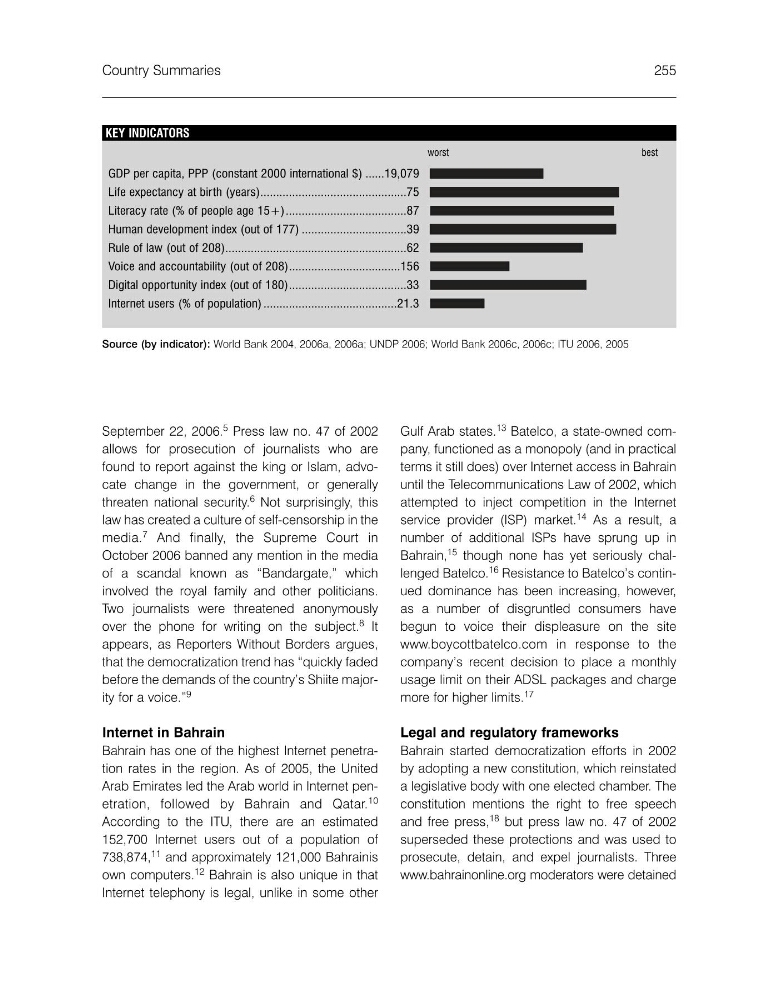
KEY INDICATORS
worst
best
GDP per capita, PPP (constant 2000 international $) ......19,079 6.88
Life expectancy at birth (years)..............................................75 6.44
Literacy rate (% of people age 15+)......................................87 5.70
Human development index (out of 177) .................................39 6.67
Rule of law (out of 208).........................................................62 6.43
Voice and accountability (out of 208)...................................156 3.30
Digital opportunity index (out of 180).....................................33 7.10
Internet users (% of population) ..........................................21.3 5.06
Source (by indicator): World Bank 2004, 2006a, 2006a; UNDP 2006; World Bank 2006c, 2006c; ITU 2006, 2005
5
Press law no. 47 of 2002
allows for prosecution of journalists who are
found to report against the king or Islam, advocate change in the government, or generally
threaten national security. 6 Not surprisingly, this
law has created a culture of self-censorship in the
media.
7
And finally, the Supreme Court in
October 2006 banned any mention in the media
of a scandal known as “Bandargate,” which
involved the royal family and other politicians.
Two journalists were threatened anonymously
over the phone for writing on the subject. 8 It
appears, as Reporters Without Borders argues,
that the democratization trend has “quickly faded
before the demands of the country’s Shiite majority for a voice.” 9
Internet in Bahrain
Bahrain has one of the highest Internet penetration rates in the region. As of 2005, the United
Arab Emirates led the Arab world in Internet penetration, followed by Bahrain and Qatar. 10
According to the ITU, there are an estimated
152,700 Internet users out of a population of
738,874, 11 and approximately 121,000 Bahrainis
own computers.
12
Bahrain is also unique in that
Internet telephony is legal, unlike in some other
Gulf Arab states.
13
Batelco, a state-owned company, functioned as a monopoly (and in practical
terms it still does) over Internet access in Bahrain
until the Telecommunications Law of 2002, which
attempted to inject competition in the Internet
service provider (ISP) market. 14 As a result, a
number of additional ISPs have sprung up in
Bahrain,
15
though none has yet seriously challenged Batelco.
16
Resistance to Batelco’s continued dominance has been increasing, however,
as a number of disgruntled consumers have
begun to voice their displeasure on the site
www.boycottbatelco.com in response to the
company’s recent decision to place a monthly
usage limit on their ADSL packages and charge
more for higher limits. 17
Legal and regulatory frameworks
Bahrain started democratization efforts in 2002
by adopting a new constitution, which reinstated
a legislative body with one elected chamber. The
constitution mentions the right to free speech
and free press, 18 but press law no. 47 of 2002
superseded these protections and was used to
prosecute, detain, and expel journalists. Three
www.bahrainonline.org moderators were detained
Country Summaries
255
KEY INDICATORS
worst
best
GDP per capita, PPP (constant 2000 international $) ......19,079 6.88
Life expectancy at birth (years)..............................................75 6.44
Literacy rate (% of people age 15+)......................................87 5.70
Human development index (out of 177) .................................39 6.67
Rule of law (out of 208).........................................................62 6.43
Voice and accountability (out of 208)...................................156 3.30
Digital opportunity index (out of 180).....................................33 7.10
Internet users (% of population) ..........................................21.3 5.06
Source (by indicator): World Bank 2004, 2006a, 2006a; UNDP 2006; World Bank 2006c, 2006c; ITU 2006, 2005