

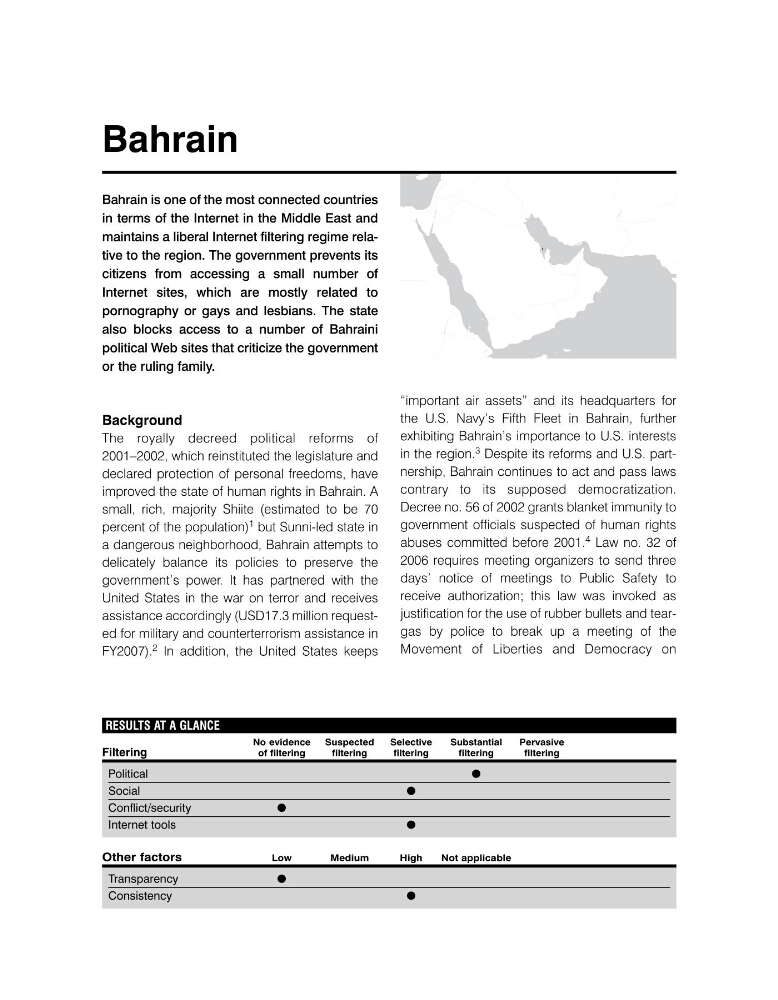
Bahrain is one of the most connected countries
in terms of the Internet in the Middle East and
maintains a liberal Internet filtering regime relative to the region. The government prevents its
citizens from accessing a small number of
Internet sites, which are mostly related to
pornography or gays and lesbians. The state
also blocks access to a number of Bahraini
political Web sites that criticize the government
or the ruling family.
Background
The royally decreed political reforms of
2001–2002, which reinstituted the legislature and
declared protection of personal freedoms, have
improved the state of human rights in Bahrain. A
small, rich, majority Shiite (estimated to be 70
percent of the population) 1 but Sunni-led state in
a dangerous neighborhood, Bahrain attempts to
delicately balance its policies to preserve the
government’s power. It has partnered with the
United States in the war on terror and receives
assistance accordingly (USD17.3 million requested for military and counterterrorism assistance in
FY2007). 2 In addition, the United States keeps
“important air assets” and its headquarters for
the U.S. Navy’s Fifth Fleet in Bahrain, further
exhibiting Bahrain’s importance to U.S. interests
in the region. 3 Despite its reforms and U.S. partnership, Bahrain continues to act and pass laws
contrary to its supposed democratization.
Decree no. 56 of 2002 grants blanket immunity to
government officials suspected of human rights
abuses committed before 2001. 4 Law no. 32 of
2006 requires meeting organizers to send three
days’ notice of meetings to Public Safety to
receive authorization; this law was invoked as
justification for the use of rubber bullets and teargas by police to break up a meeting of the
Movement of Liberties and Democracy on
RESULTS AT A GLANCE
No evidence
Suspected
Selective
Substantial
Pervasive
Filtering
of filtering
filtering
filtering
filtering
filtering
Political
●
Social
●
Conflict/security
●
Internet tools
●
Other factors
Low
Medium
High
Not applicable
Transparency
●
Consistency
●
Bahrain
in terms of the Internet in the Middle East and
maintains a liberal Internet filtering regime relative to the region. The government prevents its
citizens from accessing a small number of
Internet sites, which are mostly related to
pornography or gays and lesbians. The state
also blocks access to a number of Bahraini
political Web sites that criticize the government
or the ruling family.
Background
The royally decreed political reforms of
2001–2002, which reinstituted the legislature and
declared protection of personal freedoms, have
improved the state of human rights in Bahrain. A
small, rich, majority Shiite (estimated to be 70
percent of the population) 1 but Sunni-led state in
a dangerous neighborhood, Bahrain attempts to
delicately balance its policies to preserve the
government’s power. It has partnered with the
United States in the war on terror and receives
assistance accordingly (USD17.3 million requested for military and counterterrorism assistance in
FY2007). 2 In addition, the United States keeps
“important air assets” and its headquarters for
the U.S. Navy’s Fifth Fleet in Bahrain, further
exhibiting Bahrain’s importance to U.S. interests
in the region. 3 Despite its reforms and U.S. partnership, Bahrain continues to act and pass laws
contrary to its supposed democratization.
Decree no. 56 of 2002 grants blanket immunity to
government officials suspected of human rights
abuses committed before 2001. 4 Law no. 32 of
2006 requires meeting organizers to send three
days’ notice of meetings to Public Safety to
receive authorization; this law was invoked as
justification for the use of rubber bullets and teargas by police to break up a meeting of the
Movement of Liberties and Democracy on
RESULTS AT A GLANCE
No evidence
Suspected
Selective
Substantial
Pervasive
Filtering
of filtering
filtering
filtering
filtering
filtering
Political
●
Social
●
Conflict/security
●
Internet tools
●
Other factors
Low
Medium
High
Not applicable
Transparency
●
Consistency
●
Bahrain