

Uzbekistan, and Vietnam.
8 Thailand and Ethiopia are the most recent additions to this group
of countries that filter Web sites associated with political opposition groups. Yet in other countries with an authoritarian bent, such as Russia and Algeria, we have not uncovered filtering of
the Internet.
The perceived threat to national security is a common rationale used for blocking content.
Internet filtering that targets the Web sites of insurgents, extremists, terrorists, and other
threats generally garners wide public support. This is best typified by South Korea where
pro–North Korean sites are blocked, or by India where militant and extremist sites associated
with groups that foment domestic conflict are censored. In Pakistan, Web sites devoted to
the Balochi independence movement are blocked. Similarly, the Web sites of separatist or
radical groups such as the Muslim Brotherhood are blocked in some countries in the Middle
East.
Social filtering is focused on those topics that are held to be antithetical to accepted societal norms. Pornographic, gay and lesbian, and gambling-related content are prime examples
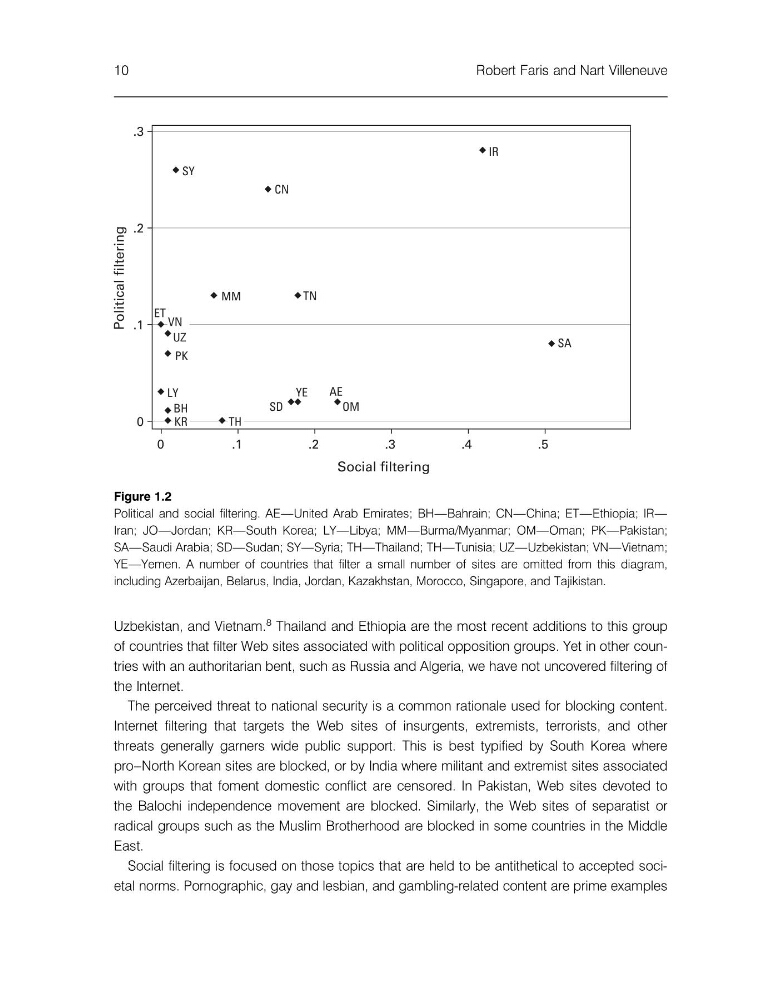
Figure 1.2
Political and social filtering. AE—United Arab Emirates; BH—Bahrain; CN—China; ET—Ethiopia; IR—
Iran; JO—Jordan; KR—South Korea; LY—Libya; MM—Burma/Myanmar; OM—Oman; PK—Pakistan;
SA—Saudi Arabia; SD—Sudan; SY—Syria; TH—Thailand; TH—Tunisia; UZ—Uzbekistan; VN—Vietnam;
YE—Yemen. A number of countries that filter a small number of sites are omitted from this diagram,
including Azerbaijan, Belarus, India, Jordan, Kazakhstan, Morocco, Singapore, and Tajikistan.
10
Robert Faris and Nart Villeneuve
8 Thailand and Ethiopia are the most recent additions to this group
of countries that filter Web sites associated with political opposition groups. Yet in other countries with an authoritarian bent, such as Russia and Algeria, we have not uncovered filtering of
the Internet.
The perceived threat to national security is a common rationale used for blocking content.
Internet filtering that targets the Web sites of insurgents, extremists, terrorists, and other
threats generally garners wide public support. This is best typified by South Korea where
pro–North Korean sites are blocked, or by India where militant and extremist sites associated
with groups that foment domestic conflict are censored. In Pakistan, Web sites devoted to
the Balochi independence movement are blocked. Similarly, the Web sites of separatist or
radical groups such as the Muslim Brotherhood are blocked in some countries in the Middle
East.
Social filtering is focused on those topics that are held to be antithetical to accepted societal norms. Pornographic, gay and lesbian, and gambling-related content are prime examples
Figure 1.2
Political and social filtering. AE—United Arab Emirates; BH—Bahrain; CN—China; ET—Ethiopia; IR—
Iran; JO—Jordan; KR—South Korea; LY—Libya; MM—Burma/Myanmar; OM—Oman; PK—Pakistan;
SA—Saudi Arabia; SD—Sudan; SY—Syria; TH—Thailand; TH—Tunisia; UZ—Uzbekistan; VN—Vietnam;
YE—Yemen. A number of countries that filter a small number of sites are omitted from this diagram,
including Azerbaijan, Belarus, India, Jordan, Kazakhstan, Morocco, Singapore, and Tajikistan.
10
Robert Faris and Nart Villeneuve