

education, and the industrial sector.
2
On a popular level, the Internet plays an increasingly important role in daily life, including politics. Opposition
groups as well as individuals voicing discontent
are now using the Internet as a communication
platform, which has prompted a mild crackdown
by authorities. Thus far these control measures
have been reversed through legal challenges,
although the government’s concern for maintaining social and political stability suggests that
more restrictive measures may be on the way.
Azerbaijani hackers are also involved in a longstanding “cyber war” with Armenian hackers over
the unresolved Nagorno-Karabakh conflict. No
official sanctions have been placed on Azeri
hackers, and the attacks do not appear to be a
government-organized campaign but rather the
work of individuals acting on their own. Web site
defacements and Denial of Service (DoS) attacks
have led to disruptions in the Azeri Internet, which
may prompt the government to act should these
attacks begin to affect critical services.
Internet in Azerbaijan
During the Soviet era, Azerbaijan was a major
center for IT development, particularly in the area
of process control systems. This legacy left the
country with a reasonably large and well-developed technical infrastructure, including several
research institutes and a political leadership that
was savvy about the importance of the ICT sector. Internet development is following the pattern
typical of many developing countries, with
access centered on the major cities, particularly
the capital city Baku. Overall—supported by the
government ICT strategy as well as the large
Azeri diaspora for whom the Internet is increasingly an important channel for maintaining contact with their homeland—Internet penetration is
rising. Between 2004 and 2005 the number of
Internet subscribers doubled; it now encompasses around 700,000 users. Official statistics state
that penetration is 8 percent, but this figure may
be misleading as many Azerbaijanis access the
Internet from shared connections, such as their
place of work or study, or from cybercafés (with
the latter providing access for 21.3 percent of
users). PC ownership is low (1.5 per 100), homes
account for only 27.5 percent of all Internet users,
and broadband penetration stands at 6.5 percent. For connectivity, most individual subscribers rely on mobile telephone (53.7 percent)
and dialup (38.4 percent) as their primary means.
Official survey results indicate that economic and
250
Country Summaries
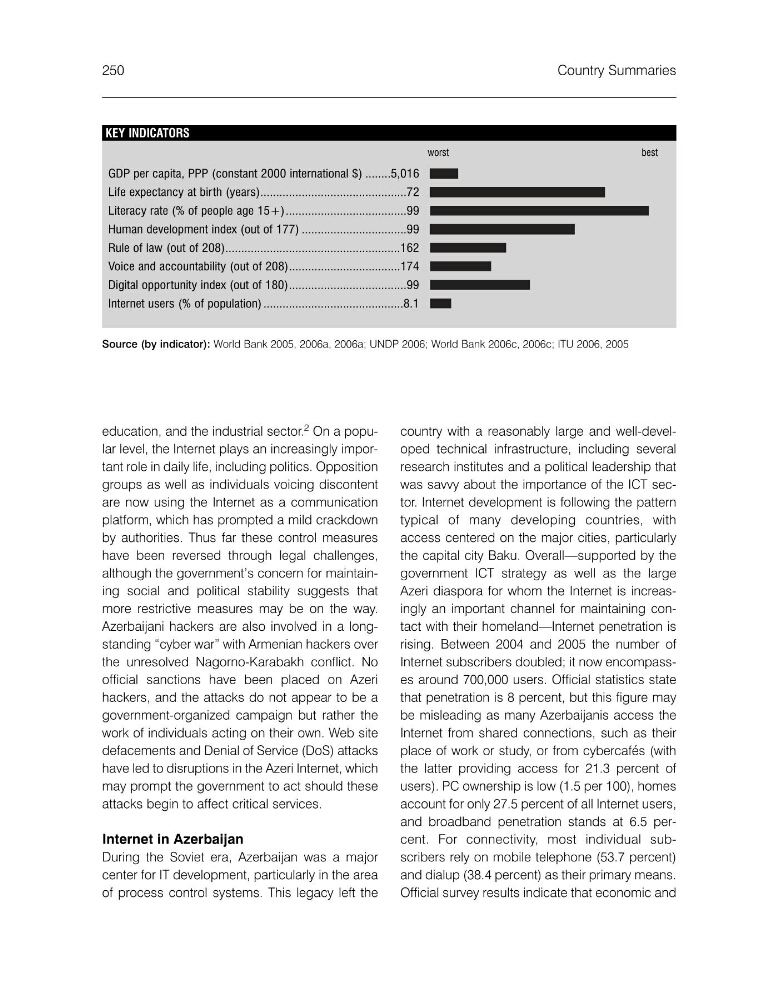
KEY INDICATORS
worst
best
GDP per capita, PPP (constant 2000 international $) ........5,016 4.44
Life expectancy at birth (years)..............................................72 5.80
Literacy rate (% of people age 15+)......................................99 4.05
Human development index (out of 177) .................................99 5.18
Rule of law (out of 208).......................................................162 3.57
Voice and accountability (out of 208)...................................174 3.17
Digital opportunity index (out of 180).....................................99 5.22
Internet users (% of population) ............................................8.1 3.61
Source (by indicator): World Bank 2005, 2006a, 2006a; UNDP 2006; World Bank 2006c, 2006c; ITU 2006, 2005
2
On a popular level, the Internet plays an increasingly important role in daily life, including politics. Opposition
groups as well as individuals voicing discontent
are now using the Internet as a communication
platform, which has prompted a mild crackdown
by authorities. Thus far these control measures
have been reversed through legal challenges,
although the government’s concern for maintaining social and political stability suggests that
more restrictive measures may be on the way.
Azerbaijani hackers are also involved in a longstanding “cyber war” with Armenian hackers over
the unresolved Nagorno-Karabakh conflict. No
official sanctions have been placed on Azeri
hackers, and the attacks do not appear to be a
government-organized campaign but rather the
work of individuals acting on their own. Web site
defacements and Denial of Service (DoS) attacks
have led to disruptions in the Azeri Internet, which
may prompt the government to act should these
attacks begin to affect critical services.
Internet in Azerbaijan
During the Soviet era, Azerbaijan was a major
center for IT development, particularly in the area
of process control systems. This legacy left the
country with a reasonably large and well-developed technical infrastructure, including several
research institutes and a political leadership that
was savvy about the importance of the ICT sector. Internet development is following the pattern
typical of many developing countries, with
access centered on the major cities, particularly
the capital city Baku. Overall—supported by the
government ICT strategy as well as the large
Azeri diaspora for whom the Internet is increasingly an important channel for maintaining contact with their homeland—Internet penetration is
rising. Between 2004 and 2005 the number of
Internet subscribers doubled; it now encompasses around 700,000 users. Official statistics state
that penetration is 8 percent, but this figure may
be misleading as many Azerbaijanis access the
Internet from shared connections, such as their
place of work or study, or from cybercafés (with
the latter providing access for 21.3 percent of
users). PC ownership is low (1.5 per 100), homes
account for only 27.5 percent of all Internet users,
and broadband penetration stands at 6.5 percent. For connectivity, most individual subscribers rely on mobile telephone (53.7 percent)
and dialup (38.4 percent) as their primary means.
Official survey results indicate that economic and
250
Country Summaries
KEY INDICATORS
worst
best
GDP per capita, PPP (constant 2000 international $) ........5,016 4.44
Life expectancy at birth (years)..............................................72 5.80
Literacy rate (% of people age 15+)......................................99 4.05
Human development index (out of 177) .................................99 5.18
Rule of law (out of 208).......................................................162 3.57
Voice and accountability (out of 208)...................................174 3.17
Digital opportunity index (out of 180).....................................99 5.22
Internet users (% of population) ............................................8.1 3.61
Source (by indicator): World Bank 2005, 2006a, 2006a; UNDP 2006; World Bank 2006c, 2006c; ITU 2006, 2005