

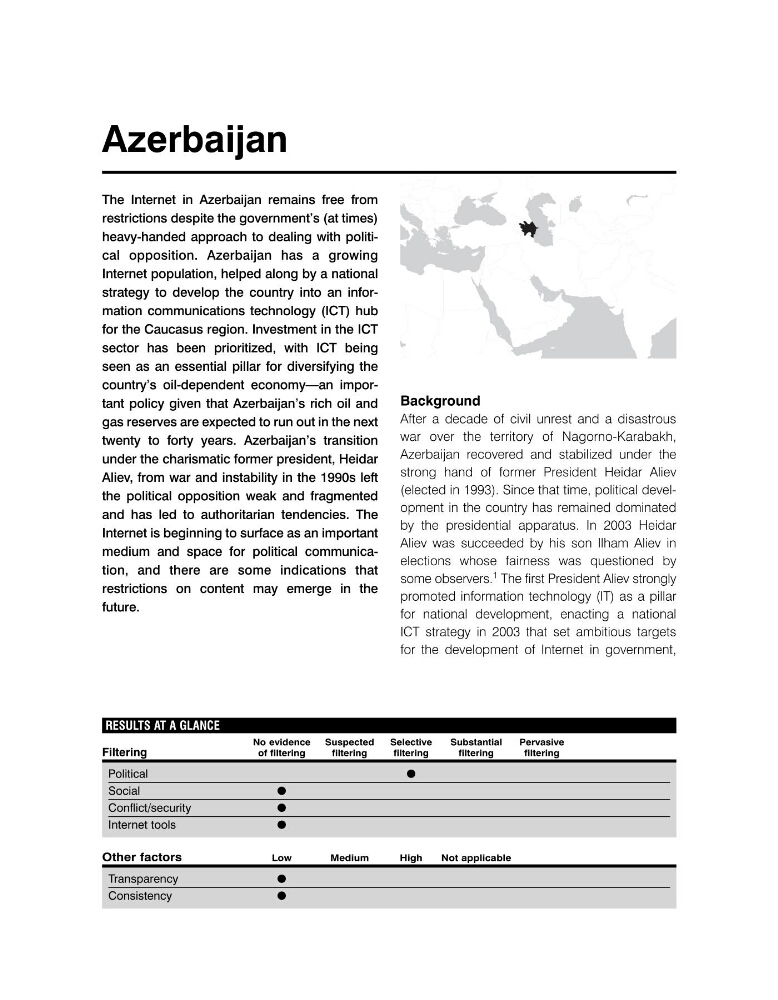
The Internet in Azerbaijan remains free from
restrictions despite the government’s (at times)
heavy-handed approach to dealing with political opposition. Azerbaijan has a growing
Internet population, helped along by a national
strategy to develop the country into an information communications technology (ICT) hub
for the Caucasus region. Investment in the ICT
sector has been prioritized, with ICT being
seen as an essential pillar for diversifying the
country’s oil-dependent economy—an important policy given that Azerbaijan’s rich oil and
gas reserves are expected to run out in the next
twenty to forty years. Azerbaijan’s transition
under the charismatic former president, Heidar
Aliev, from war and instability in the 1990s left
the political opposition weak and fragmented
and has led to authoritarian tendencies. The
Internet is beginning to surface as an important
medium and space for political communication, and there are some indications that
restrictions on content may emerge in the
future.
Background
After a decade of civil unrest and a disastrous
war over the territory of Nagorno-Karabakh,
Azerbaijan recovered and stabilized under the
strong hand of former President Heidar Aliev
(elected in 1993). Since that time, political development in the country has remained dominated
by the presidential apparatus. In 2003 Heidar
Aliev was succeeded by his son Ilham Aliev in
elections whose fairness was questioned by
some observers. 1 The first President Aliev strongly
promoted information technology (IT) as a pillar
for national development, enacting a national
ICT strategy in 2003 that set ambitious targets
for the development of Internet in government,
RESULTS AT A GLANCE
No evidence
Suspected
Selective
Substantial
Pervasive
Filtering
of filtering
filtering
filtering
filtering
filtering
Political
●
Social
●
Conflict/security
●
Internet tools
●
Other factors
Low
Medium
High
Not applicable
Transparency
●
Consistency
●
Azerbaijan
restrictions despite the government’s (at times)
heavy-handed approach to dealing with political opposition. Azerbaijan has a growing
Internet population, helped along by a national
strategy to develop the country into an information communications technology (ICT) hub
for the Caucasus region. Investment in the ICT
sector has been prioritized, with ICT being
seen as an essential pillar for diversifying the
country’s oil-dependent economy—an important policy given that Azerbaijan’s rich oil and
gas reserves are expected to run out in the next
twenty to forty years. Azerbaijan’s transition
under the charismatic former president, Heidar
Aliev, from war and instability in the 1990s left
the political opposition weak and fragmented
and has led to authoritarian tendencies. The
Internet is beginning to surface as an important
medium and space for political communication, and there are some indications that
restrictions on content may emerge in the
future.
Background
After a decade of civil unrest and a disastrous
war over the territory of Nagorno-Karabakh,
Azerbaijan recovered and stabilized under the
strong hand of former President Heidar Aliev
(elected in 1993). Since that time, political development in the country has remained dominated
by the presidential apparatus. In 2003 Heidar
Aliev was succeeded by his son Ilham Aliev in
elections whose fairness was questioned by
some observers. 1 The first President Aliev strongly
promoted information technology (IT) as a pillar
for national development, enacting a national
ICT strategy in 2003 that set ambitious targets
for the development of Internet in government,
RESULTS AT A GLANCE
No evidence
Suspected
Selective
Substantial
Pervasive
Filtering
of filtering
filtering
filtering
filtering
filtering
Political
●
Social
●
Conflict/security
●
Internet tools
●
Other factors
Low
Medium
High
Not applicable
Transparency
●
Consistency
●
Azerbaijan