

groups and improve the access of the rural poor
to markets.
4
However, the struggle to make the Internet
widely available is an arduous one. With a total of
1,200 Internet subscribers and an average of one
Internet user per thousand people for a total of
30,000 estimated users, 5 Afghanistan remains
almost completely outside the cybersphere. One
major obstacle is the adult literacy rate, which
stands around 28 percent (as of 2004). 6 The literacy rate for women is between 9 and 18 percent,
the lowest in the world;
7
ongoing violence and
intimidation threaten primary school education
for girls, and indeed for all children.
8
A second barrier to Internet use is its cost,
which is prohibitive for most Afghans.
9
In part to
address these concerns, the Ministry of
Communications and Information Technology
(MCIT, formerly the Ministry of Communications)
contracted two Chinese firms, ZPE and Huawei,
to build a digital wireless network in twelve
provinces. 10 Internet service providers (ISPs)
often choose wireless networks as well, since the
number of fixed lines is limited. Still, although the
Internet is essentially a luxury of the wealthy,
Afghans are interested in the Internet and all it
offers. 11
In 2003 Afghanistan was given legal control
of the “.af” domain, and the Afghanistan Network
Information Center (AFGNIC) was established to
administer domain names. Through a presidential decree, the MCIT was charged with spinning
off all telecommunications operations and services to a newly created independent company
called Afghan Telecom. 12 Up from five functional
ISPs in 2003, in 2006 Afghanistan supported
twenty-two Internet hosts and seven main ISPs
13
and a growing number of Internet cafés and
telekiosks (public access points located in post
offices and at the Kabul airport).
14
It plans to connect the country (and neighboring nations) along
major highways with Afghan Telecom’s National
Optical Fibre Backbone project. 15
Legal and regulatory frameworks
Freedom of expression is inviolable under the
Afghanistan Constitution, and every Afghan has
the right to print or publish topics without prior
submission to state authorities in accordance
with the law. 16 However, the normative limits of
the law are clear: under the Constitution no law
can be contrary to the beliefs and provisions of
the sacred religion of Islam. 17 Mass media law
has become increasingly attentive to a more
Country Summaries
241
KEY INDICATORS
worst
best
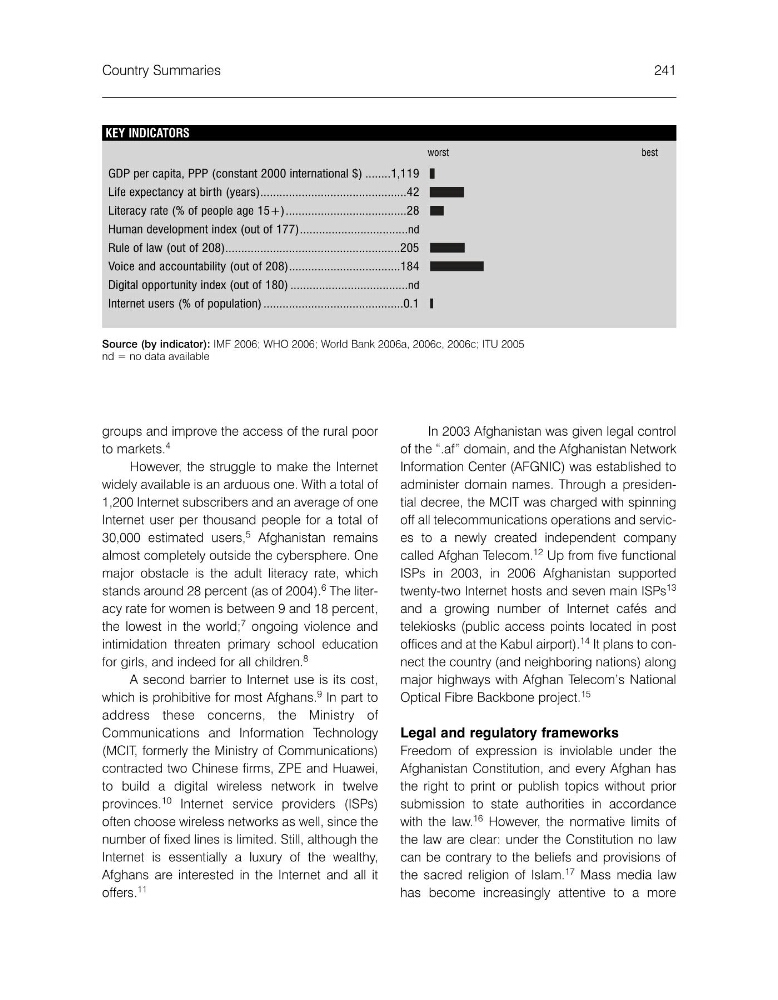
GDP per capita, PPP (constant 2000 international $) ........1,119 3.43
Life expectancy at birth (years)..............................................42 1.13
Literacy rate (% of people age 15+)......................................28 0.00
Human development index (out of 177)..................................nd —
Rule of law (out of 208).......................................................205 1.64
Voice and accountability (out of 208)...................................184 2.44
Digital opportunity index (out of 180) .....................................nd —
Internet users (% of population) ............................................0.1 3.07
Source (by indicator): IMF 2006; WHO 2006; World Bank 2006a, 2006c, 2006c; ITU 2005
nd = no data available
to markets.
4
However, the struggle to make the Internet
widely available is an arduous one. With a total of
1,200 Internet subscribers and an average of one
Internet user per thousand people for a total of
30,000 estimated users, 5 Afghanistan remains
almost completely outside the cybersphere. One
major obstacle is the adult literacy rate, which
stands around 28 percent (as of 2004). 6 The literacy rate for women is between 9 and 18 percent,
the lowest in the world;
7
ongoing violence and
intimidation threaten primary school education
for girls, and indeed for all children.
8
A second barrier to Internet use is its cost,
which is prohibitive for most Afghans.
9
In part to
address these concerns, the Ministry of
Communications and Information Technology
(MCIT, formerly the Ministry of Communications)
contracted two Chinese firms, ZPE and Huawei,
to build a digital wireless network in twelve
provinces. 10 Internet service providers (ISPs)
often choose wireless networks as well, since the
number of fixed lines is limited. Still, although the
Internet is essentially a luxury of the wealthy,
Afghans are interested in the Internet and all it
offers. 11
In 2003 Afghanistan was given legal control
of the “.af” domain, and the Afghanistan Network
Information Center (AFGNIC) was established to
administer domain names. Through a presidential decree, the MCIT was charged with spinning
off all telecommunications operations and services to a newly created independent company
called Afghan Telecom. 12 Up from five functional
ISPs in 2003, in 2006 Afghanistan supported
twenty-two Internet hosts and seven main ISPs
13
and a growing number of Internet cafés and
telekiosks (public access points located in post
offices and at the Kabul airport).
14
It plans to connect the country (and neighboring nations) along
major highways with Afghan Telecom’s National
Optical Fibre Backbone project. 15
Legal and regulatory frameworks
Freedom of expression is inviolable under the
Afghanistan Constitution, and every Afghan has
the right to print or publish topics without prior
submission to state authorities in accordance
with the law. 16 However, the normative limits of
the law are clear: under the Constitution no law
can be contrary to the beliefs and provisions of
the sacred religion of Islam. 17 Mass media law
has become increasingly attentive to a more
Country Summaries
241
KEY INDICATORS
worst
best
GDP per capita, PPP (constant 2000 international $) ........1,119 3.43
Life expectancy at birth (years)..............................................42 1.13
Literacy rate (% of people age 15+)......................................28 0.00
Human development index (out of 177)..................................nd —
Rule of law (out of 208).......................................................205 1.64
Voice and accountability (out of 208)...................................184 2.44
Digital opportunity index (out of 180) .....................................nd —
Internet users (% of population) ............................................0.1 3.07
Source (by indicator): IMF 2006; WHO 2006; World Bank 2006a, 2006c, 2006c; ITU 2005
nd = no data available