

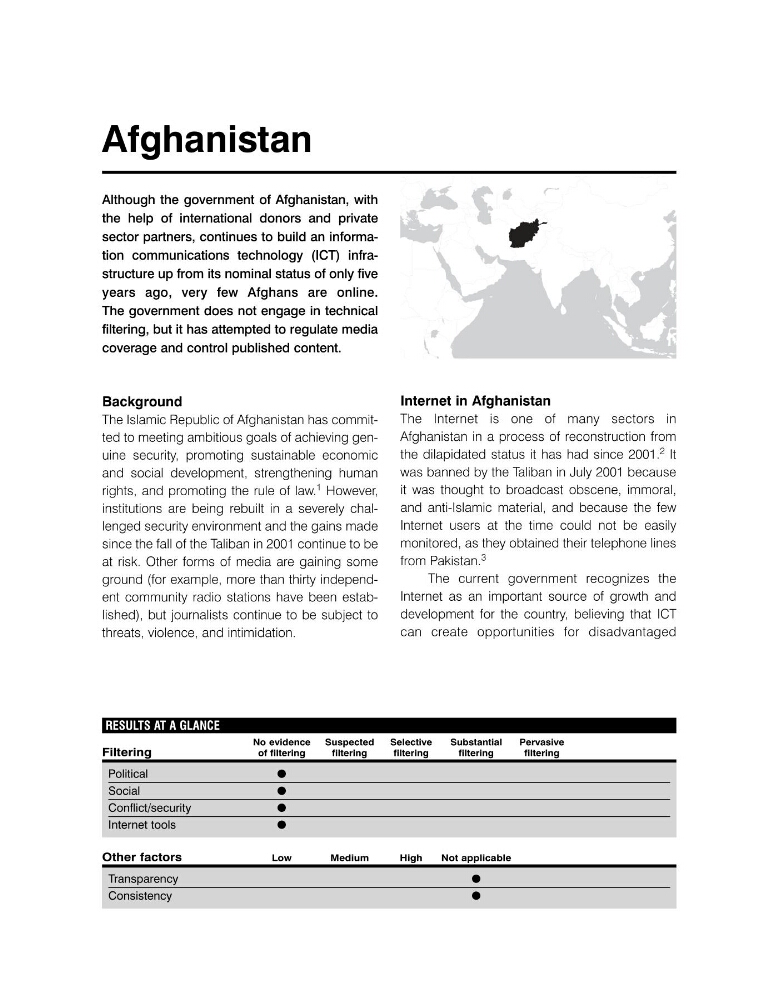
Although the government of Afghanistan, with
the help of international donors and private
sector partners, continues to build an information communications technology (ICT) infrastructure up from its nominal status of only five
years ago, very few Afghans are online.
The government does not engage in technical
filtering, but it has attempted to regulate media
coverage and control published content.
Background
The Islamic Republic of Afghanistan has committed to meeting ambitious goals of achieving genuine security, promoting sustainable economic
and social development, strengthening human
rights, and promoting the rule of law. 1 However,
institutions are being rebuilt in a severely challenged security environment and the gains made
since the fall of the Taliban in 2001 continue to be
at risk. Other forms of media are gaining some
ground (for example, more than thirty independent community radio stations have been established), but journalists continue to be subject to
threats, violence, and intimidation.
Internet in Afghanistan
The Internet is one of many sectors in
Afghanistan in a process of reconstruction from
the dilapidated status it has had since 2001.
2
It
was banned by the Taliban in July 2001 because
it was thought to broadcast obscene, immoral,
and anti-Islamic material, and because the few
Internet users at the time could not be easily
monitored, as they obtained their telephone lines
from Pakistan. 3
The current government recognizes the
Internet as an important source of growth and
development for the country, believing that ICT
can create opportunities for disadvantaged
RESULTS AT A GLANCE
No evidence
Suspected
Selective
Substantial
Pervasive
Filtering
of filtering
filtering
filtering
filtering
filtering
Political
●
Social
●
Conflict/security
●
Internet tools
●
Other factors
Low
Medium
High
Not applicable
Transparency
●
Consistency
●
Afghanistan
the help of international donors and private
sector partners, continues to build an information communications technology (ICT) infrastructure up from its nominal status of only five
years ago, very few Afghans are online.
The government does not engage in technical
filtering, but it has attempted to regulate media
coverage and control published content.
Background
The Islamic Republic of Afghanistan has committed to meeting ambitious goals of achieving genuine security, promoting sustainable economic
and social development, strengthening human
rights, and promoting the rule of law. 1 However,
institutions are being rebuilt in a severely challenged security environment and the gains made
since the fall of the Taliban in 2001 continue to be
at risk. Other forms of media are gaining some
ground (for example, more than thirty independent community radio stations have been established), but journalists continue to be subject to
threats, violence, and intimidation.
Internet in Afghanistan
The Internet is one of many sectors in
Afghanistan in a process of reconstruction from
the dilapidated status it has had since 2001.
2
It
was banned by the Taliban in July 2001 because
it was thought to broadcast obscene, immoral,
and anti-Islamic material, and because the few
Internet users at the time could not be easily
monitored, as they obtained their telephone lines
from Pakistan. 3
The current government recognizes the
Internet as an important source of growth and
development for the country, believing that ICT
can create opportunities for disadvantaged
RESULTS AT A GLANCE
No evidence
Suspected
Selective
Substantial
Pervasive
Filtering
of filtering
filtering
filtering
filtering
filtering
Political
●
Social
●
Conflict/security
●
Internet tools
●
Other factors
Low
Medium
High
Not applicable
Transparency
●
Consistency
●
Afghanistan