

information gap could hinder the ISA’s ability to meet its duty to protect and
preserve the marine environment.
2.3 Institutional Capacity
The disjunction identified above between information-holders (contractor, Secretariat and LTC) and regulatory decision-makers (Council, sponsoring State, and
Assembly), in relation to contractor monitoring, prompts the question: who plays
the role of the ‘Environmental Protection Agency’ (permitting, monitoring and
enforcement body) within the ISA?
Within national jurisdictions, the usual model is for a named government agency
to have statutory responsibility for an environmental protection function, which
would include: requiring environmental impact assessment, taking permitting decisions in relation to a planned project, monitoring environment-impacting projects
that are permitted, and enforcing compliance with conditions attached to the
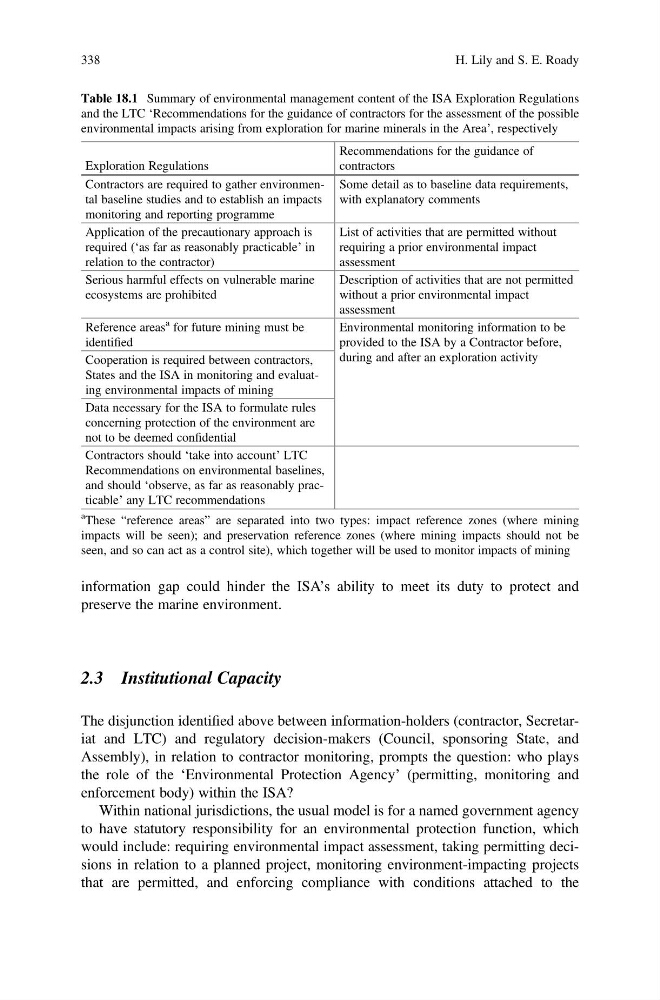
Table 18.1 Summary of environmental management content of the ISA Exploration Regulations
and the LTC ‘Recommendations for the guidance of contractors for the assessment of the possible
environmental impacts arising from exploration for marine minerals in the Area’, respectively
Exploration Regulations
Recommendations for the guidance of
contractors
Contractors are required to gather environmental baseline studies and to establish an impacts
monitoring and reporting programme
Some detail as to baseline data requirements,
with explanatory comments
Application of the precautionary approach is
required (‘as far as reasonably practicable’ in
relation to the contractor)
List of activities that are permitted without
requiring a prior environmental impact
assessment
Serious harmful effects on vulnerable marine
ecosystems are prohibited
Description of activities that are not permitted
without a prior environmental impact
assessment
Reference areas
a for future mining must be
identified
Environmental monitoring information to be
provided to the ISA by a Contractor before,
during and after an exploration activity
Cooperation is required between contractors,
States and the ISA in monitoring and evaluating environmental impacts of mining
Data necessary for the ISA to formulate rules
concerning protection of the environment are
not to be deemed confidential
Contractors should ‘take into account’ LTC
Recommendations on environmental baselines,
and should ‘observe, as far as reasonably practicable’ any LTC recommendations
a These “reference areas” are separated into two types: impact reference zones (where mining
impacts will be seen); and preservation reference zones (where mining impacts should not be
seen, and so can act as a control site), which together will be used to monitor impacts of mining
338
H. Lily and S. E. Roady
preserve the marine environment.
2.3 Institutional Capacity
The disjunction identified above between information-holders (contractor, Secretariat and LTC) and regulatory decision-makers (Council, sponsoring State, and
Assembly), in relation to contractor monitoring, prompts the question: who plays
the role of the ‘Environmental Protection Agency’ (permitting, monitoring and
enforcement body) within the ISA?
Within national jurisdictions, the usual model is for a named government agency
to have statutory responsibility for an environmental protection function, which
would include: requiring environmental impact assessment, taking permitting decisions in relation to a planned project, monitoring environment-impacting projects
that are permitted, and enforcing compliance with conditions attached to the
Table 18.1 Summary of environmental management content of the ISA Exploration Regulations
and the LTC ‘Recommendations for the guidance of contractors for the assessment of the possible
environmental impacts arising from exploration for marine minerals in the Area’, respectively
Exploration Regulations
Recommendations for the guidance of
contractors
Contractors are required to gather environmental baseline studies and to establish an impacts
monitoring and reporting programme
Some detail as to baseline data requirements,
with explanatory comments
Application of the precautionary approach is
required (‘as far as reasonably practicable’ in
relation to the contractor)
List of activities that are permitted without
requiring a prior environmental impact
assessment
Serious harmful effects on vulnerable marine
ecosystems are prohibited
Description of activities that are not permitted
without a prior environmental impact
assessment
Reference areas
a for future mining must be
identified
Environmental monitoring information to be
provided to the ISA by a Contractor before,
during and after an exploration activity
Cooperation is required between contractors,
States and the ISA in monitoring and evaluating environmental impacts of mining
Data necessary for the ISA to formulate rules
concerning protection of the environment are
not to be deemed confidential
Contractors should ‘take into account’ LTC
Recommendations on environmental baselines,
and should ‘observe, as far as reasonably practicable’ any LTC recommendations
a These “reference areas” are separated into two types: impact reference zones (where mining
impacts will be seen); and preservation reference zones (where mining impacts should not be
seen, and so can act as a control site), which together will be used to monitor impacts of mining
338
H. Lily and S. E. Roady