

4.8 Results and Discussion
83
40
60
80
100
0
30
60
90
120
150
180
Removal, %
Contact Ɵme (min)
cadmium
lead
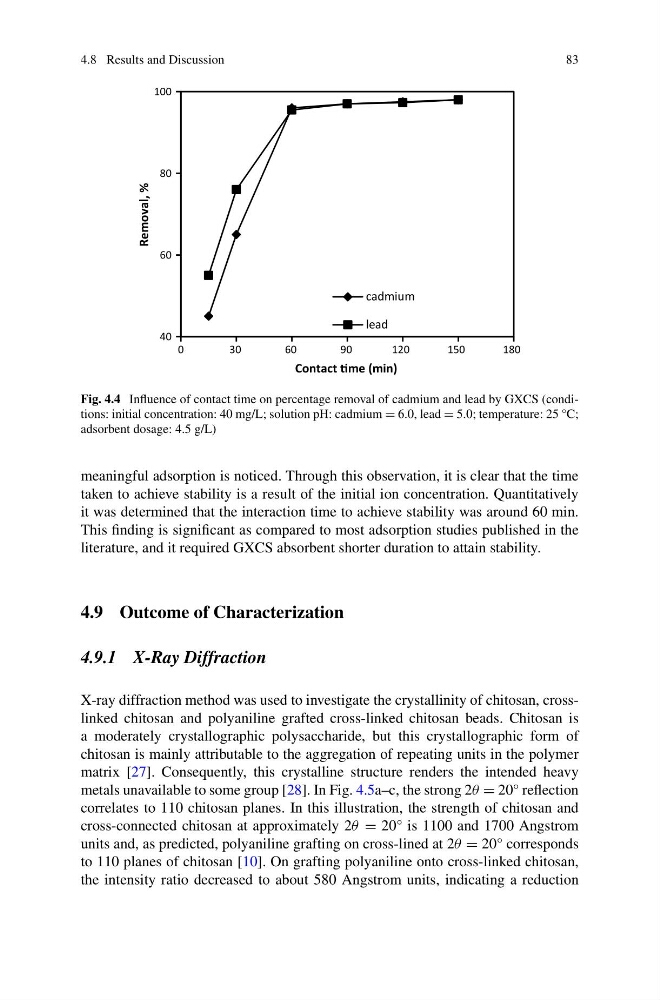
Fig. 4.4 Influence of contact time on percentage removal of cadmium and lead by GXCS (conditions: initial concentration: 40 mg/L; solution pH: cadmium = 6.0, lead = 5.0; temperature: 25 °C;
adsorbent dosage: 4.5 g/L)
meaningful adsorption is noticed. Through this observation, it is clear that the time
taken to achieve stability is a result of the initial ion concentration. Quantitatively
it was determined that the interaction time to achieve stability was around 60 min.
This finding is significant as compared to most adsorption studies published in the
literature, and it required GXCS absorbent shorter duration to attain stability.
4.9 Outcome of Characterization
4.9.1 X-Ray Diffraction
X-ray diffraction method was used to investigate the crystallinity of chitosan, crosslinked chitosan and polyaniline grafted cross-linked chitosan beads. Chitosan is
a moderately crystallographic polysaccharide, but this crystallographic form of
chitosan is mainly attributable to the aggregation of repeating units in the polymer
matrix [27]. Consequently, this crystalline structure renders the intended heavy
metals unavailable to some group [28]. In Fig. 4.5a–c, the strong 2θ = 20° reflection
correlates to 110 chitosan planes. In this illustration, the strength of chitosan and
cross-connected chitosan at approximately 2θ = 20° is 1100 and 1700 Angstrom
units and, as predicted, polyaniline grafting on cross-lined at 2θ = 20° corresponds
to 110 planes of chitosan [10]. On grafting polyaniline onto cross-linked chitosan,
the intensity ratio decreased to about 580 Angstrom units, indicating a reduction
83
40
60
80
100
0
30
60
90
120
150
180
Removal, %
Contact Ɵme (min)
cadmium
lead
Fig. 4.4 Influence of contact time on percentage removal of cadmium and lead by GXCS (conditions: initial concentration: 40 mg/L; solution pH: cadmium = 6.0, lead = 5.0; temperature: 25 °C;
adsorbent dosage: 4.5 g/L)
meaningful adsorption is noticed. Through this observation, it is clear that the time
taken to achieve stability is a result of the initial ion concentration. Quantitatively
it was determined that the interaction time to achieve stability was around 60 min.
This finding is significant as compared to most adsorption studies published in the
literature, and it required GXCS absorbent shorter duration to attain stability.
4.9 Outcome of Characterization
4.9.1 X-Ray Diffraction
X-ray diffraction method was used to investigate the crystallinity of chitosan, crosslinked chitosan and polyaniline grafted cross-linked chitosan beads. Chitosan is
a moderately crystallographic polysaccharide, but this crystallographic form of
chitosan is mainly attributable to the aggregation of repeating units in the polymer
matrix [27]. Consequently, this crystalline structure renders the intended heavy
metals unavailable to some group [28]. In Fig. 4.5a–c, the strong 2θ = 20° reflection
correlates to 110 chitosan planes. In this illustration, the strength of chitosan and
cross-connected chitosan at approximately 2θ = 20° is 1100 and 1700 Angstrom
units and, as predicted, polyaniline grafting on cross-lined at 2θ = 20° corresponds
to 110 planes of chitosan [10]. On grafting polyaniline onto cross-linked chitosan,
the intensity ratio decreased to about 580 Angstrom units, indicating a reduction