

4.7 Theory of Evaluation of Data
79
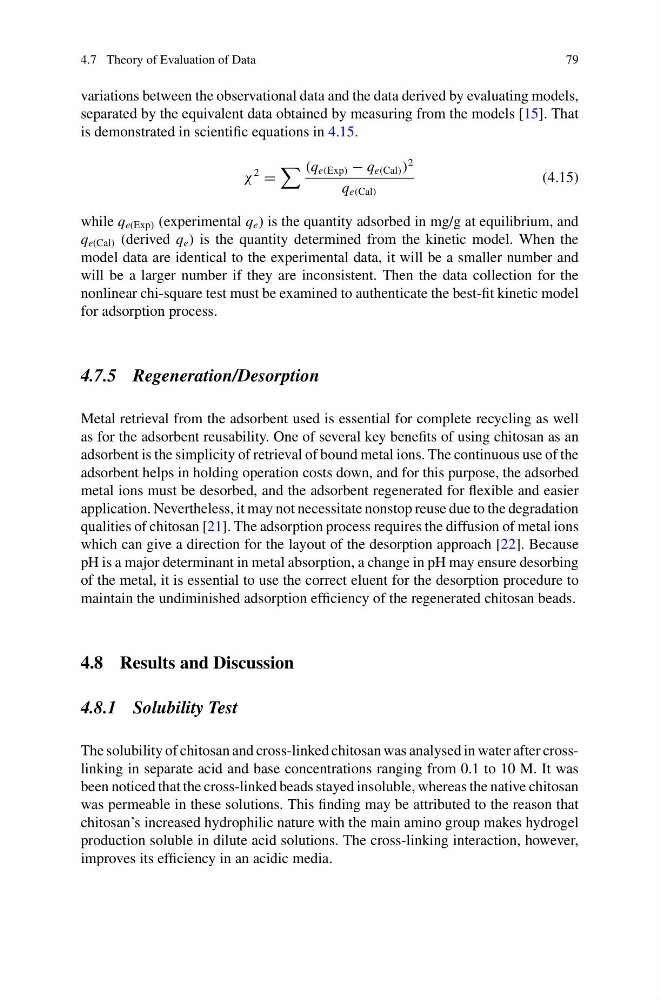
variations between the observational data and the data derived by evaluating models,
separated by the equivalent data obtained by measuring from the models [15]. That
is demonstrated in scientific equations in 4.15.
χ
2
=
(q e(Exp) − q e(Cal) )
2
q e(Cal)
(4.15)
while q e(Exp) (experimental q e ) is the quantity adsorbed in mg/g at equilibrium, and
q e(Cal) (derived q e ) is the quantity determined from the kinetic model. When the
model data are identical to the experimental data, it will be a smaller number and
will be a larger number if they are inconsistent. Then the data collection for the
nonlinear chi-square test must be examined to authenticate the best-fit kinetic model
for adsorption process.
4.7.5 Regeneration/Desorption
Metal retrieval from the adsorbent used is essential for complete recycling as well
as for the adsorbent reusability. One of several key benefits of using chitosan as an
adsorbent is the simplicity of retrieval of bound metal ions. The continuous use of the
adsorbent helps in holding operation costs down, and for this purpose, the adsorbed
metal ions must be desorbed, and the adsorbent regenerated for flexible and easier
application. Nevertheless, it may not necessitate nonstop reuse due to the degradation
qualities of chitosan [21]. The adsorption process requires the diffusion of metal ions
which can give a direction for the layout of the desorption approach [22]. Because
pH is a major determinant in metal absorption, a change in pH may ensure desorbing
of the metal, it is essential to use the correct eluent for the desorption procedure to
maintain the undiminished adsorption efficiency of the regenerated chitosan beads.
4.8 Results and Discussion
4.8.1 Solubility Test
The solubility of chitosan and cross-linked chitosan was analysed in water after crosslinking in separate acid and base concentrations ranging from 0.1 to 10 M. It was
been noticed that the cross-linked beads stayed insoluble, whereas the native chitosan
was permeable in these solutions. This finding may be attributed to the reason that
chitosan’s increased hydrophilic nature with the main amino group makes hydrogel
production soluble in dilute acid solutions. The cross-linking interaction, however,
improves its efficiency in an acidic media.
79
variations between the observational data and the data derived by evaluating models,
separated by the equivalent data obtained by measuring from the models [15]. That
is demonstrated in scientific equations in 4.15.
χ
2
=
(q e(Exp) − q e(Cal) )
2
q e(Cal)
(4.15)
while q e(Exp) (experimental q e ) is the quantity adsorbed in mg/g at equilibrium, and
q e(Cal) (derived q e ) is the quantity determined from the kinetic model. When the
model data are identical to the experimental data, it will be a smaller number and
will be a larger number if they are inconsistent. Then the data collection for the
nonlinear chi-square test must be examined to authenticate the best-fit kinetic model
for adsorption process.
4.7.5 Regeneration/Desorption
Metal retrieval from the adsorbent used is essential for complete recycling as well
as for the adsorbent reusability. One of several key benefits of using chitosan as an
adsorbent is the simplicity of retrieval of bound metal ions. The continuous use of the
adsorbent helps in holding operation costs down, and for this purpose, the adsorbed
metal ions must be desorbed, and the adsorbent regenerated for flexible and easier
application. Nevertheless, it may not necessitate nonstop reuse due to the degradation
qualities of chitosan [21]. The adsorption process requires the diffusion of metal ions
which can give a direction for the layout of the desorption approach [22]. Because
pH is a major determinant in metal absorption, a change in pH may ensure desorbing
of the metal, it is essential to use the correct eluent for the desorption procedure to
maintain the undiminished adsorption efficiency of the regenerated chitosan beads.
4.8 Results and Discussion
4.8.1 Solubility Test
The solubility of chitosan and cross-linked chitosan was analysed in water after crosslinking in separate acid and base concentrations ranging from 0.1 to 10 M. It was
been noticed that the cross-linked beads stayed insoluble, whereas the native chitosan
was permeable in these solutions. This finding may be attributed to the reason that
chitosan’s increased hydrophilic nature with the main amino group makes hydrogel
production soluble in dilute acid solutions. The cross-linking interaction, however,
improves its efficiency in an acidic media.