

4.7 Theory of Evaluation of Data
77
4.7.2 Temperature and Thermodynamic Investigation
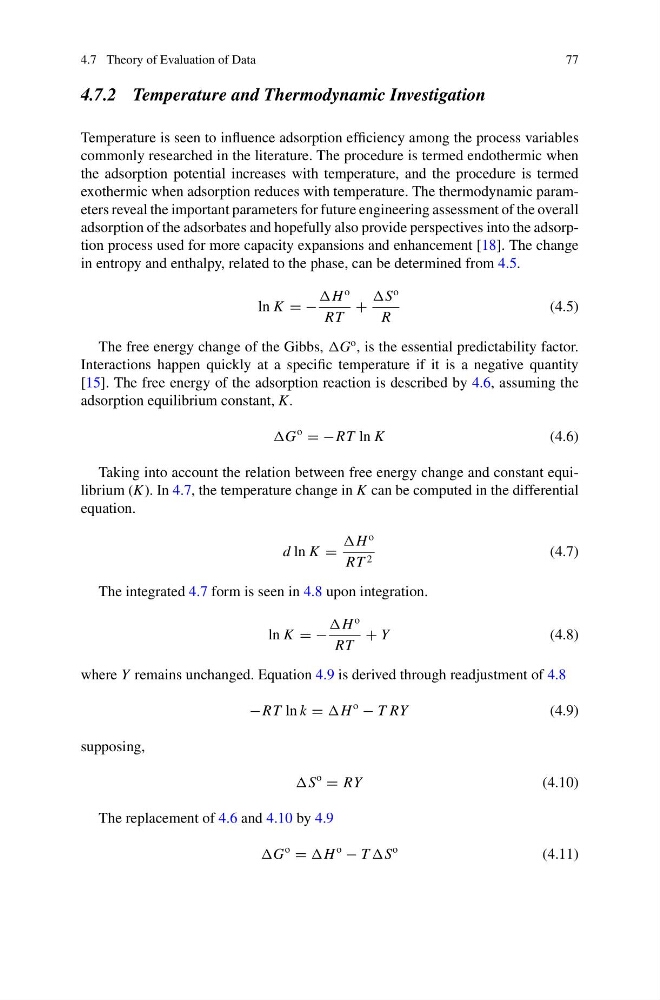
Temperature is seen to influence adsorption efficiency among the process variables
commonly researched in the literature. The procedure is termed endothermic when
the adsorption potential increases with temperature, and the procedure is termed
exothermic when adsorption reduces with temperature. The thermodynamic parameters reveal the important parameters for future engineering assessment of the overall
adsorption of the adsorbates and hopefully also provide perspectives into the adsorption process used for more capacity expansions and enhancement [18]. The change
in entropy and enthalpy, related to the phase, can be determined from 4.5.
ln K = −
H
o
RT
+
S
o
R
(4.5)
The free energy change of the Gibbs, G
o , is the essential predictability factor.
Interactions happen quickly at a specific temperature if it is a negative quantity
[15]. The free energy of the adsorption reaction is described by 4.6, assuming the
adsorption equilibrium constant, K.
G
o
= −RT ln K
(4.6)
Taking into account the relation between free energy change and constant equilibrium (K). In 4.7, the temperature change in K can be computed in the differential
equation.
d ln K =
H
o
RT 2
(4.7)
The integrated 4.7 form is seen in 4.8 upon integration.
ln K = −
H
o
RT
+ Y
(4.8)
where Y remains unchanged. Equation 4.9 is derived through readjustment of 4.8
−RT ln k = H
o
− T RY
(4.9)
supposing,
S
o
= RY
(4.10)
The replacement of 4.6 and 4.10 by 4.9
G
o
= H
o
− T S
o
(4.11)
77
4.7.2 Temperature and Thermodynamic Investigation
Temperature is seen to influence adsorption efficiency among the process variables
commonly researched in the literature. The procedure is termed endothermic when
the adsorption potential increases with temperature, and the procedure is termed
exothermic when adsorption reduces with temperature. The thermodynamic parameters reveal the important parameters for future engineering assessment of the overall
adsorption of the adsorbates and hopefully also provide perspectives into the adsorption process used for more capacity expansions and enhancement [18]. The change
in entropy and enthalpy, related to the phase, can be determined from 4.5.
ln K = −
H
o
RT
+
S
o
R
(4.5)
The free energy change of the Gibbs, G
o , is the essential predictability factor.
Interactions happen quickly at a specific temperature if it is a negative quantity
[15]. The free energy of the adsorption reaction is described by 4.6, assuming the
adsorption equilibrium constant, K.
G
o
= −RT ln K
(4.6)
Taking into account the relation between free energy change and constant equilibrium (K). In 4.7, the temperature change in K can be computed in the differential
equation.
d ln K =
H
o
RT 2
(4.7)
The integrated 4.7 form is seen in 4.8 upon integration.
ln K = −
H
o
RT
+ Y
(4.8)
where Y remains unchanged. Equation 4.9 is derived through readjustment of 4.8
−RT ln k = H
o
− T RY
(4.9)
supposing,
S
o
= RY
(4.10)
The replacement of 4.6 and 4.10 by 4.9
G
o
= H
o
− T S
o
(4.11)