

54
3 Adsorption of Pb(II), Cu(II), Ni(II), Zn(II), Cr(VI) …
ln K = −
H
o
RT
+
S
o
R
(3.12)
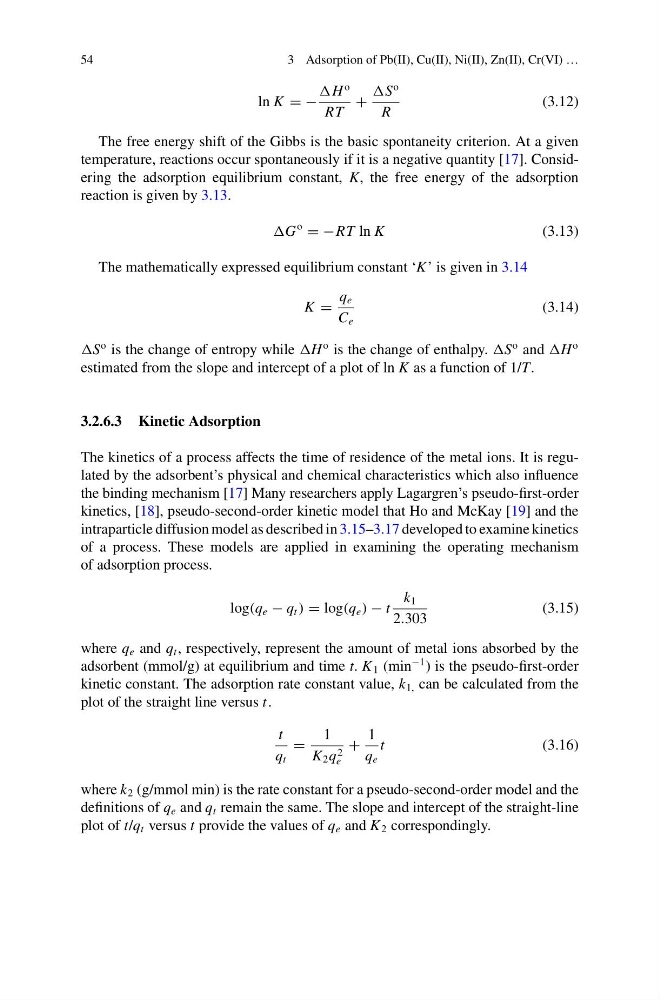
The free energy shift of the Gibbs is the basic spontaneity criterion. At a given
temperature, reactions occur spontaneously if it is a negative quantity [17]. Considering the adsorption equilibrium constant, K, the free energy of the adsorption
reaction is given by 3.13.
G
o
= −RT ln K
(3.13)
The mathematically expressed equilibrium constant ‘K’ is given in 3.14
K =
q e
C e
(3.14)
S
o is the change of entropy while H
o is the change of enthalpy. S
o and H
o
estimated from the slope and intercept of a plot of ln K as a function of 1/T.
3.2.6.3 Kinetic Adsorption
The kinetics of a process affects the time of residence of the metal ions. It is regulated by the adsorbent’s physical and chemical characteristics which also influence
the binding mechanism [17] Many researchers apply Lagargren’s pseudo-first-order
kinetics, [18], pseudo-second-order kinetic model that Ho and McKay [19] and the
intraparticle diffusion model as described in 3.15–3.17 developed to examine kinetics
of a process. These models are applied in examining the operating mechanism
of adsorption process.
log(q e − q t ) = log(q e ) − t
k 1
2.303
(3.15)
where q e and q t , respectively, represent the amount of metal ions absorbed by the
adsorbent (mmol/g) at equilibrium and time t. K 1 (min
−1 ) is the pseudo-first-order
kinetic constant. The adsorption rate constant value, k 1, can be calculated from the
plot of the straight line versus t.
t
q t
=
1
K 2 q 2
e
+
1
q e
t
(3.16)
where k 2 (g/mmol min) is the rate constant for a pseudo-second-order model and the
definitions of q e and q t remain the same. The slope and intercept of the straight-line
plot of t/q t versus t provide the values of q e and K 2 correspondingly.
3 Adsorption of Pb(II), Cu(II), Ni(II), Zn(II), Cr(VI) …
ln K = −
H
o
RT
+
S
o
R
(3.12)
The free energy shift of the Gibbs is the basic spontaneity criterion. At a given
temperature, reactions occur spontaneously if it is a negative quantity [17]. Considering the adsorption equilibrium constant, K, the free energy of the adsorption
reaction is given by 3.13.
G
o
= −RT ln K
(3.13)
The mathematically expressed equilibrium constant ‘K’ is given in 3.14
K =
q e
C e
(3.14)
S
o is the change of entropy while H
o is the change of enthalpy. S
o and H
o
estimated from the slope and intercept of a plot of ln K as a function of 1/T.
3.2.6.3 Kinetic Adsorption
The kinetics of a process affects the time of residence of the metal ions. It is regulated by the adsorbent’s physical and chemical characteristics which also influence
the binding mechanism [17] Many researchers apply Lagargren’s pseudo-first-order
kinetics, [18], pseudo-second-order kinetic model that Ho and McKay [19] and the
intraparticle diffusion model as described in 3.15–3.17 developed to examine kinetics
of a process. These models are applied in examining the operating mechanism
of adsorption process.
log(q e − q t ) = log(q e ) − t
k 1
2.303
(3.15)
where q e and q t , respectively, represent the amount of metal ions absorbed by the
adsorbent (mmol/g) at equilibrium and time t. K 1 (min
−1 ) is the pseudo-first-order
kinetic constant. The adsorption rate constant value, k 1, can be calculated from the
plot of the straight line versus t.
t
q t
=
1
K 2 q 2
e
+
1
q e
t
(3.16)
where k 2 (g/mmol min) is the rate constant for a pseudo-second-order model and the
definitions of q e and q t remain the same. The slope and intercept of the straight-line
plot of t/q t versus t provide the values of q e and K 2 correspondingly.