

3.2 Experimental
53
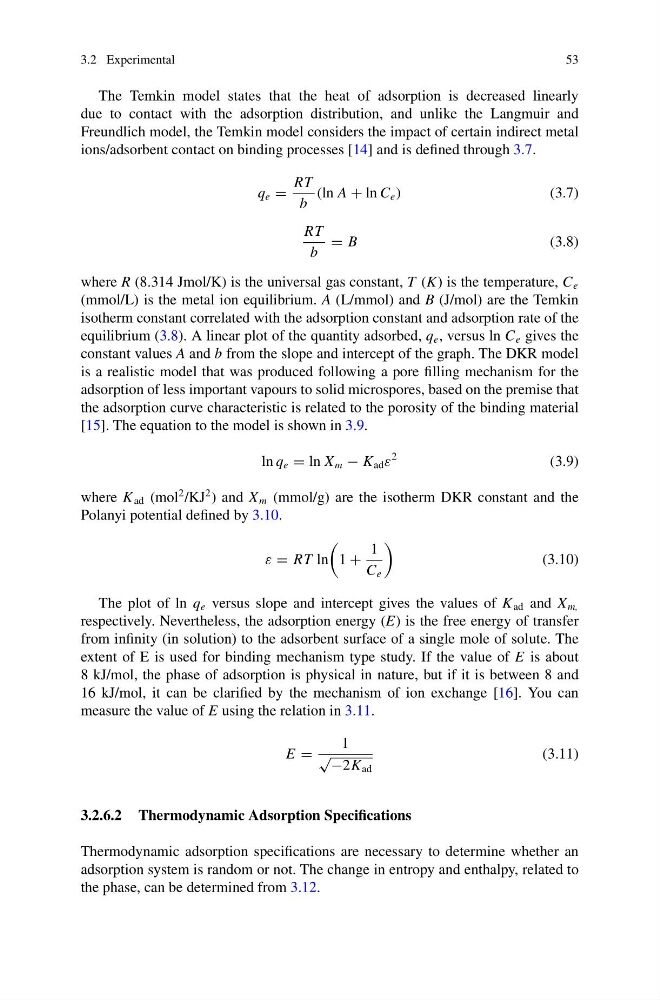
The Temkin model states that the heat of adsorption is decreased linearly
due to contact with the adsorption distribution, and unlike the Langmuir and
Freundlich model, the Temkin model considers the impact of certain indirect metal
ions/adsorbent contact on binding processes [14] and is defined through 3.7.
q e =
RT
b
(ln A + ln C e )
(3.7)
RT
b
= B
(3.8)
where R (8.314 Jmol/K) is the universal gas constant, T (K) is the temperature, C e
(mmol/L) is the metal ion equilibrium. A (L/mmol) and B (J/mol) are the Temkin
isotherm constant correlated with the adsorption constant and adsorption rate of the
equilibrium (3.8). A linear plot of the quantity adsorbed, q e , versus ln C e gives the
constant values A and b from the slope and intercept of the graph. The DKR model
is a realistic model that was produced following a pore filling mechanism for the
adsorption of less important vapours to solid microspores, based on the premise that
the adsorption curve characteristic is related to the porosity of the binding material
[15]. The equation to the model is shown in 3.9.
ln q e = ln X m − K ad ε
2
(3.9)
where K ad (mol
2 /KJ
2 ) and X m (mmol/g) are the isotherm DKR constant and the
Polanyi potential defined by 3.10.
ε = RT ln
1 +
1
C e
(3.10)
The plot of ln q e versus slope and intercept gives the values of K ad and X m,
respectively. Nevertheless, the adsorption energy (E) is the free energy of transfer
from infinity (in solution) to the adsorbent surface of a single mole of solute. The
extent of E is used for binding mechanism type study. If the value of E is about
8 kJ/mol, the phase of adsorption is physical in nature, but if it is between 8 and
16 kJ/mol, it can be clarified by the mechanism of ion exchange [16]. You can
measure the value of E using the relation in 3.11.
E =
1
√
−2K ad
(3.11)
3.2.6.2 Thermodynamic Adsorption Specifications
Thermodynamic adsorption specifications are necessary to determine whether an
adsorption system is random or not. The change in entropy and enthalpy, related to
the phase, can be determined from 3.12.
53
The Temkin model states that the heat of adsorption is decreased linearly
due to contact with the adsorption distribution, and unlike the Langmuir and
Freundlich model, the Temkin model considers the impact of certain indirect metal
ions/adsorbent contact on binding processes [14] and is defined through 3.7.
q e =
RT
b
(ln A + ln C e )
(3.7)
RT
b
= B
(3.8)
where R (8.314 Jmol/K) is the universal gas constant, T (K) is the temperature, C e
(mmol/L) is the metal ion equilibrium. A (L/mmol) and B (J/mol) are the Temkin
isotherm constant correlated with the adsorption constant and adsorption rate of the
equilibrium (3.8). A linear plot of the quantity adsorbed, q e , versus ln C e gives the
constant values A and b from the slope and intercept of the graph. The DKR model
is a realistic model that was produced following a pore filling mechanism for the
adsorption of less important vapours to solid microspores, based on the premise that
the adsorption curve characteristic is related to the porosity of the binding material
[15]. The equation to the model is shown in 3.9.
ln q e = ln X m − K ad ε
2
(3.9)
where K ad (mol
2 /KJ
2 ) and X m (mmol/g) are the isotherm DKR constant and the
Polanyi potential defined by 3.10.
ε = RT ln
1 +
1
C e
(3.10)
The plot of ln q e versus slope and intercept gives the values of K ad and X m,
respectively. Nevertheless, the adsorption energy (E) is the free energy of transfer
from infinity (in solution) to the adsorbent surface of a single mole of solute. The
extent of E is used for binding mechanism type study. If the value of E is about
8 kJ/mol, the phase of adsorption is physical in nature, but if it is between 8 and
16 kJ/mol, it can be clarified by the mechanism of ion exchange [16]. You can
measure the value of E using the relation in 3.11.
E =
1
√
−2K ad
(3.11)
3.2.6.2 Thermodynamic Adsorption Specifications
Thermodynamic adsorption specifications are necessary to determine whether an
adsorption system is random or not. The change in entropy and enthalpy, related to
the phase, can be determined from 3.12.