

290
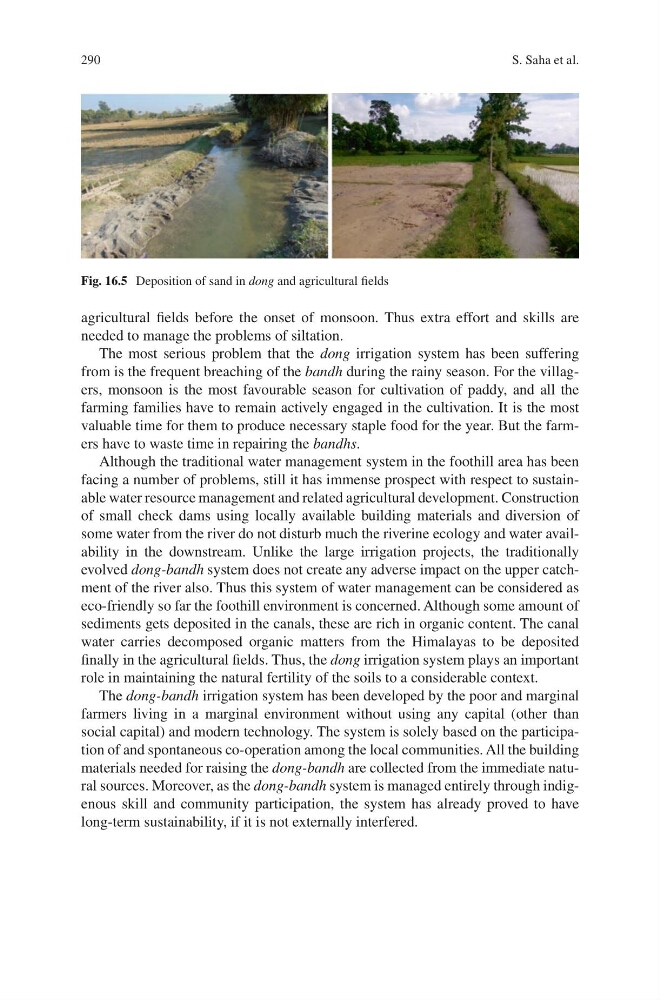
agricultural fields before the onset of monsoon. Thus extra effort and skills are
needed to manage the problems of siltation.
The most serious problem that the dong irrigation system has been suffering
from is the frequent breaching of the bandh during the rainy season. For the villagers, monsoon is the most favourable season for cultivation of paddy, and all the
farming families have to remain actively engaged in the cultivation. It is the most
valuable time for them to produce necessary staple food for the year. But the farmers have to waste time in repairing the bandhs.
Although the traditional water management system in the foothill area has been
facing a number of problems, still it has immense prospect with respect to sustainable water resource management and related agricultural development. Construction
of small check dams using locally available building materials and diversion of
some water from the river do not disturb much the riverine ecology and water availability in the downstream. Unlike the large irrigation projects, the traditionally
evolved dong-bandh system does not create any adverse impact on the upper catchment of the river also. Thus this system of water management can be considered as
eco-friendly so far the foothill environment is concerned. Although some amount of
sediments gets deposited in the canals, these are rich in organic content. The canal
water carries decomposed organic matters from the Himalayas to be deposited
finally in the agricultural fields. Thus, the dong irrigation system plays an important
role in maintaining the natural fertility of the soils to a considerable context.
The dong-bandh irrigation system has been developed by the poor and marginal
farmers living in a marginal environment without using any capital (other than
social capital) and modern technology. The system is solely based on the participation of and spontaneous co-operation among the local communities. All the building
materials needed for raising the dong-bandh are collected from the immediate natural sources. Moreover, as the dong-bandh system is managed entirely through indigenous skill and community participation, the system has already proved to have
long-term sustainability, if it is not externally interfered.
Fig. 16.5 Deposition of sand in dong and agricultural fields
S. Saha et al.
agricultural fields before the onset of monsoon. Thus extra effort and skills are
needed to manage the problems of siltation.
The most serious problem that the dong irrigation system has been suffering
from is the frequent breaching of the bandh during the rainy season. For the villagers, monsoon is the most favourable season for cultivation of paddy, and all the
farming families have to remain actively engaged in the cultivation. It is the most
valuable time for them to produce necessary staple food for the year. But the farmers have to waste time in repairing the bandhs.
Although the traditional water management system in the foothill area has been
facing a number of problems, still it has immense prospect with respect to sustainable water resource management and related agricultural development. Construction
of small check dams using locally available building materials and diversion of
some water from the river do not disturb much the riverine ecology and water availability in the downstream. Unlike the large irrigation projects, the traditionally
evolved dong-bandh system does not create any adverse impact on the upper catchment of the river also. Thus this system of water management can be considered as
eco-friendly so far the foothill environment is concerned. Although some amount of
sediments gets deposited in the canals, these are rich in organic content. The canal
water carries decomposed organic matters from the Himalayas to be deposited
finally in the agricultural fields. Thus, the dong irrigation system plays an important
role in maintaining the natural fertility of the soils to a considerable context.
The dong-bandh irrigation system has been developed by the poor and marginal
farmers living in a marginal environment without using any capital (other than
social capital) and modern technology. The system is solely based on the participation of and spontaneous co-operation among the local communities. All the building
materials needed for raising the dong-bandh are collected from the immediate natural sources. Moreover, as the dong-bandh system is managed entirely through indigenous skill and community participation, the system has already proved to have
long-term sustainability, if it is not externally interfered.
Fig. 16.5 Deposition of sand in dong and agricultural fields
S. Saha et al.