

138
In 2018, the additional number was raised up to 1000. Among a total of approximately 2000 dilapidated buildings in this city at present, 150 buildings are now in
most severe conditions and accidents can happen at any time and take lives of their
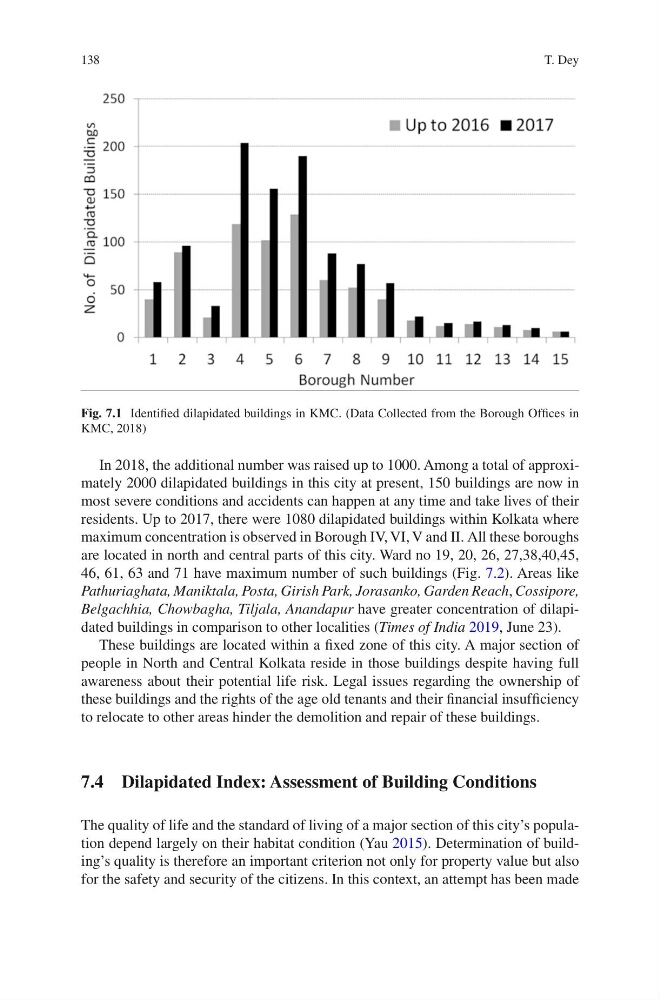
residents. Up to 2017, there were 1080 dilapidated buildings within Kolkata where
maximum concentration is observed in Borough IV, VI, V and II. All these boroughs
are located in north and central parts of this city. Ward no 19, 20, 26, 27,38,40,45,
46, 61, 63 and 71 have maximum number of such buildings (Fig. 7.2). Areas like
Pathuriaghata, Maniktala, Posta, Girish Park, Jorasanko, Garden Reach, Cossipore,
Belgachhia, Chowbagha, Tiljala, Anandapur have greater concentration of dilapidated buildings in comparison to other localities (Times of India 2019, June 23).
These buildings are located within a fixed zone of this city. A major section of
people in North and Central Kolkata reside in those buildings despite having full
awareness about their potential life risk. Legal issues regarding the ownership of
these buildings and the rights of the age old tenants and their financial insufficiency
to relocate to other areas hinder the demolition and repair of these buildings.
7.4 Dilapidated Index: Assessment of Building Conditions
The quality of life and the standard of living of a major section of this city’s population depend largely on their habitat condition (Yau 2015). Determination of building’s quality is therefore an important criterion not only for property value but also
for the safety and security of the citizens. In this context, an attempt has been made
Fig. 7.1 Identified dilapidated buildings in KMC. (Data Collected from the Borough Offices in
KMC, 2018)
T. Dey
In 2018, the additional number was raised up to 1000. Among a total of approximately 2000 dilapidated buildings in this city at present, 150 buildings are now in
most severe conditions and accidents can happen at any time and take lives of their
residents. Up to 2017, there were 1080 dilapidated buildings within Kolkata where
maximum concentration is observed in Borough IV, VI, V and II. All these boroughs
are located in north and central parts of this city. Ward no 19, 20, 26, 27,38,40,45,
46, 61, 63 and 71 have maximum number of such buildings (Fig. 7.2). Areas like
Pathuriaghata, Maniktala, Posta, Girish Park, Jorasanko, Garden Reach, Cossipore,
Belgachhia, Chowbagha, Tiljala, Anandapur have greater concentration of dilapidated buildings in comparison to other localities (Times of India 2019, June 23).
These buildings are located within a fixed zone of this city. A major section of
people in North and Central Kolkata reside in those buildings despite having full
awareness about their potential life risk. Legal issues regarding the ownership of
these buildings and the rights of the age old tenants and their financial insufficiency
to relocate to other areas hinder the demolition and repair of these buildings.
7.4 Dilapidated Index: Assessment of Building Conditions
The quality of life and the standard of living of a major section of this city’s population depend largely on their habitat condition (Yau 2015). Determination of building’s quality is therefore an important criterion not only for property value but also
for the safety and security of the citizens. In this context, an attempt has been made
Fig. 7.1 Identified dilapidated buildings in KMC. (Data Collected from the Borough Offices in
KMC, 2018)
T. Dey