

117
6.2.2 Objectives
This study aimed to quantify the amounts of CO 2 e emissions caused by various
activities directly or indirectly linked with energy consumption and utilization by
households, in order to ascertain the carbon footprint pattern and to examine household CO 2 e emissions relative to household economic status.
6.2.3 Data and Methodology
This study was based on both primary and secondary sources of data. Secondary
data were collected from published and unpublished sources such as the Census of
India, KMC Office, National Atlas and Thematic Mapping Organization (NATMO),
and National Sample Survey Office (NSSO). For the primary data collection, six
sample wards (out of a total of 141 KMC wards) were selected for the field investigation. A total of 432 sample households were surveyed from the six selected wards
(ward numbers 4, 15, 53, 100, 127, and 133), at a 1% sampling rate.
The sample respondents were stratified into income groups: low income (greater
than INR 10,000), middle (INR 10,000–25,000), high (INR 25,000–50,000) and
very high (higher than INR 50,000).
The data were analyzed using regression, a correlation matrix, CO 2 emission
equations, and per capita carbon footprint calculation.
6.2.4 Calculation of the Primary Carbon Footprint
at the Household Level
The household primary carbon footprints in the study area were calculated on the
basis of various sources in the literature and using reported calculation methods
produced by various organizations (country specific and default) (DEFRA 2012,
2017). The IPCC guidelines for calculation of emission factors were used. The total
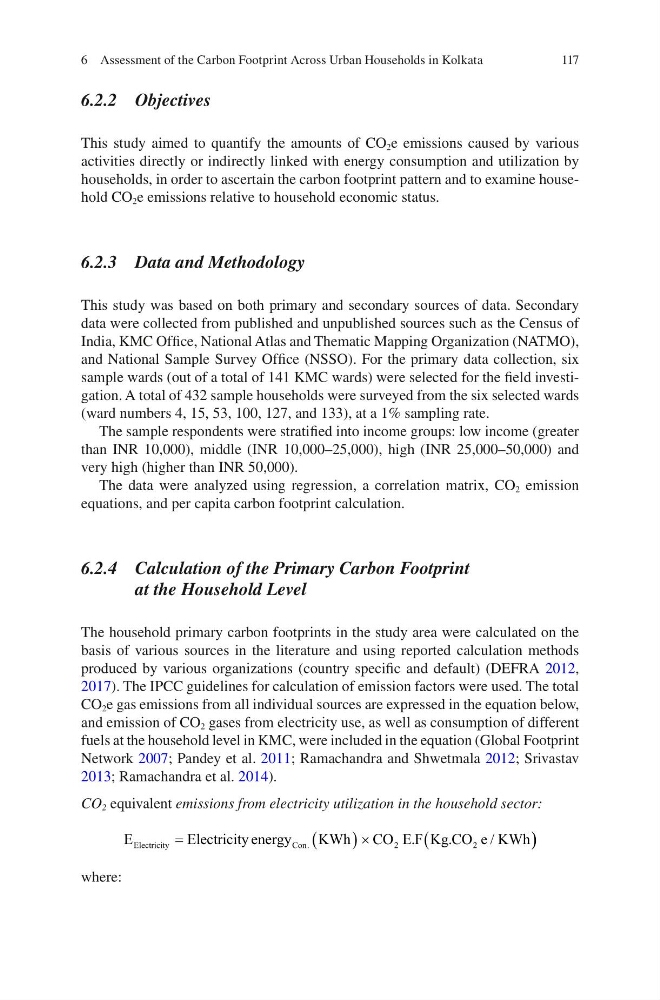
CO 2 e gas emissions from all individual sources are expressed in the equation below,
and emission of CO 2 gases from electricity use, as well as consumption of different
fuels at the household level in KMC, were included in the equation (Global Footprint
Network 2007; Pandey et al. 2011; Ramachandra and Shwetmala 2012; Srivastav
2013; Ramachandra et al. 2014).
CO 2 equivalent emissions from electricity utilization in the household sector:
E
E lectricity energy
KWh CO E F Kg CO e KWh
Electricity
Con
=
(
)×
(
.
.
.
/
2
2
) )
where:
6 Assessment of the Carbon Footprint Across Urban Households in Kolkata
6.2.2 Objectives
This study aimed to quantify the amounts of CO 2 e emissions caused by various
activities directly or indirectly linked with energy consumption and utilization by
households, in order to ascertain the carbon footprint pattern and to examine household CO 2 e emissions relative to household economic status.
6.2.3 Data and Methodology
This study was based on both primary and secondary sources of data. Secondary
data were collected from published and unpublished sources such as the Census of
India, KMC Office, National Atlas and Thematic Mapping Organization (NATMO),
and National Sample Survey Office (NSSO). For the primary data collection, six
sample wards (out of a total of 141 KMC wards) were selected for the field investigation. A total of 432 sample households were surveyed from the six selected wards
(ward numbers 4, 15, 53, 100, 127, and 133), at a 1% sampling rate.
The sample respondents were stratified into income groups: low income (greater
than INR 10,000), middle (INR 10,000–25,000), high (INR 25,000–50,000) and
very high (higher than INR 50,000).
The data were analyzed using regression, a correlation matrix, CO 2 emission
equations, and per capita carbon footprint calculation.
6.2.4 Calculation of the Primary Carbon Footprint
at the Household Level
The household primary carbon footprints in the study area were calculated on the
basis of various sources in the literature and using reported calculation methods
produced by various organizations (country specific and default) (DEFRA 2012,
2017). The IPCC guidelines for calculation of emission factors were used. The total
CO 2 e gas emissions from all individual sources are expressed in the equation below,
and emission of CO 2 gases from electricity use, as well as consumption of different
fuels at the household level in KMC, were included in the equation (Global Footprint
Network 2007; Pandey et al. 2011; Ramachandra and Shwetmala 2012; Srivastav
2013; Ramachandra et al. 2014).
CO 2 equivalent emissions from electricity utilization in the household sector:
E
E lectricity energy
KWh CO E F Kg CO e KWh
Electricity
Con
=
(
)×
(
.
.
.
/
2
2
) )
where:
6 Assessment of the Carbon Footprint Across Urban Households in Kolkata