

96
to check littering on the streets by imposing fine and confirming timely collection of
waste from the households while Panaji municipality maintains a unique way of
source segregation of waste in eight clear streams by reorganizing the management
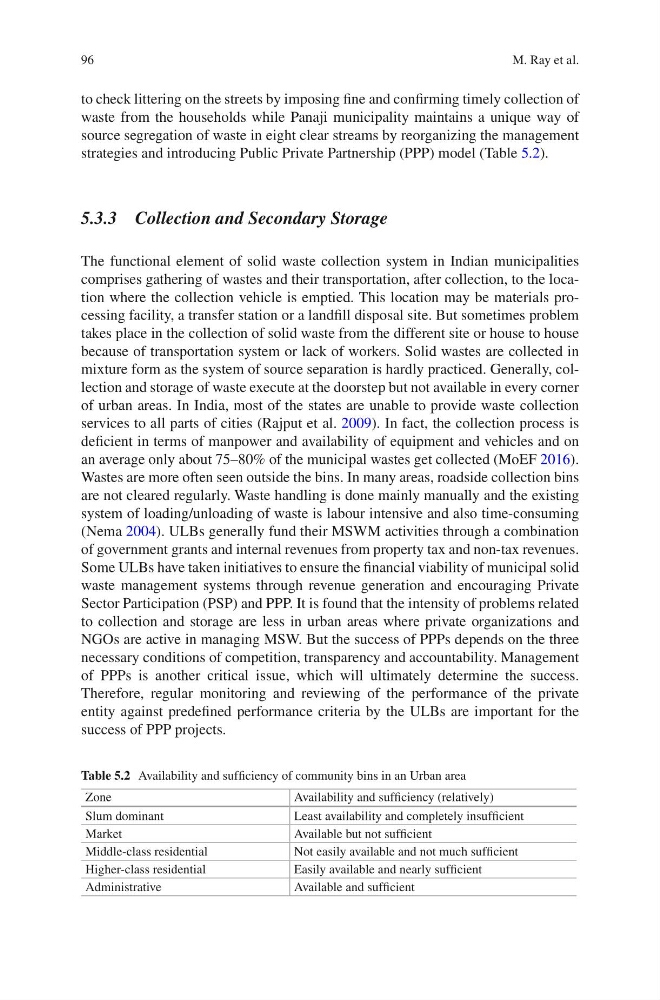
strategies and introducing Public Private Partnership (PPP) model (Table 5.2).
5.3.3 Collection and Secondary Storage
The functional element of solid waste collection system in Indian municipalities
comprises gathering of wastes and their transportation, after collection, to the location where the collection vehicle is emptied. This location may be materials processing facility, a transfer station or a landfill disposal site. But sometimes problem
takes place in the collection of solid waste from the different site or house to house
because of transportation system or lack of workers. Solid wastes are collected in
mixture form as the system of source separation is hardly practiced. Generally, collection and storage of waste execute at the doorstep but not available in every corner
of urban areas. In India, most of the states are unable to provide waste collection
services to all parts of cities (Rajput et al. 2009). In fact, the collection process is
deficient in terms of manpower and availability of equipment and vehicles and on
an average only about 75–80% of the municipal wastes get collected (MoEF 2016).
Wastes are more often seen outside the bins. In many areas, roadside collection bins
are not cleared regularly. Waste handling is done mainly manually and the existing
system of loading/unloading of waste is labour intensive and also time-consuming
(Nema 2004). ULBs generally fund their MSWM activities through a combination
of government grants and internal revenues from property tax and non-tax revenues.
Some ULBs have taken initiatives to ensure the financial viability of municipal solid
waste management systems through revenue generation and encouraging Private
Sector Participation (PSP) and PPP. It is found that the intensity of problems related
to collection and storage are less in urban areas where private organizations and
NGOs are active in managing MSW. But the success of PPPs depends on the three
necessary conditions of competition, transparency and accountability. Management
of PPPs is another critical issue, which will ultimately determine the success.
Therefore, regular monitoring and reviewing of the performance of the private
entity against predefined performance criteria by the ULBs are important for the
success of PPP projects.
Table 5.2 Availability and sufficiency of community bins in an Urban area
Zone
Availability and sufficiency (relatively)
Slum dominant
Least availability and completely insufficient
Market
Available but not sufficient
Middle-class residential
Not easily available and not much sufficient
Higher-class residential
Easily available and nearly sufficient
Administrative
Available and sufficient
M. Ray et al.
to check littering on the streets by imposing fine and confirming timely collection of
waste from the households while Panaji municipality maintains a unique way of
source segregation of waste in eight clear streams by reorganizing the management
strategies and introducing Public Private Partnership (PPP) model (Table 5.2).
5.3.3 Collection and Secondary Storage
The functional element of solid waste collection system in Indian municipalities
comprises gathering of wastes and their transportation, after collection, to the location where the collection vehicle is emptied. This location may be materials processing facility, a transfer station or a landfill disposal site. But sometimes problem
takes place in the collection of solid waste from the different site or house to house
because of transportation system or lack of workers. Solid wastes are collected in
mixture form as the system of source separation is hardly practiced. Generally, collection and storage of waste execute at the doorstep but not available in every corner
of urban areas. In India, most of the states are unable to provide waste collection
services to all parts of cities (Rajput et al. 2009). In fact, the collection process is
deficient in terms of manpower and availability of equipment and vehicles and on
an average only about 75–80% of the municipal wastes get collected (MoEF 2016).
Wastes are more often seen outside the bins. In many areas, roadside collection bins
are not cleared regularly. Waste handling is done mainly manually and the existing
system of loading/unloading of waste is labour intensive and also time-consuming
(Nema 2004). ULBs generally fund their MSWM activities through a combination
of government grants and internal revenues from property tax and non-tax revenues.
Some ULBs have taken initiatives to ensure the financial viability of municipal solid
waste management systems through revenue generation and encouraging Private
Sector Participation (PSP) and PPP. It is found that the intensity of problems related
to collection and storage are less in urban areas where private organizations and
NGOs are active in managing MSW. But the success of PPPs depends on the three
necessary conditions of competition, transparency and accountability. Management
of PPPs is another critical issue, which will ultimately determine the success.
Therefore, regular monitoring and reviewing of the performance of the private
entity against predefined performance criteria by the ULBs are important for the
success of PPP projects.
Table 5.2 Availability and sufficiency of community bins in an Urban area
Zone
Availability and sufficiency (relatively)
Slum dominant
Least availability and completely insufficient
Market
Available but not sufficient
Middle-class residential
Not easily available and not much sufficient
Higher-class residential
Easily available and nearly sufficient
Administrative
Available and sufficient
M. Ray et al.