

95
in India is lower than the many low-income countries in other parts of the world and
much lower compared to developed countries (Asnani 2006). Changing lifestyle,
especially in the larger cities generate more of packaging material and per capita
waste generation, is increasing by about 1.3% per year in India (Annepu 2012).
Physical and chemical characteristics of solid wastes in Indian cities vary depending
on population size and geographical location. Although the composition of urban
waste is changing with increasing use of packaging material and plastics, yet, as
compared to developed countries, Indian solid waste still comprises mostly of
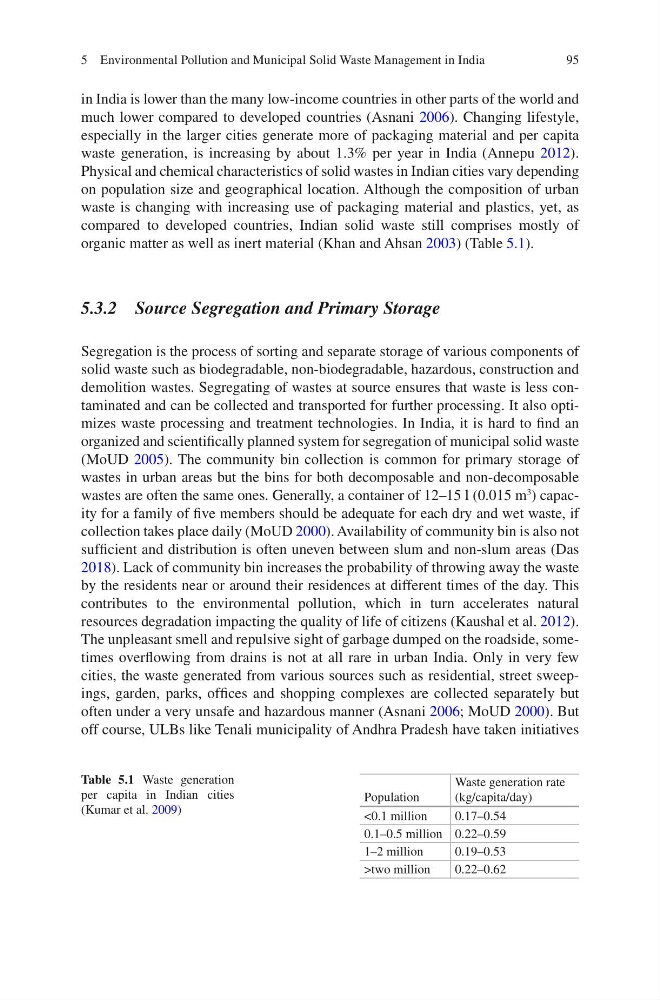
organic matter as well as inert material (Khan and Ahsan 2003) (Table 5.1).
5.3.2 Source Segregation and Primary Storage
Segregation is the process of sorting and separate storage of various components of
solid waste such as biodegradable, non-biodegradable, hazardous, construction and
demolition wastes. Segregating of wastes at source ensures that waste is less contaminated and can be collected and transported for further processing. It also optimizes waste processing and treatment technologies. In India, it is hard to find an
organized and scientifically planned system for segregation of municipal solid waste
(MoUD 2005). The community bin collection is common for primary storage of
wastes in urban areas but the bins for both decomposable and non-decomposable
wastes are often the same ones. Generally, a container of 12–15 l (0.015 m
3
) capacity for a family of five members should be adequate for each dry and wet waste, if
collection takes place daily (MoUD 2000). Availability of community bin is also not
sufficient and distribution is often uneven between slum and non-slum areas (Das
2018). Lack of community bin increases the probability of throwing away the waste
by the residents near or around their residences at different times of the day. This
contributes to the environmental pollution, which in turn accelerates natural
resources degradation impacting the quality of life of citizens (Kaushal et al. 2012).
The unpleasant smell and repulsive sight of garbage dumped on the roadside, sometimes overflowing from drains is not at all rare in urban India. Only in very few
cities, the waste generated from various sources such as residential, street sweepings, garden, parks, offices and shopping complexes are collected separately but
often under a very unsafe and hazardous manner (Asnani 2006; MoUD 2000). But
off course, ULBs like Tenali municipality of Andhra Pradesh have taken initiatives
Table 5.1 Waste generation
per capita in Indian cities
(Kumar et al. 2009)
Population
Waste generation rate
(kg/capita/day)
<0.1 million
0.17–0.54
0.1–0.5 million 0.22–0.59
1–2 million
0.19–0.53
>two million
0.22–0.62
5 Environmental Pollution and Municipal Solid Waste Management in India
in India is lower than the many low-income countries in other parts of the world and
much lower compared to developed countries (Asnani 2006). Changing lifestyle,
especially in the larger cities generate more of packaging material and per capita
waste generation, is increasing by about 1.3% per year in India (Annepu 2012).
Physical and chemical characteristics of solid wastes in Indian cities vary depending
on population size and geographical location. Although the composition of urban
waste is changing with increasing use of packaging material and plastics, yet, as
compared to developed countries, Indian solid waste still comprises mostly of
organic matter as well as inert material (Khan and Ahsan 2003) (Table 5.1).
5.3.2 Source Segregation and Primary Storage
Segregation is the process of sorting and separate storage of various components of
solid waste such as biodegradable, non-biodegradable, hazardous, construction and
demolition wastes. Segregating of wastes at source ensures that waste is less contaminated and can be collected and transported for further processing. It also optimizes waste processing and treatment technologies. In India, it is hard to find an
organized and scientifically planned system for segregation of municipal solid waste
(MoUD 2005). The community bin collection is common for primary storage of
wastes in urban areas but the bins for both decomposable and non-decomposable
wastes are often the same ones. Generally, a container of 12–15 l (0.015 m
3
) capacity for a family of five members should be adequate for each dry and wet waste, if
collection takes place daily (MoUD 2000). Availability of community bin is also not
sufficient and distribution is often uneven between slum and non-slum areas (Das
2018). Lack of community bin increases the probability of throwing away the waste
by the residents near or around their residences at different times of the day. This
contributes to the environmental pollution, which in turn accelerates natural
resources degradation impacting the quality of life of citizens (Kaushal et al. 2012).
The unpleasant smell and repulsive sight of garbage dumped on the roadside, sometimes overflowing from drains is not at all rare in urban India. Only in very few
cities, the waste generated from various sources such as residential, street sweepings, garden, parks, offices and shopping complexes are collected separately but
often under a very unsafe and hazardous manner (Asnani 2006; MoUD 2000). But
off course, ULBs like Tenali municipality of Andhra Pradesh have taken initiatives
Table 5.1 Waste generation
per capita in Indian cities
(Kumar et al. 2009)
Population
Waste generation rate
(kg/capita/day)
<0.1 million
0.17–0.54
0.1–0.5 million 0.22–0.59
1–2 million
0.19–0.53
>two million
0.22–0.62
5 Environmental Pollution and Municipal Solid Waste Management in India