

81
maps below show the landuse and land cover changes in 1990, 2008 and 2018
(Figs. 4.4, 4.5 and 4.6 and Table 4.1).
Asian elephant populations have been confined to smaller habitat patches due to
increased fragmentation of their available habitats. Poaching for ivory has led to the
depletion of the number of tuskers that has altered their sex ratio considerably (Easa
2017). Traditional movement paths of elephants have been lost due to various developmental activities and the resulting biotic pressure has degraded elephant habitats
and increased human-elephant conflict, which has led to the loss of both human and
elephant lives (Easa 2017). Habitat fragmentation and degradation are the alarming
threats along with the changing climate that has led to species isolation and their
extinction (Dennis et al. 2013). Habitat fragmentation eventually causes decrease in
the surface area of the habitat patches that makes them suffer the adverse impacts of
edge effect including noise from adjacent roads and surface runoff of pesticides
from agricultural fields (Lemming 2016). Habitat fragmentation also leads to reduction of the landscape connectivity that leads to the loss of the species’ ability for
dispersion, foraging and migration (Sahana and Sajjad, 2019; Lemming 2016).
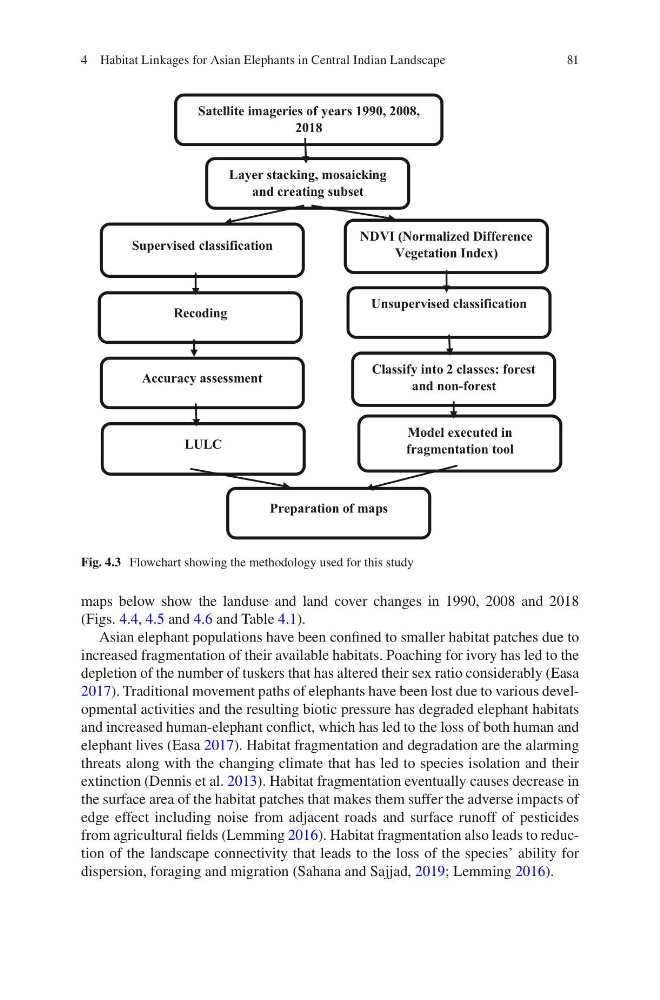
Satellite imageries of years 1990, 2008,
2018
Layer stacking, mosaicking
and creating subset
Accuracy assessment
NDVI (Normalized Difference
Vegetation Index)
Supervised classification
Recoding
LULC
Unsupervised classification
Classify into 2 classes: forest
and non-forest
Model executed in
fragmentation tool
Preparation of maps
Fig. 4.3 Flowchart showing the methodology used for this study
4 Habitat Linkages for Asian Elephants in Central Indian Landscape
maps below show the landuse and land cover changes in 1990, 2008 and 2018
(Figs. 4.4, 4.5 and 4.6 and Table 4.1).
Asian elephant populations have been confined to smaller habitat patches due to
increased fragmentation of their available habitats. Poaching for ivory has led to the
depletion of the number of tuskers that has altered their sex ratio considerably (Easa
2017). Traditional movement paths of elephants have been lost due to various developmental activities and the resulting biotic pressure has degraded elephant habitats
and increased human-elephant conflict, which has led to the loss of both human and
elephant lives (Easa 2017). Habitat fragmentation and degradation are the alarming
threats along with the changing climate that has led to species isolation and their
extinction (Dennis et al. 2013). Habitat fragmentation eventually causes decrease in
the surface area of the habitat patches that makes them suffer the adverse impacts of
edge effect including noise from adjacent roads and surface runoff of pesticides
from agricultural fields (Lemming 2016). Habitat fragmentation also leads to reduction of the landscape connectivity that leads to the loss of the species’ ability for
dispersion, foraging and migration (Sahana and Sajjad, 2019; Lemming 2016).
Satellite imageries of years 1990, 2008,
2018
Layer stacking, mosaicking
and creating subset
Accuracy assessment
NDVI (Normalized Difference
Vegetation Index)
Supervised classification
Recoding
LULC
Unsupervised classification
Classify into 2 classes: forest
and non-forest
Model executed in
fragmentation tool
Preparation of maps
Fig. 4.3 Flowchart showing the methodology used for this study
4 Habitat Linkages for Asian Elephants in Central Indian Landscape