

imprisonment. The majority of the country’s newspapers conform to the official line of
the government, and opposition newspapers have been seized. 2 The Internet is also
heavily regulated and perceived as a potential threat to the stability and security of
the country. 3 There are also instances of banning foreign publications for publishing
content that is deemed prejudicial to Islam. 4
Internet in Tunisia
Tunisia has one of the most developed telecommunications infrastructures in North
Africa, with a high mobile penetration rate and one of the lowest broadband prices in
Africa. 5 As of October 2008, the number of GSM subscribers had reached 9 million,
while the number of Internet users was 1.7 million, 114,000 of whom have broadband
subscriptions. 6 Out of a population of 10.2 million, nine out of ten Tunisians own a
cell phone. 7 Of the Internet users, 84 percent access the Internet at home, 75.8 percent
use it at work, and 24 percent use Internet cafe ´s. 8
The Tunisian Ministry of Communications established the Tunisian Internet Agency
(ATI) to regulate the country’s Internet and DNS services, which had formerly fallen
under the purview of the Regional Institute for Computer Sciences and Telecommunications (IRSIT). 9 The ATI is also the gateway from which all of Tunisia’s 11 ISPs lease
their bandwidth. 10 Six of these ISPs are public (ATI, INBMI, CCK, CIMSP, IRESA, and
Defense’s ISP); the other five—Planet Tunisie, 3S Global Net, HEXABYTE, TopNet, and
TUNET—are private. 11
The government has made concentrated efforts to spread Internet access. The ATI
reports connectivity of 100 percent for the education sector (universities, research laboratories, secondary schools, and primary schools). 12 Government-brokered ‘‘free
Internet’’ programs that provide Web access for the price of a local telephone call and
increased competition among ISPs have significantly reduced the economic barriers to
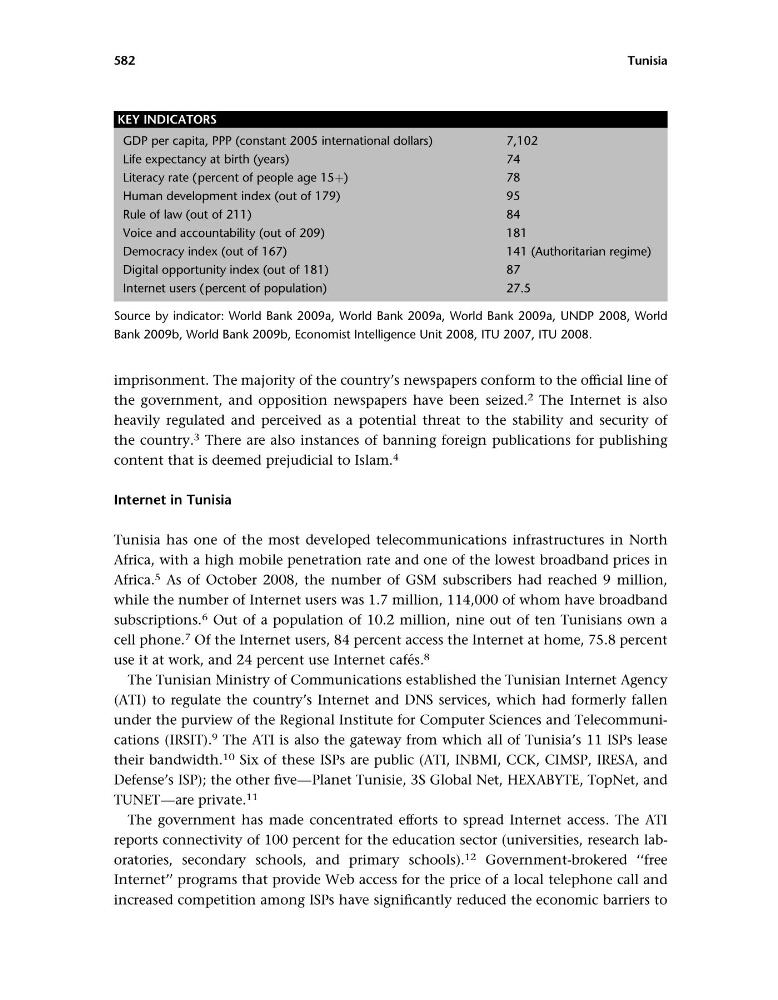
KEY INDICATORS
GDP per capita, PPP (constant 2005 international dollars)
7,102
Life expectancy at birth (years)
74
Literacy rate (percent of people age 15þ)7 8
Human development index (out of 179)
95
Rule of law (out of 211)
84
Voice and accountability (out of 209)
181
Democracy index (out of 167)
141 (Authoritarian regime)
Digital opportunity index (out of 181)
87
Internet users (percent of population)
27.5
Source by indicator: World Bank 2009a, World Bank 2009a, World Bank 2009a, UNDP 2008, World
Bank 2009b, World Bank 2009b, Economist Intelligence Unit 2008, ITU 2007, ITU 2008.
582
Tunisia