

have been arrested for interviewing exiled regime opponents, participating in conferences abroad, and criticizing government policies. 5 In 2006, Reporters Without Borders
ranked Syria among the 13 ‘‘enemies of the Internet,’’ 6 and in 2007 described Syria as
the biggest prison for cyber dissidents in the Middle East because of the number of
arrests and the frequency of mistreatment of online activists. 7 In 2009, the Committee
to Protect Journalists ranked Syria third in a list of the ten worst countries in which to
be a blogger, given the arrests, harassment, and restrictions that online writers in Syria
have faced. 8
The government admits to censoring ‘‘pro-Israel and hyper-Islamist’’ Web sites, such
as those run by the illegal Muslim Brotherhood and those calling for autonomy for
Syrian Kurds. 9 In defense of these practices, former Minister of Technology and Communications Amr Salem has said that ‘‘Syria is currently under attack . . . and if somebody writes, or publishes or whatever, something that supports the attack, they will
be tried.’’ 10
Internet in Syria
The telecommunications market in Syria is the most regulated in the Middle East and is
among the least developed. State-owned Syrian Telecom (STE) owns all telecommunications infrastructure and has made some substantial investment to bring services to
rural areas, but limited competition exists with private ISPs competing with STE in the
Internet provision market. 11
A government body that is part of the Ministry of Telecommunications and Technology, STE is also the regulator of telecommunications in Syria; in addition to being
an ISP, it enjoys a monopoly over wired and wireless services provided anywhere in
Syria. 12 Telecom providers in Syria include Syriatel, 13 MTN, 14 Aya, 15 and SCS-Net,
which is the ISP arm of the Syrian Computer Society. 16 Additionally, MTN and Syriatel
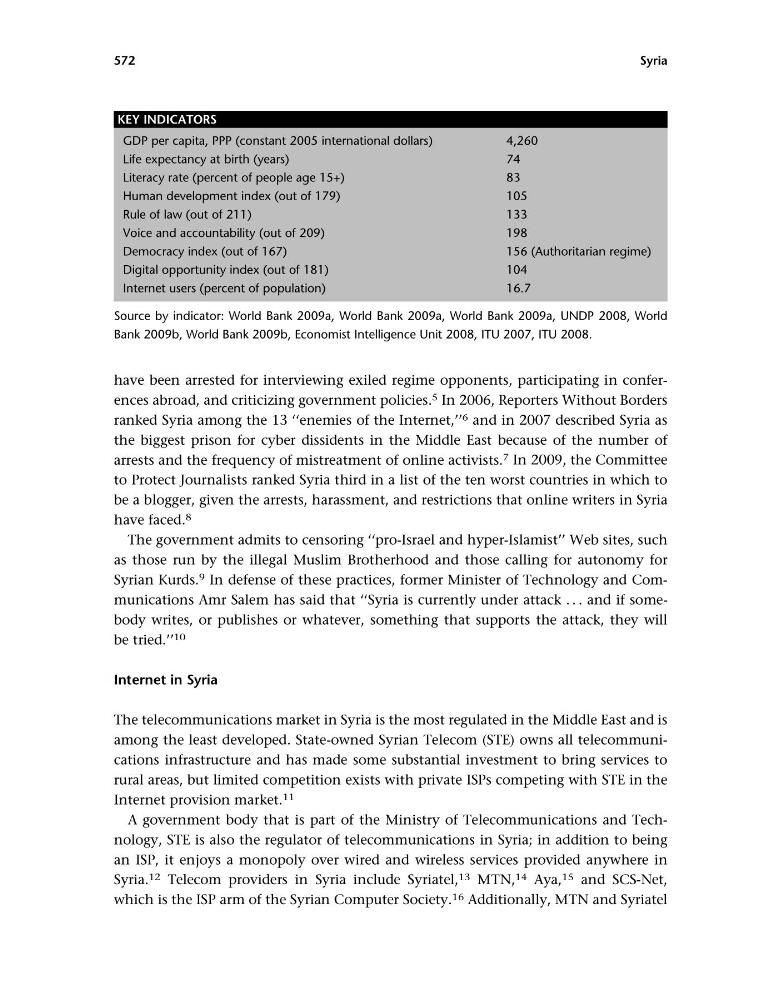
KEY INDICATORS
GDP per capita, PPP (constant 2005 international dollars)
4,260
Life expectancy at birth (years)
74
Literacy rate (percent of people age 15+)
83
Human development index (out of 179)
105
Rule of law (out of 211)
133
Voice and accountability (out of 209)
198
Democracy index (out of 167)
156 (Authoritarian regime)
Digital opportunity index (out of 181)
104
Internet users (percent of population)
16.7
Source by indicator: World Bank 2009a, World Bank 2009a, World Bank 2009a, UNDP 2008, World
Bank 2009b, World Bank 2009b, Economist Intelligence Unit 2008, ITU 2007, ITU 2008.
572
Syria