

Syria
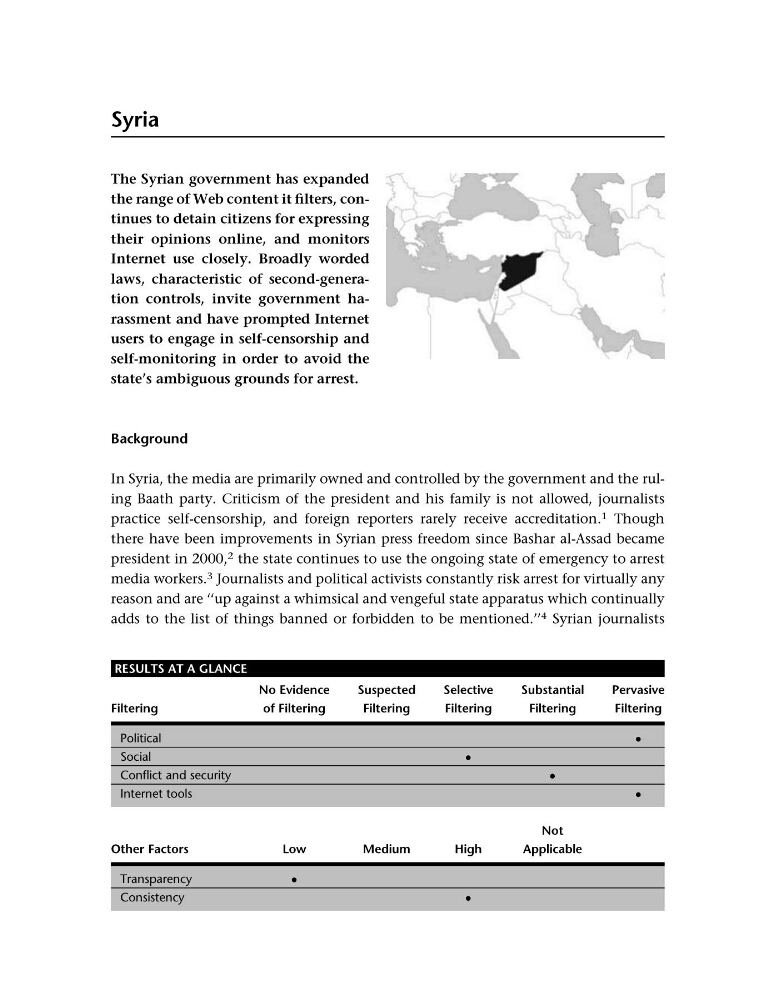
The Syrian government has expanded
the range of Web content it filters, continues to detain citizens for expressing
their opinions online, and monitors
Internet use closely. Broadly worded
laws, characteristic of second-generation controls, invite government harassment and have prompted Internet
users to engage in self-censorship and
self-monitoring in order to avoid the
state’s ambiguous grounds for arrest.
Background
In Syria, the media are primarily owned and controlled by the government and the ruling Baath party. Criticism of the president and his family is not allowed, journalists
practice self-censorship, and foreign reporters rarely receive accreditation. 1 Though
there have been improvements in Syrian press freedom since Bashar al-Assad became
president in 2000, 2 the state continues to use the ongoing state of emergency to arrest
media workers. 3 Journalists and political activists constantly risk arrest for virtually any
reason and are ‘‘up against a whimsical and vengeful state apparatus which continually
adds to the list of things banned or forbidden to be mentioned.’’ 4 Syrian journalists
RESULTS AT A GLANCE
Filtering
No Evidence
of Filtering
Suspected
Filtering
Selective
Filtering
Substantial
Filtering
Pervasive
Filtering
Political
Social
Conflict and security
Internet tools
Other Factors
Low
Medium
High
Not
Applicable
Transparency
Consistency