

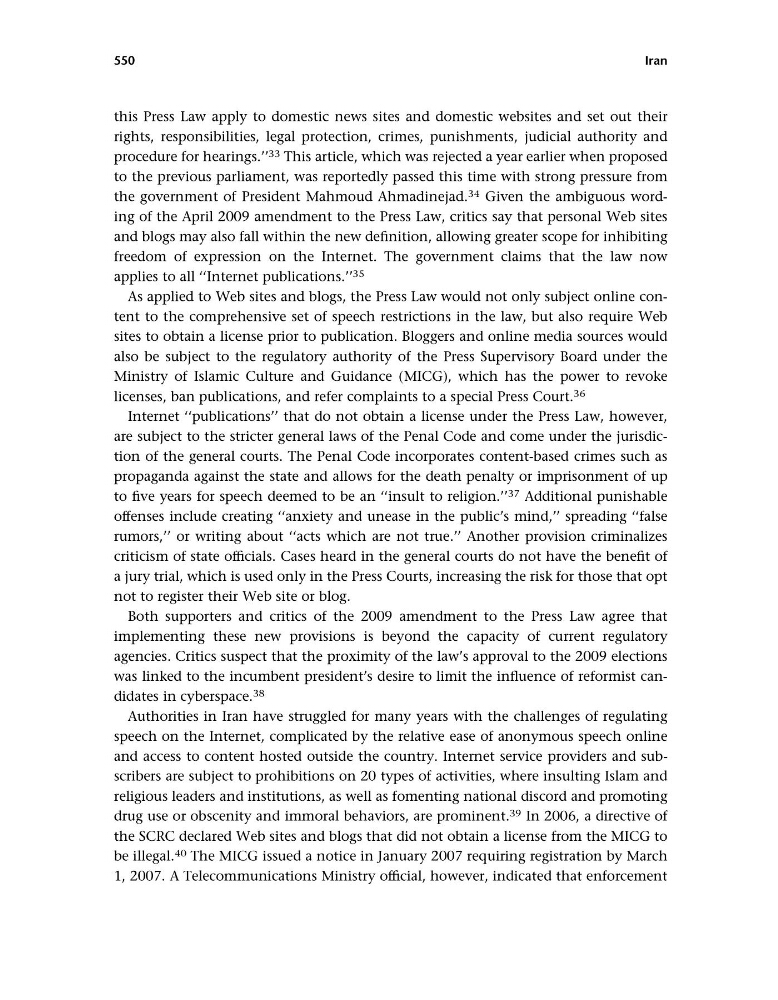
this Press Law apply to domestic news sites and domestic websites and set out their
rights, responsibilities, legal protection, crimes, punishments, judicial authority and
procedure for hearings.’’ 33 This article, which was rejected a year earlier when proposed
to the previous parliament, was reportedly passed this time with strong pressure from
the government of President Mahmoud Ahmadinejad. 34 Given the ambiguous wording of the April 2009 amendment to the Press Law, critics say that personal Web sites
and blogs may also fall within the new definition, allowing greater scope for inhibiting
freedom of expression on the Internet. The government claims that the law now
applies to all ‘‘Internet publications.’’ 35
As applied to Web sites and blogs, the Press Law would not only subject online content to the comprehensive set of speech restrictions in the law, but also require Web
sites to obtain a license prior to publication. Bloggers and online media sources would
also be subject to the regulatory authority of the Press Supervisory Board under the
Ministry of Islamic Culture and Guidance (MICG), which has the power to revoke
licenses, ban publications, and refer complaints to a special Press Court. 36
Internet ‘‘publications’’ that do not obtain a license under the Press Law, however,
are subject to the stricter general laws of the Penal Code and come under the jurisdiction of the general courts. The Penal Code incorporates content-based crimes such as
propaganda against the state and allows for the death penalty or imprisonment of up
to five years for speech deemed to be an ‘‘insult to religion.’’ 37 Additional punishable
offenses include creating ‘‘anxiety and unease in the public’s mind,’’ spreading ‘‘false
rumors,’’ or writing about ‘‘acts which are not true.’’ Another provision criminalizes
criticism of state officials. Cases heard in the general courts do not have the benefit of
a jury trial, which is used only in the Press Courts, increasing the risk for those that opt
not to register their Web site or blog.
Both supporters and critics of the 2009 amendment to the Press Law agree that
implementing these new provisions is beyond the capacity of current regulatory
agencies. Critics suspect that the proximity of the law’s approval to the 2009 elections
was linked to the incumbent president’s desire to limit the influence of reformist candidates in cyberspace. 38
Authorities in Iran have struggled for many years with the challenges of regulating
speech on the Internet, complicated by the relative ease of anonymous speech online
and access to content hosted outside the country. Internet service providers and subscribers are subject to prohibitions on 20 types of activities, where insulting Islam and
religious leaders and institutions, as well as fomenting national discord and promoting
drug use or obscenity and immoral behaviors, are prominent. 39 In 2006, a directive of
the SCRC declared Web sites and blogs that did not obtain a license from the MICG to
be illegal. 40 The MICG issued a notice in January 2007 requiring registration by March
1, 2007. A Telecommunications Ministry official, however, indicated that enforcement
550
Iran