

levels of Internet penetration in the region. This latter explanation, which suggests
that the RUNET in these counties has not become the locus for informal networks
that it has in some of the less authoritarian countries, may make it more vulnerable
and a target for filtering controls than what would be the case elsewhere in the CIS
where the RUNET is more central to the political mainstream. In this respect, the maturity of the network itself seems to influence the degree to which filtering controls
will be applied. This observation begs the obvious question—will the RUNET remain
open even as countries in the CIS slide toward a new authoritarianism?
While the possibility of greater direct content controls being applied in the RUNET
certainly exists, there is a far greater potential that information controls will continue
to evolve along the evolutionary trajectory, toward strategies that seek to compete, engage, and dominate opponents in the informational battle space through persistent
messaging, disinformation, intimidation, and other tactics designed to divide, confuse,
and disable. In this respect, the patterns of information control in the CIS may in fact
represent a model that will evolve elsewhere as governments are faced with the choice
of imposing harsh controls and being labeled pariahs or doing nothing and risking
that the technologies could become enablers of hyperdemocracy and undesired regime
change.
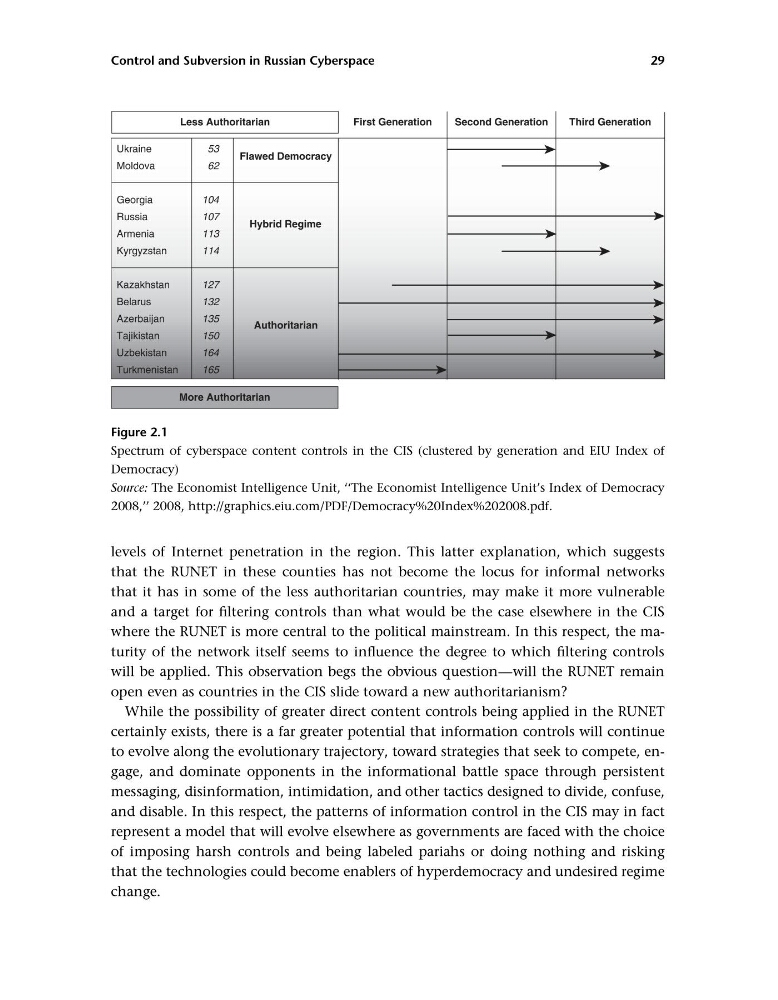
Figure 2.1
Spectrum of cyberspace content controls in the CIS (clustered by generation and EIU Index of
Democracy)
Source: The Economist Intelligence Unit, ‘‘The Economist Intelligence Unit’s Index of Democracy
2008,’’ 2008, http://graphics.eiu.com/PDF/Democracy%20Index%202008.pdf.
Control and Subversion in Russian Cyberspace
29
that the RUNET in these counties has not become the locus for informal networks
that it has in some of the less authoritarian countries, may make it more vulnerable
and a target for filtering controls than what would be the case elsewhere in the CIS
where the RUNET is more central to the political mainstream. In this respect, the maturity of the network itself seems to influence the degree to which filtering controls
will be applied. This observation begs the obvious question—will the RUNET remain
open even as countries in the CIS slide toward a new authoritarianism?
While the possibility of greater direct content controls being applied in the RUNET
certainly exists, there is a far greater potential that information controls will continue
to evolve along the evolutionary trajectory, toward strategies that seek to compete, engage, and dominate opponents in the informational battle space through persistent
messaging, disinformation, intimidation, and other tactics designed to divide, confuse,
and disable. In this respect, the patterns of information control in the CIS may in fact
represent a model that will evolve elsewhere as governments are faced with the choice
of imposing harsh controls and being labeled pariahs or doing nothing and risking
that the technologies could become enablers of hyperdemocracy and undesired regime
change.
Figure 2.1
Spectrum of cyberspace content controls in the CIS (clustered by generation and EIU Index of
Democracy)
Source: The Economist Intelligence Unit, ‘‘The Economist Intelligence Unit’s Index of Democracy
2008,’’ 2008, http://graphics.eiu.com/PDF/Democracy%20Index%202008.pdf.
Control and Subversion in Russian Cyberspace
29