

him overwhelmingly. On a few occasions, the government has resorted to the use of
force in order to maintain its control over the country. One such occasion were the
events in Andijan in 2005 when hundreds of civilians were killed. 1 During the clampdown that followed the public demonstrations, most of the foreign media were expelled from the country. The majority of human rights organizations were ousted and
their activities banned. 2
During his extended authoritarian rule, President Karimov has demonstrated an
active commitment to controlling the information environment in the country and
constraining the expression of dissident viewpoints. The active opposition has been
forced to leave Uzbekistan and has been banned. 3 The Internet often remains the
only way for the opposition to communicate with Uzbek society. In 2004, Internews
International—a nonprofit organization that supports open media and Internet development worldwide—was banned from Uzbekistan. 4
In the beginning of October 2008, an unprecedented two-day media seminar in
Tashkent focused on freedom of speech in the country. The government did not allow
foreign media and independent Uzbek journalists to cover this seminar. The only
media admitted were representatives of the state-controlled electronic and print media.
The complex laws and regulations in Uzbekistan have resulted in self-censorship of
online publishers, independent journalists, and bloggers. This self-censorship, coupled
with a highly sophisticated Internet filtering regime, significantly stifles public discourse on political and human-rights topics.
State control of the Internet stands in stark contrast to the government’s official
enthusiasm for promoting ICTs. Until 2001, Uzbekistan was a regional leader in the
adoption of the Internet and the prioritization of ICT as a mechanism for national
development. Uzbekistan was among the first of the post-Soviet republics to establish
a national agency responsible for ICT development (UzInfoCom), to contribute state
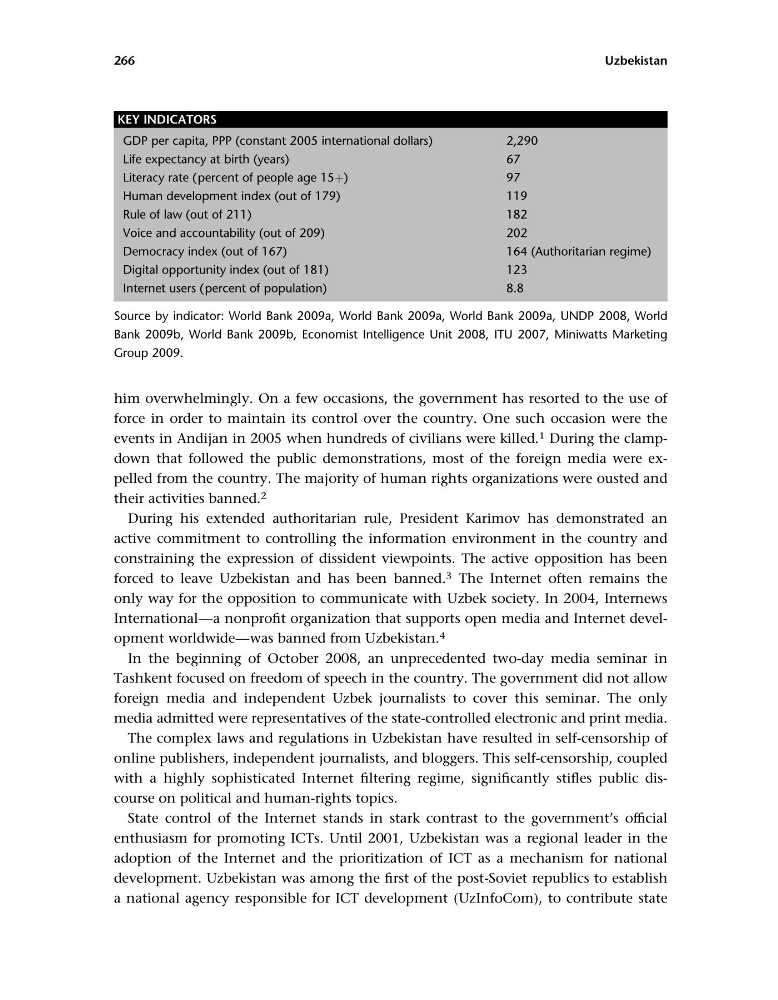
KEY INDICATORS
GDP per capita, PPP (constant 2005 international dollars)
2,290
Life expectancy at birth (years)
67
Literacy rate (percent of people age 15þ)9 7
Human development index (out of 179)
119
Rule of law (out of 211)
182
Voice and accountability (out of 209)
202
Democracy index (out of 167)
164 (Authoritarian regime)
Digital opportunity index (out of 181)
123
Internet users (percent of population)
8.8
Source by indicator: World Bank 2009a, World Bank 2009a, World Bank 2009a, UNDP 2008, World
Bank 2009b, World Bank 2009b, Economist Intelligence Unit 2008, ITU 2007, Miniwatts Marketing
Group 2009.
266
Uzbekistan
force in order to maintain its control over the country. One such occasion were the
events in Andijan in 2005 when hundreds of civilians were killed. 1 During the clampdown that followed the public demonstrations, most of the foreign media were expelled from the country. The majority of human rights organizations were ousted and
their activities banned. 2
During his extended authoritarian rule, President Karimov has demonstrated an
active commitment to controlling the information environment in the country and
constraining the expression of dissident viewpoints. The active opposition has been
forced to leave Uzbekistan and has been banned. 3 The Internet often remains the
only way for the opposition to communicate with Uzbek society. In 2004, Internews
International—a nonprofit organization that supports open media and Internet development worldwide—was banned from Uzbekistan. 4
In the beginning of October 2008, an unprecedented two-day media seminar in
Tashkent focused on freedom of speech in the country. The government did not allow
foreign media and independent Uzbek journalists to cover this seminar. The only
media admitted were representatives of the state-controlled electronic and print media.
The complex laws and regulations in Uzbekistan have resulted in self-censorship of
online publishers, independent journalists, and bloggers. This self-censorship, coupled
with a highly sophisticated Internet filtering regime, significantly stifles public discourse on political and human-rights topics.
State control of the Internet stands in stark contrast to the government’s official
enthusiasm for promoting ICTs. Until 2001, Uzbekistan was a regional leader in the
adoption of the Internet and the prioritization of ICT as a mechanism for national
development. Uzbekistan was among the first of the post-Soviet republics to establish
a national agency responsible for ICT development (UzInfoCom), to contribute state
KEY INDICATORS
GDP per capita, PPP (constant 2005 international dollars)
2,290
Life expectancy at birth (years)
67
Literacy rate (percent of people age 15þ)9 7
Human development index (out of 179)
119
Rule of law (out of 211)
182
Voice and accountability (out of 209)
202
Democracy index (out of 167)
164 (Authoritarian regime)
Digital opportunity index (out of 181)
123
Internet users (percent of population)
8.8
Source by indicator: World Bank 2009a, World Bank 2009a, World Bank 2009a, UNDP 2008, World
Bank 2009b, World Bank 2009b, Economist Intelligence Unit 2008, ITU 2007, Miniwatts Marketing
Group 2009.
266
Uzbekistan