

Uzbekistan
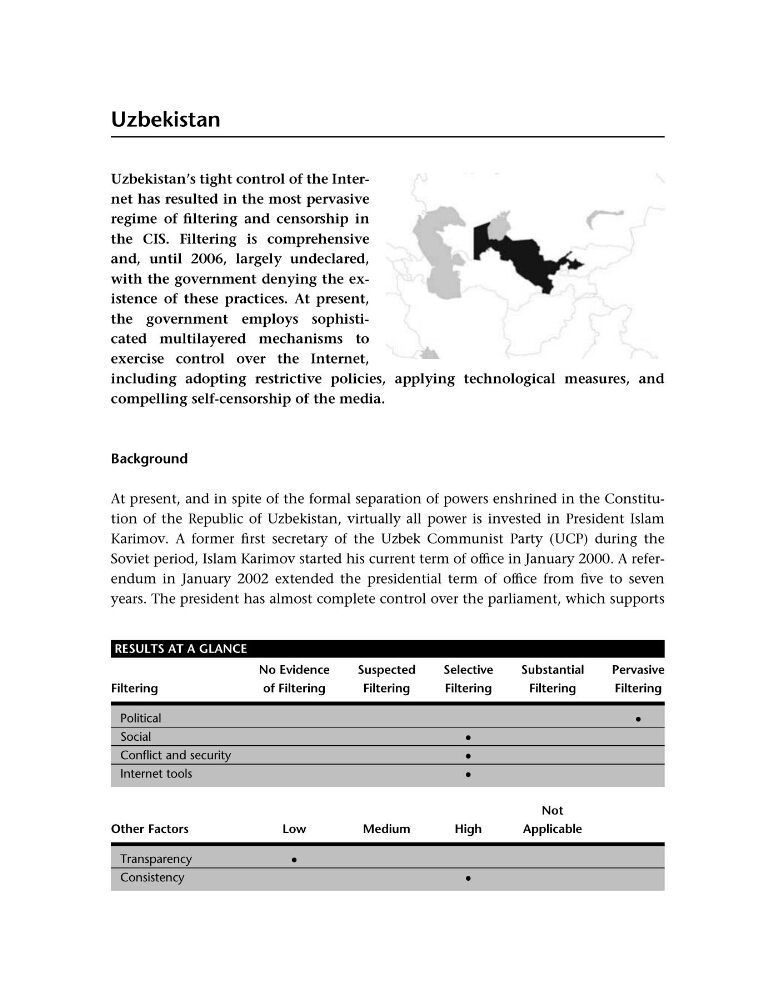
Uzbekistan’s tight control of the Internet has resulted in the most pervasive
regime of filtering and censorship in
the CIS. Filtering is comprehensive
and, until 2006, largely undeclared,
with the government denying the existence of these practices. At present,
the government employs sophisticated multilayered mechanisms to
exercise control over the Internet,
including adopting restrictive policies, applying technological measures, and
compelling self-censorship of the media.
Background
At present, and in spite of the formal separation of powers enshrined in the Constitution of the Republic of Uzbekistan, virtually all power is invested in President Islam
Karimov. A former first secretary of the Uzbek Communist Party (UCP) during the
Soviet period, Islam Karimov started his current term of office in January 2000. A referendum in January 2002 extended the presidential term of office from five to seven
years. The president has almost complete control over the parliament, which supports
RESULTS AT A GLANCE
Filtering
No Evidence
of Filtering
Suspected
Filtering
Selective
Filtering
Substantial
Filtering
Pervasive
Filtering
Political
Social
Conflict and security
Internet tools
Other Factors
Low
Medium
High
Not
Applicable
Transparency
Consistency
Uzbekistan’s tight control of the Internet has resulted in the most pervasive
regime of filtering and censorship in
the CIS. Filtering is comprehensive
and, until 2006, largely undeclared,
with the government denying the existence of these practices. At present,
the government employs sophisticated multilayered mechanisms to
exercise control over the Internet,
including adopting restrictive policies, applying technological measures, and
compelling self-censorship of the media.
Background
At present, and in spite of the formal separation of powers enshrined in the Constitution of the Republic of Uzbekistan, virtually all power is invested in President Islam
Karimov. A former first secretary of the Uzbek Communist Party (UCP) during the
Soviet period, Islam Karimov started his current term of office in January 2000. A referendum in January 2002 extended the presidential term of office from five to seven
years. The president has almost complete control over the parliament, which supports
RESULTS AT A GLANCE
Filtering
No Evidence
of Filtering
Suspected
Filtering
Selective
Filtering
Substantial
Filtering
Pervasive
Filtering
Political
Social
Conflict and security
Internet tools
Other Factors
Low
Medium
High
Not
Applicable
Transparency
Consistency