

Government claims of an improving economic and political situation and investor
confidence in the telecommunications and Internet market 4 are difficult to substantiate
given that the majority of the population live below the poverty line. 5 The unemployment rate is high, and remittances from economic migrants form the backbone of the
economy. According to World Bank statistics, in 2008 Tajikistan received USD 1.25 billion in remittances from workers abroad, while unofficial sources claim that this figure
amounts to 60 percent of the country’s GDP. 6
Opposition parties are only beginning to explore the Internet’s potential, in part
owing to the low levels of Internet penetration throughout the country. None of the
registered opposition parties have domain names registered in the ‘‘.tj’’ Internet zone,
and only one party has its Web site available in Tajik. 7
Internet in Tajikistan
The Internet in Tajikistan emerged as the country was ending a bloody civil war that
followed the demise of Soviet rule in the early 1990s. The resulting fragmentation of
power also meant that Internet services developed largely without state interference
and the Ministry of Transport and Communications played a weak role in the development of the sector as a whole. Telecommunications remained fragmented up until the
end of the 1990s, with several companies failing to interconnect because of fierce (and
at times violent and armed) competition. During this period of instability, ISPs were
aligned with feuding political and criminal interests that spilled over to the competition among the ISPs themselves.
Since the end of the civil war, the government has taken steps to attract investors
and liberalize the sector prompted by expectations of accession to the WTO. However,
important steps are still pending, such as the privatization of Tajiktelecom (the naKEY INDICATORS
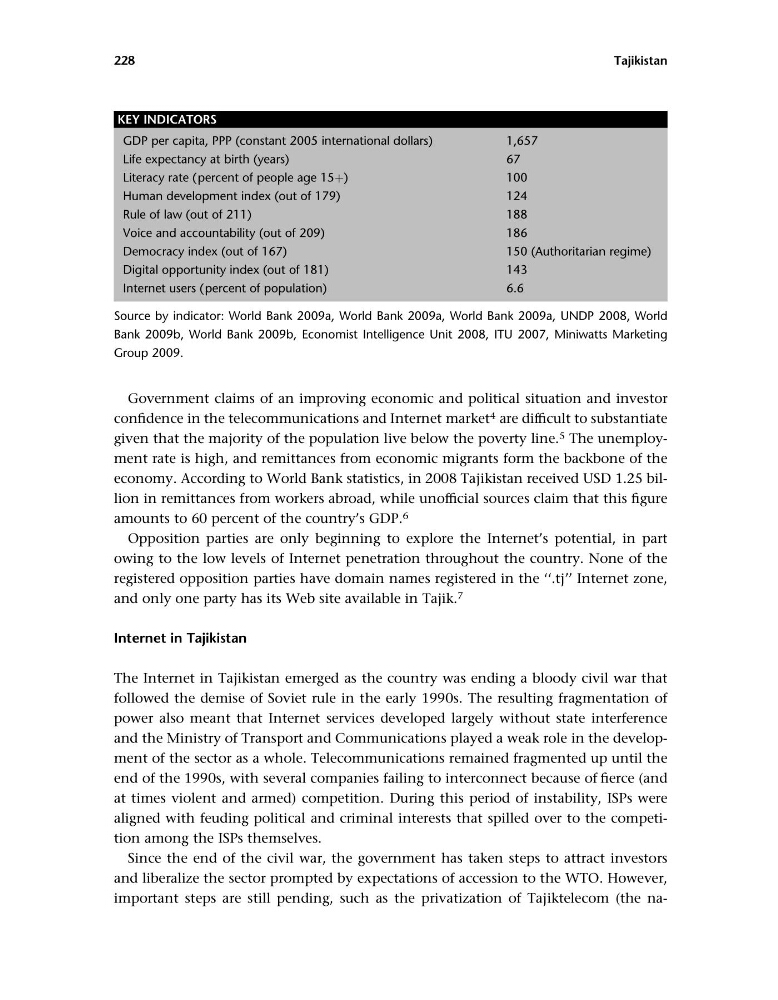
GDP per capita, PPP (constant 2005 international dollars)
1,657
Life expectancy at birth (years)
67
Literacy rate (percent of people age 15þ)
100
Human development index (out of 179)
124
Rule of law (out of 211)
188
Voice and accountability (out of 209)
186
Democracy index (out of 167)
150 (Authoritarian regime)
Digital opportunity index (out of 181)
143
Internet users (percent of population)
6.6
Source by indicator: World Bank 2009a, World Bank 2009a, World Bank 2009a, UNDP 2008, World
Bank 2009b, World Bank 2009b, Economist Intelligence Unit 2008, ITU 2007, Miniwatts Marketing
Group 2009.
228
Tajikistan
confidence in the telecommunications and Internet market 4 are difficult to substantiate
given that the majority of the population live below the poverty line. 5 The unemployment rate is high, and remittances from economic migrants form the backbone of the
economy. According to World Bank statistics, in 2008 Tajikistan received USD 1.25 billion in remittances from workers abroad, while unofficial sources claim that this figure
amounts to 60 percent of the country’s GDP. 6
Opposition parties are only beginning to explore the Internet’s potential, in part
owing to the low levels of Internet penetration throughout the country. None of the
registered opposition parties have domain names registered in the ‘‘.tj’’ Internet zone,
and only one party has its Web site available in Tajik. 7
Internet in Tajikistan
The Internet in Tajikistan emerged as the country was ending a bloody civil war that
followed the demise of Soviet rule in the early 1990s. The resulting fragmentation of
power also meant that Internet services developed largely without state interference
and the Ministry of Transport and Communications played a weak role in the development of the sector as a whole. Telecommunications remained fragmented up until the
end of the 1990s, with several companies failing to interconnect because of fierce (and
at times violent and armed) competition. During this period of instability, ISPs were
aligned with feuding political and criminal interests that spilled over to the competition among the ISPs themselves.
Since the end of the civil war, the government has taken steps to attract investors
and liberalize the sector prompted by expectations of accession to the WTO. However,
important steps are still pending, such as the privatization of Tajiktelecom (the naKEY INDICATORS
GDP per capita, PPP (constant 2005 international dollars)
1,657
Life expectancy at birth (years)
67
Literacy rate (percent of people age 15þ)
100
Human development index (out of 179)
124
Rule of law (out of 211)
188
Voice and accountability (out of 209)
186
Democracy index (out of 167)
150 (Authoritarian regime)
Digital opportunity index (out of 181)
143
Internet users (percent of population)
6.6
Source by indicator: World Bank 2009a, World Bank 2009a, World Bank 2009a, UNDP 2008, World
Bank 2009b, World Bank 2009b, Economist Intelligence Unit 2008, ITU 2007, Miniwatts Marketing
Group 2009.
228
Tajikistan