

Tajikistan
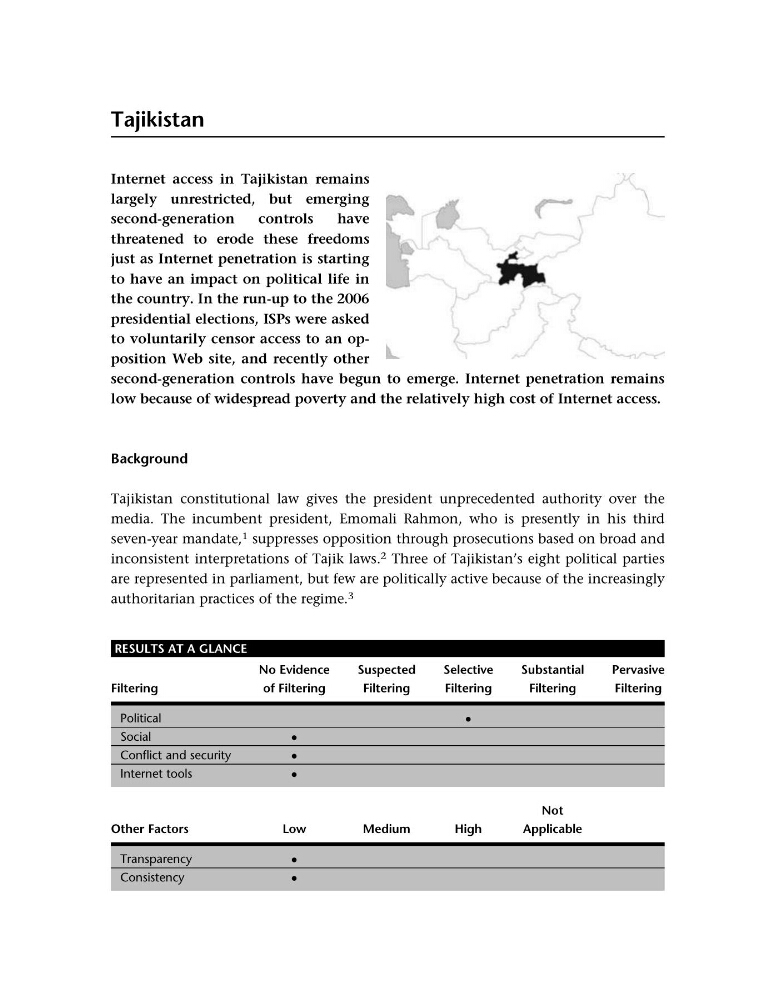
Internet access in Tajikistan remains
largely unrestricted, but emerging
second-generation
controls
have
threatened to erode these freedoms
just as Internet penetration is starting
to have an impact on political life in
the country. In the run-up to the 2006
presidential elections, ISPs were asked
to voluntarily censor access to an opposition Web site, and recently other
second-generation controls have begun to emerge. Internet penetration remains
low because of widespread poverty and the relatively high cost of Internet access.
Background
Tajikistan constitutional law gives the president unprecedented authority over the
media. The incumbent president, Emomali Rahmon, who is presently in his third
seven-year mandate, 1 suppresses opposition through prosecutions based on broad and
inconsistent interpretations of Tajik laws. 2 Three of Tajikistan’s eight political parties
are represented in parliament, but few are politically active because of the increasingly
authoritarian practices of the regime. 3
RESULTS AT A GLANCE
Filtering
No Evidence
of Filtering
Suspected
Filtering
Selective
Filtering
Substantial
Filtering
Pervasive
Filtering
Political
Social
Conflict and security
Internet tools
Other Factors
Low
Medium
High
Not
Applicable
Transparency
Consistency
Internet access in Tajikistan remains
largely unrestricted, but emerging
second-generation
controls
have
threatened to erode these freedoms
just as Internet penetration is starting
to have an impact on political life in
the country. In the run-up to the 2006
presidential elections, ISPs were asked
to voluntarily censor access to an opposition Web site, and recently other
second-generation controls have begun to emerge. Internet penetration remains
low because of widespread poverty and the relatively high cost of Internet access.
Background
Tajikistan constitutional law gives the president unprecedented authority over the
media. The incumbent president, Emomali Rahmon, who is presently in his third
seven-year mandate, 1 suppresses opposition through prosecutions based on broad and
inconsistent interpretations of Tajik laws. 2 Three of Tajikistan’s eight political parties
are represented in parliament, but few are politically active because of the increasingly
authoritarian practices of the regime. 3
RESULTS AT A GLANCE
Filtering
No Evidence
of Filtering
Suspected
Filtering
Selective
Filtering
Substantial
Filtering
Pervasive
Filtering
Political
Social
Conflict and security
Internet tools
Other Factors
Low
Medium
High
Not
Applicable
Transparency
Consistency