

CIS Overview
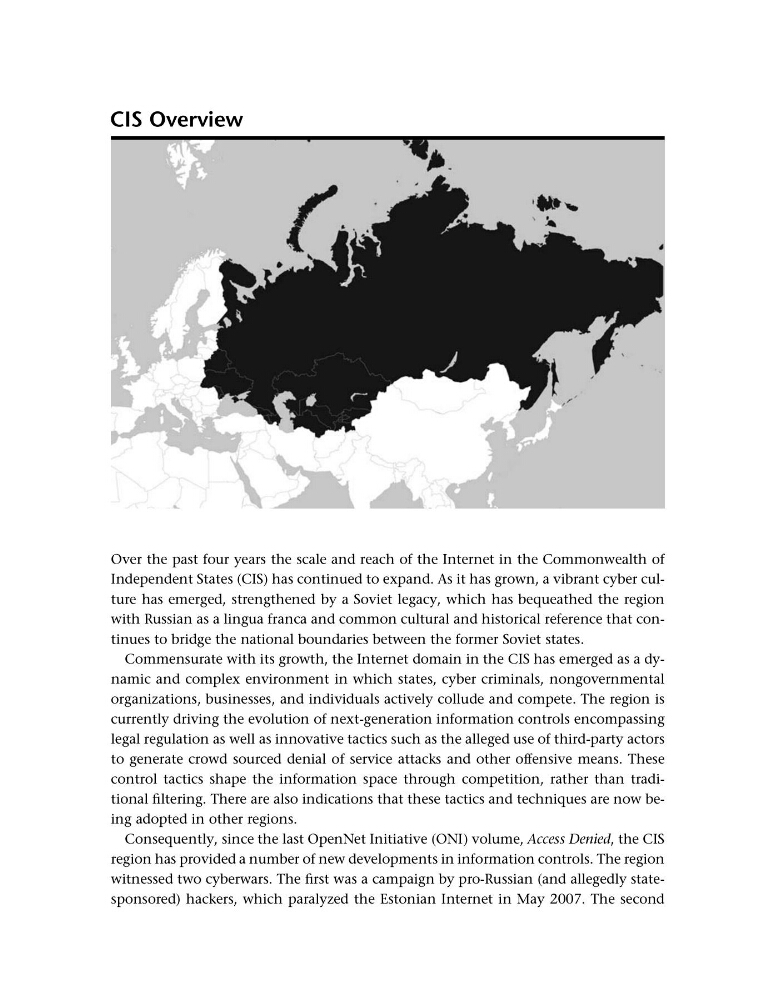
Over the past four years the scale and reach of the Internet in the Commonwealth of
Independent States (CIS) has continued to expand. As it has grown, a vibrant cyber culture has emerged, strengthened by a Soviet legacy, which has bequeathed the region
with Russian as a lingua franca and common cultural and historical reference that continues to bridge the national boundaries between the former Soviet states.
Commensurate with its growth, the Internet domain in the CIS has emerged as a dynamic and complex environment in which states, cyber criminals, nongovernmental
organizations, businesses, and individuals actively collude and compete. The region is
currently driving the evolution of next-generation information controls encompassing
legal regulation as well as innovative tactics such as the alleged use of third-party actors
to generate crowd sourced denial of service attacks and other offensive means. These
control tactics shape the information space through competition, rather than traditional filtering. There are also indications that these tactics and techniques are now being adopted in other regions.
Consequently, since the last OpenNet Initiative (ONI) volume, Access Denied, the CIS
region has provided a number of new developments in information controls. The region
witnessed two cyberwars. The first was a campaign by pro-Russian (and allegedly statesponsored) hackers, which paralyzed the Estonian Internet in May 2007. The second
Over the past four years the scale and reach of the Internet in the Commonwealth of
Independent States (CIS) has continued to expand. As it has grown, a vibrant cyber culture has emerged, strengthened by a Soviet legacy, which has bequeathed the region
with Russian as a lingua franca and common cultural and historical reference that continues to bridge the national boundaries between the former Soviet states.
Commensurate with its growth, the Internet domain in the CIS has emerged as a dynamic and complex environment in which states, cyber criminals, nongovernmental
organizations, businesses, and individuals actively collude and compete. The region is
currently driving the evolution of next-generation information controls encompassing
legal regulation as well as innovative tactics such as the alleged use of third-party actors
to generate crowd sourced denial of service attacks and other offensive means. These
control tactics shape the information space through competition, rather than traditional filtering. There are also indications that these tactics and techniques are now being adopted in other regions.
Consequently, since the last OpenNet Initiative (ONI) volume, Access Denied, the CIS
region has provided a number of new developments in information controls. The region
witnessed two cyberwars. The first was a campaign by pro-Russian (and allegedly statesponsored) hackers, which paralyzed the Estonian Internet in May 2007. The second