

68
Heike Jensen, Jac sm Kee, Gayathry Venkiteswaran, and Sonia Randhawa
Table 4.1
AGENTS, LEVELS, AND FORMS OF CENSORSHIP AND SURVEILLANCE
State
Censorship
Nonstate
Censorship
State
Surveillance
Nonstate
Surveillance
Laws
Direct
n/a
Direct
n/a
Violence
Direct
Direct
n/a
n/a
Administration
Indirect
Direct
Indirect
n/a
Business
Indirect
Direct
Indirect
Direct
Norms/society
Indirect
Direct
Indirect
Direct
Architecture, including code
Indirect
Direct
Indirect
Direct
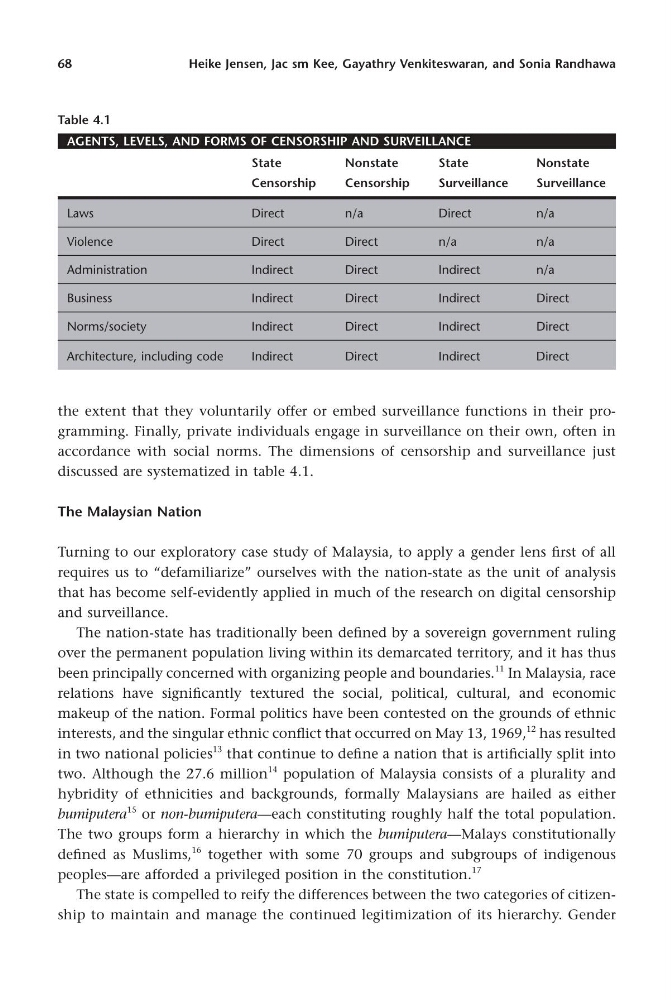
the extent that they voluntarily offer or embed surveillance functions in their programming. Finally, private individuals engage in surveillance on their own, often in
accordance with social norms. The dimensions of censorship and surveillance just
discussed are systematized in table 4.1 .
The Malaysian Nation
Turning to our exploratory case study of Malaysia, to apply a gender lens fi rst of all
requires us to “ defamiliarize ” ourselves with the nation-state as the unit of analysis
that has become self-evidently applied in much of the research on digital censorship
and surveillance.
The nation-state has traditionally been defi ned by a sovereign government ruling
over the permanent population living within its demarcated territory, and it has thus
been principally concerned with organizing people and boundaries.
11 In Malaysia, race
relations have signifi cantly textured the social, political, cultural, and economic
makeup of the nation. Formal politics have been contested on the grounds of ethnic
interests, and the singular ethnic confl ict that occurred on May 13, 1969,
12 has resulted
in two national policies
13 that continue to defi ne a nation that is artifi cially split into
two. Although the 27.6 million
14 population of Malaysia consists of a plurality and
hybridity of ethnicities and backgrounds, formally Malaysians are hailed as either
bumiputera
15 or non-bumiputera — each constituting roughly half the total population.
The two groups form a hierarchy in which the bumiputera — Malays constitutionally
defi ned as Muslims,
16 together with some 70 groups and subgroups of indigenous
peoples — are afforded a privileged position in the constitution.
17
The state is compelled to reify the differences between the two categories of citizenship to maintain and manage the continued legitimization of its hierarchy. Gender
Heike Jensen, Jac sm Kee, Gayathry Venkiteswaran, and Sonia Randhawa
Table 4.1
AGENTS, LEVELS, AND FORMS OF CENSORSHIP AND SURVEILLANCE
State
Censorship
Nonstate
Censorship
State
Surveillance
Nonstate
Surveillance
Laws
Direct
n/a
Direct
n/a
Violence
Direct
Direct
n/a
n/a
Administration
Indirect
Direct
Indirect
n/a
Business
Indirect
Direct
Indirect
Direct
Norms/society
Indirect
Direct
Indirect
Direct
Architecture, including code
Indirect
Direct
Indirect
Direct
the extent that they voluntarily offer or embed surveillance functions in their programming. Finally, private individuals engage in surveillance on their own, often in
accordance with social norms. The dimensions of censorship and surveillance just
discussed are systematized in table 4.1 .
The Malaysian Nation
Turning to our exploratory case study of Malaysia, to apply a gender lens fi rst of all
requires us to “ defamiliarize ” ourselves with the nation-state as the unit of analysis
that has become self-evidently applied in much of the research on digital censorship
and surveillance.
The nation-state has traditionally been defi ned by a sovereign government ruling
over the permanent population living within its demarcated territory, and it has thus
been principally concerned with organizing people and boundaries.
11 In Malaysia, race
relations have signifi cantly textured the social, political, cultural, and economic
makeup of the nation. Formal politics have been contested on the grounds of ethnic
interests, and the singular ethnic confl ict that occurred on May 13, 1969,
12 has resulted
in two national policies
13 that continue to defi ne a nation that is artifi cially split into
two. Although the 27.6 million
14 population of Malaysia consists of a plurality and
hybridity of ethnicities and backgrounds, formally Malaysians are hailed as either
bumiputera
15 or non-bumiputera — each constituting roughly half the total population.
The two groups form a hierarchy in which the bumiputera — Malays constitutionally
defi ned as Muslims,
16 together with some 70 groups and subgroups of indigenous
peoples — are afforded a privileged position in the constitution.
17
The state is compelled to reify the differences between the two categories of citizenship to maintain and manage the continued legitimization of its hierarchy. Gender