

The Struggle for Digital Freedom of Speech
45
Malaysian government ’ s imposition of linear regulatory measures, defi ned as traditional top-down imposition of state power. The chapter concludes by describing the
recent emergence of third-generation controls in Malaysia and hypothesizing that it
may be part of a wider shift toward subtler, covert, and, most importantly, nonlinear ,
participatory, and competitive forms of regulating the Internet in Malaysia. This shift
in regulatory methodology also demonstrates the advent of a singular, unprecedented,
bilateral dialogue between the Malaysian government and its regulatory subjects,
namely, the sociopolitical blogosphere. I suggest that the direction of this conversation
is still susceptible to infl uence by the Malaysian blogosphere.
Linear Regulatory Attempts: Hierarchical Top-Down Application of Firstand Second-Generation Controls
Around 2007 the Malaysian government moved from publicly denouncing sociopolitical bloggers as untrustworthy to taking concrete steps against these vocal critics. In lieu
of its well-known 1998 pledge of noncensorship of the Internet, the Malaysian government resorted mainly to second-generation controls.
13 It took a two-pronged approach
in its attempt to extend traditional, unidirectional, top-down, and hence what I call
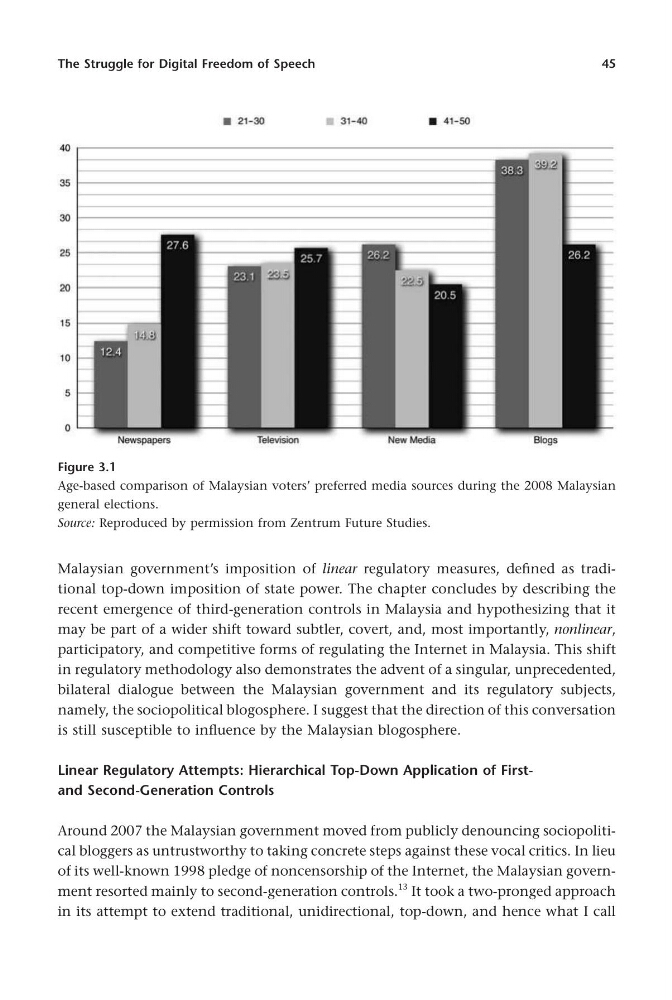
Figure 3.1
Age-based comparison of Malaysian voters ’ preferred media sources during the 2008 Malaysian
general elections.
Source: Reproduced by permission from Zentrum Future Studies.
45
Malaysian government ’ s imposition of linear regulatory measures, defi ned as traditional top-down imposition of state power. The chapter concludes by describing the
recent emergence of third-generation controls in Malaysia and hypothesizing that it
may be part of a wider shift toward subtler, covert, and, most importantly, nonlinear ,
participatory, and competitive forms of regulating the Internet in Malaysia. This shift
in regulatory methodology also demonstrates the advent of a singular, unprecedented,
bilateral dialogue between the Malaysian government and its regulatory subjects,
namely, the sociopolitical blogosphere. I suggest that the direction of this conversation
is still susceptible to infl uence by the Malaysian blogosphere.
Linear Regulatory Attempts: Hierarchical Top-Down Application of Firstand Second-Generation Controls
Around 2007 the Malaysian government moved from publicly denouncing sociopolitical bloggers as untrustworthy to taking concrete steps against these vocal critics. In lieu
of its well-known 1998 pledge of noncensorship of the Internet, the Malaysian government resorted mainly to second-generation controls.
13 It took a two-pronged approach
in its attempt to extend traditional, unidirectional, top-down, and hence what I call
Figure 3.1
Age-based comparison of Malaysian voters ’ preferred media sources during the 2008 Malaysian
general elections.
Source: Reproduced by permission from Zentrum Future Studies.