

324
Malaysia
Background
In 1998, the Malaysian government pledged to refrain from censorship of the Internet
as part of a fi nancial calculation to attract foreign investment. This pledge was statutorily enshrined in Section 3(3) of the Communications and Multimedia Act of 1998
(CMA), which regulates telecommunications in Malaysia.
1 The pledge was repeated in
a bill of guarantees attached to the main Malaysian IT development project aimed at
reassuring foreign investors.
2 Thus the Internet initially offered a relatively unconstrained medium for opposition voices to fl ourish, allowing for the nascence of the
active, vibrant, and mostly antigovernment Malaysian sociopolitical blogosphere.
3
This pledge of noncensorship of the Internet has been substantially eroded under the
banner of preserving “ racial harmony ” in recent years, especially after a major political
setback suffered by the ruling coalition in 2008.
Malaysia is an ethnically diverse country that has been governed by the same political coalition, Barisan Nasional (BN),
4 since independence from British colonial rule in
1957.
5 Malays make up 49.6 percent of the population, while 22.8 percent and 6.8
percent are Chinese and Indian, respectively.
6 The strength of the Malaysian government ’ s appeal to “ racial harmony ” in justifying Internet regulation lies in the nation ’ s
historical experience with race relations. Race forms the “ most prominent and pervasive line of cleavage in Malaysian politics, economics and society. ”
7 Racial tension,
especially between the majority Malays and minority races over affi rmative action,
has been the source of the two most severe disruptions to social stability in Malaysia.
8
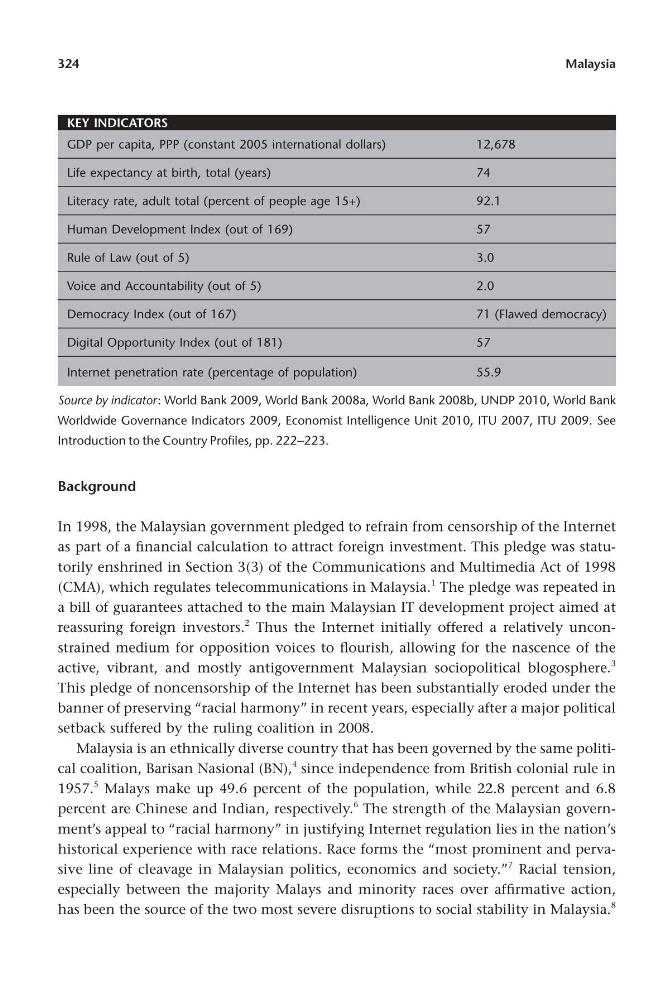
KEY INDICATORS
GDP per capita, PPP (constant 2005 international dollars)
12,678
Life expectancy at birth, total (years)
74
Literacy rate, adult total (percent of people age 15+)
92.1
Human Development Index (out of 169)
57
Rule of Law (out of 5)
3.0
Voice and Accountability (out of 5)
2.0
Democracy Index (out of 167)
71 (Flawed democracy)
Digital Opportunity Index (out of 181)
57
Internet penetration rate (percentage of population)
55.9
Source by indicator : World Bank 2009, World Bank 2008a, World Bank 2008b, UNDP 2010, World Bank
Worldwide Governance Indicators 2009, Economist Intelligence Unit 2010, ITU 2007, ITU 2009. See
Introduction to the Country Profi les, pp. 222 – 223.
Malaysia
Background
In 1998, the Malaysian government pledged to refrain from censorship of the Internet
as part of a fi nancial calculation to attract foreign investment. This pledge was statutorily enshrined in Section 3(3) of the Communications and Multimedia Act of 1998
(CMA), which regulates telecommunications in Malaysia.
1 The pledge was repeated in
a bill of guarantees attached to the main Malaysian IT development project aimed at
reassuring foreign investors.
2 Thus the Internet initially offered a relatively unconstrained medium for opposition voices to fl ourish, allowing for the nascence of the
active, vibrant, and mostly antigovernment Malaysian sociopolitical blogosphere.
3
This pledge of noncensorship of the Internet has been substantially eroded under the
banner of preserving “ racial harmony ” in recent years, especially after a major political
setback suffered by the ruling coalition in 2008.
Malaysia is an ethnically diverse country that has been governed by the same political coalition, Barisan Nasional (BN),
4 since independence from British colonial rule in
1957.
5 Malays make up 49.6 percent of the population, while 22.8 percent and 6.8
percent are Chinese and Indian, respectively.
6 The strength of the Malaysian government ’ s appeal to “ racial harmony ” in justifying Internet regulation lies in the nation ’ s
historical experience with race relations. Race forms the “ most prominent and pervasive line of cleavage in Malaysian politics, economics and society. ”
7 Racial tension,
especially between the majority Malays and minority races over affi rmative action,
has been the source of the two most severe disruptions to social stability in Malaysia.
8
KEY INDICATORS
GDP per capita, PPP (constant 2005 international dollars)
12,678
Life expectancy at birth, total (years)
74
Literacy rate, adult total (percent of people age 15+)
92.1
Human Development Index (out of 169)
57
Rule of Law (out of 5)
3.0
Voice and Accountability (out of 5)
2.0
Democracy Index (out of 167)
71 (Flawed democracy)
Digital Opportunity Index (out of 181)
57
Internet penetration rate (percentage of population)
55.9
Source by indicator : World Bank 2009, World Bank 2008a, World Bank 2008b, UNDP 2010, World Bank
Worldwide Governance Indicators 2009, Economist Intelligence Unit 2010, ITU 2007, ITU 2009. See
Introduction to the Country Profi les, pp. 222 – 223.