

90
Pirongrong Ramasoota
knowledge or intent. It claims that “ any service providers [who] knowingly or unknowingly support or allow offenses indicated in Section 14 to be committed in the computer or system under his control shall receive the same penalties as offenders under Section
14 ”
26 (my emphasis).
According to the law, no distinction is made between network providers who act
as mere conduits and content providers who actually host content in the way they
are held liable for harmful or illegal content. Whether or not the providers have actual
knowledge of the content in question or whether they quickly remove the content
after becoming aware of it does not grant any immunity. However, the law does not
extend liability to search engines and portals that provide links to illegal content.
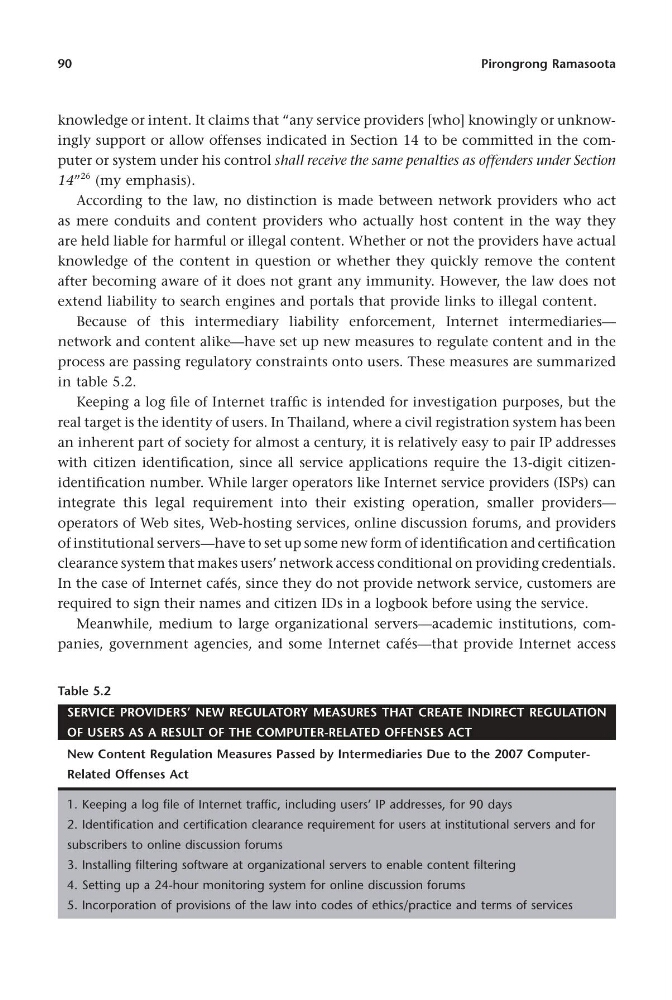
Because of this intermediary liability enforcement, Internet intermediaries —
network and content alike — have set up new measures to regulate content and in the
process are passing regulatory constraints onto users. These measures are summarized
in table 5.2 .
Keeping a log fi le of Internet traffi c is intended for investigation purposes, but the
real target is the identity of users. In Thailand, where a civil registration system has been
an inherent part of society for almost a century, it is relatively easy to pair IP addresses
with citizen identifi cation, since all service applications require the 13-digit citizenidentifi cation number. While larger operators like Internet service providers (ISPs) can
integrate this legal requirement into their existing operation, smaller providers —
operators of Web sites, Web-hosting services, online discussion forums, and providers
of institutional servers — have to set up some new form of identifi cation and certifi cation
clearance system that makes users ’ network access conditional on providing credentials.
In the case of Internet caf é s, since they do not provide network service, customers are
required to sign their names and citizen IDs in a logbook before using the service.
Meanwhile, medium to large organizational servers — academic institutions, companies, government agencies, and some Internet caf é s — that provide Internet access
Table 5.2
SERVICE PROVIDERS ’ NEW REGULATORY MEASURES THAT CREATE INDIRECT REGULATION
OF USERS AS A RESULT OF THE COMPUTER-RELATED OFFENSES ACT
New Content Regulation Measures Passed by Intermediaries Due to the 2007 ComputerRelated Offenses Act
1. Keeping a log fi le of Internet traffi c, including users ’ IP addresses, for 90 days
2. Identifi cation and certifi cation clearance requirement for users at institutional servers and for
subscribers to online discussion forums
3. Installing fi ltering software at organizational servers to enable content fi ltering
4. Setting up a 24-hour monitoring system for online discussion forums
5. Incorporation of provisions of the law into codes of ethics/practice and terms of services
Pirongrong Ramasoota
knowledge or intent. It claims that “ any service providers [who] knowingly or unknowingly support or allow offenses indicated in Section 14 to be committed in the computer or system under his control shall receive the same penalties as offenders under Section
14 ”
26 (my emphasis).
According to the law, no distinction is made between network providers who act
as mere conduits and content providers who actually host content in the way they
are held liable for harmful or illegal content. Whether or not the providers have actual
knowledge of the content in question or whether they quickly remove the content
after becoming aware of it does not grant any immunity. However, the law does not
extend liability to search engines and portals that provide links to illegal content.
Because of this intermediary liability enforcement, Internet intermediaries —
network and content alike — have set up new measures to regulate content and in the
process are passing regulatory constraints onto users. These measures are summarized
in table 5.2 .
Keeping a log fi le of Internet traffi c is intended for investigation purposes, but the
real target is the identity of users. In Thailand, where a civil registration system has been
an inherent part of society for almost a century, it is relatively easy to pair IP addresses
with citizen identifi cation, since all service applications require the 13-digit citizenidentifi cation number. While larger operators like Internet service providers (ISPs) can
integrate this legal requirement into their existing operation, smaller providers —
operators of Web sites, Web-hosting services, online discussion forums, and providers
of institutional servers — have to set up some new form of identifi cation and certifi cation
clearance system that makes users ’ network access conditional on providing credentials.
In the case of Internet caf é s, since they do not provide network service, customers are
required to sign their names and citizen IDs in a logbook before using the service.
Meanwhile, medium to large organizational servers — academic institutions, companies, government agencies, and some Internet caf é s — that provide Internet access
Table 5.2
SERVICE PROVIDERS ’ NEW REGULATORY MEASURES THAT CREATE INDIRECT REGULATION
OF USERS AS A RESULT OF THE COMPUTER-RELATED OFFENSES ACT
New Content Regulation Measures Passed by Intermediaries Due to the 2007 ComputerRelated Offenses Act
1. Keeping a log fi le of Internet traffi c, including users ’ IP addresses, for 90 days
2. Identifi cation and certifi cation clearance requirement for users at institutional servers and for
subscribers to online discussion forums
3. Installing fi ltering software at organizational servers to enable content fi ltering
4. Setting up a 24-hour monitoring system for online discussion forums
5. Incorporation of provisions of the law into codes of ethics/practice and terms of services