

88
Pirongrong Ramasoota
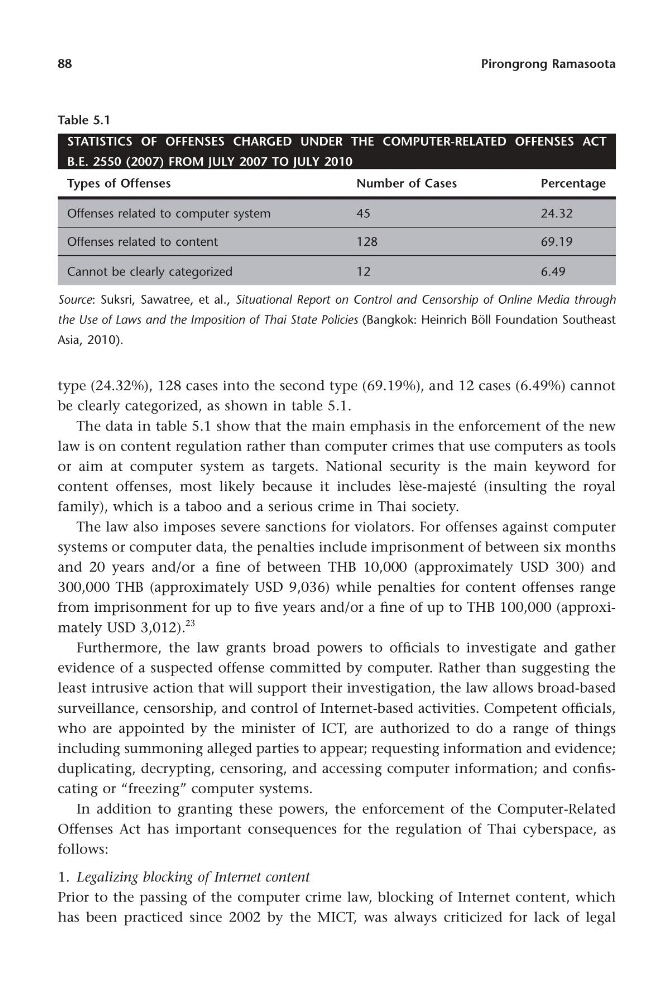
type (24.32%), 128 cases into the second type (69.19%), and 12 cases (6.49%) cannot
be clearly categorized, as shown in table 5.1.
The data in table 5.1 show that the main emphasis in the enforcement of the new
law is on content regulation rather than computer crimes that use computers as tools
or aim at computer system as targets. National security is the main keyword for
content offenses, most likely because it includes l è se-majest é (insulting the royal
family), which is a taboo and a serious crime in Thai society.
The law also imposes severe sanctions for violators. For offenses against computer
systems or computer data, the penalties include imprisonment of between six months
and 20 years and/or a fi ne of between THB 10,000 (approximately USD 300) and
300,000 THB (approximately USD 9,036) while penalties for content offenses range
from imprisonment for up to fi ve years and/or a fi ne of up to THB 100,000 (approximately USD 3,012).
23
Furthermore, the law grants broad powers to offi cials to investigate and gather
evidence of a suspected offense committed by computer. Rather than suggesting the
least intrusive action that will support their investigation, the law allows broad-based
surveillance, censorship, and control of Internet-based activities. Competent offi cials,
who are appointed by the minister of ICT, are authorized to do a range of things
including summoning alleged parties to appear; requesting information and evidence;
duplicating, decrypting, censoring, and accessing computer information; and confi scating or “ freezing ” computer systems.
In addition to granting these powers, the enforcement of the Computer-Related
Offenses Act has important consequences for the regulation of Thai cyberspace, as
follows:
1. Legalizing blocking of Internet content
Prior to the passing of the computer crime law, blocking of Internet content, which
has been practiced since 2002 by the MICT, was always criticized for lack of legal
Table 5.1
STATISTICS OF OFFENSES CHARGED UNDER THE COMPUTER-RELATED OFFENSES ACT
B.E. 2550 (2007) FROM JULY 2007 TO JULY 2010
Types of Offenses
Number of Cases
Percentage
Offenses related to computer system
45
24.32
Offenses related to content
128
69.19
Cannot be clearly categorized
12
6.49
Source : Suksri, Sawatree, et al., Situational Report on Control and Censorship of Online Media through
the Use of Laws and the Imposition of Thai State Policies (Bangkok: Heinrich Böll Foundation Southeast
Asia, 2010).
Pirongrong Ramasoota
type (24.32%), 128 cases into the second type (69.19%), and 12 cases (6.49%) cannot
be clearly categorized, as shown in table 5.1.
The data in table 5.1 show that the main emphasis in the enforcement of the new
law is on content regulation rather than computer crimes that use computers as tools
or aim at computer system as targets. National security is the main keyword for
content offenses, most likely because it includes l è se-majest é (insulting the royal
family), which is a taboo and a serious crime in Thai society.
The law also imposes severe sanctions for violators. For offenses against computer
systems or computer data, the penalties include imprisonment of between six months
and 20 years and/or a fi ne of between THB 10,000 (approximately USD 300) and
300,000 THB (approximately USD 9,036) while penalties for content offenses range
from imprisonment for up to fi ve years and/or a fi ne of up to THB 100,000 (approximately USD 3,012).
23
Furthermore, the law grants broad powers to offi cials to investigate and gather
evidence of a suspected offense committed by computer. Rather than suggesting the
least intrusive action that will support their investigation, the law allows broad-based
surveillance, censorship, and control of Internet-based activities. Competent offi cials,
who are appointed by the minister of ICT, are authorized to do a range of things
including summoning alleged parties to appear; requesting information and evidence;
duplicating, decrypting, censoring, and accessing computer information; and confi scating or “ freezing ” computer systems.
In addition to granting these powers, the enforcement of the Computer-Related
Offenses Act has important consequences for the regulation of Thai cyberspace, as
follows:
1. Legalizing blocking of Internet content
Prior to the passing of the computer crime law, blocking of Internet content, which
has been practiced since 2002 by the MICT, was always criticized for lack of legal
Table 5.1
STATISTICS OF OFFENSES CHARGED UNDER THE COMPUTER-RELATED OFFENSES ACT
B.E. 2550 (2007) FROM JULY 2007 TO JULY 2010
Types of Offenses
Number of Cases
Percentage
Offenses related to computer system
45
24.32
Offenses related to content
128
69.19
Cannot be clearly categorized
12
6.49
Source : Suksri, Sawatree, et al., Situational Report on Control and Censorship of Online Media through
the Use of Laws and the Imposition of Thai State Policies (Bangkok: Heinrich Böll Foundation Southeast
Asia, 2010).