

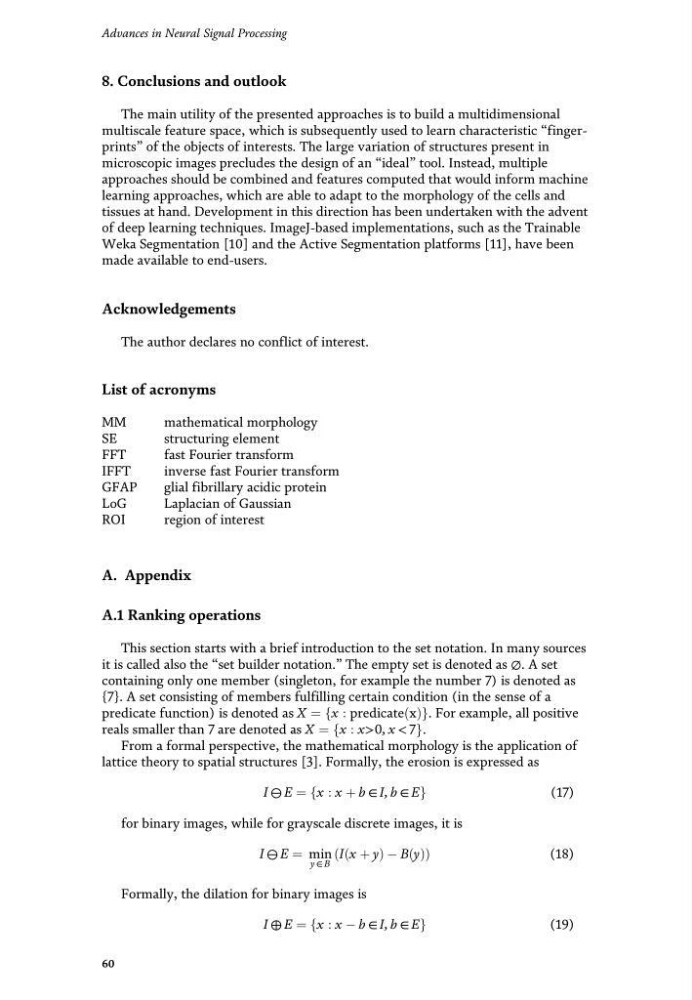
8. Conclusions and outlook
The main utility of the presented approaches is to build a multidimensional
multiscale feature space, which is subsequently used to learn characteristic “fingerprints” of the objects of interests. The large variation of structures present in
microscopic images precludes the design of an “ideal” tool. Instead, multiple
approaches should be combined and features computed that would inform machine
learning approaches, which are able to adapt to the morphology of the cells and
tissues at hand. Development in this direction has been undertaken with the advent
of deep learning techniques. ImageJ-based implementations, such as the Trainable
Weka Segmentation [10] and the Active Segmentation platforms [11], have been
made available to end-users.
Acknowledgements
The author declares no conflict of interest.
List of acronyms
MM
mathematical morphology
SE
structuring element
FFT
fast Fourier transform
IFFT
inverse fast Fourier transform
GFAP
glial fibrillary acidic protein
LoG
Laplacian of Gaussian
ROI
region of interest
A. Appendix
A.1 Ranking operations
This section starts with a brief introduction to the set notation. In many sources
it is called also the “set builder notation.” The empty set is denoted as ∅. A set
containing only one member (singleton, for example the number 7) is denoted as
{7}. A set consisting of members fulfilling certain condition (in the sense of a
predicate function) is denoted as X ¼ x : predicate x
ðÞ
fg . For example, all positive
reals smaller than 7 are denoted as X ¼ x : x>0,x< 7
fg .
From a formal perspective, the mathematical morphology is the application of
lattice theory to spatial structures [3]. Formally, the erosion is expressed as
I ⊖ E ¼ x : x þ b ∈ I, b ∈ E
fg
(17)
for binary images, while for grayscale discrete images, it is
I ⊖ E ¼ min
y ∈ B
Ixþ y
ð
Þ�By ðÞ
ðÞ
(18)
Formally, the dilation for binary images is
I ⊕ E ¼ x : x � b ∈ I, b ∈ E
fg
(19)
60
Advances in Neural Signal Processing
The main utility of the presented approaches is to build a multidimensional
multiscale feature space, which is subsequently used to learn characteristic “fingerprints” of the objects of interests. The large variation of structures present in
microscopic images precludes the design of an “ideal” tool. Instead, multiple
approaches should be combined and features computed that would inform machine
learning approaches, which are able to adapt to the morphology of the cells and
tissues at hand. Development in this direction has been undertaken with the advent
of deep learning techniques. ImageJ-based implementations, such as the Trainable
Weka Segmentation [10] and the Active Segmentation platforms [11], have been
made available to end-users.
Acknowledgements
The author declares no conflict of interest.
List of acronyms
MM
mathematical morphology
SE
structuring element
FFT
fast Fourier transform
IFFT
inverse fast Fourier transform
GFAP
glial fibrillary acidic protein
LoG
Laplacian of Gaussian
ROI
region of interest
A. Appendix
A.1 Ranking operations
This section starts with a brief introduction to the set notation. In many sources
it is called also the “set builder notation.” The empty set is denoted as ∅. A set
containing only one member (singleton, for example the number 7) is denoted as
{7}. A set consisting of members fulfilling certain condition (in the sense of a
predicate function) is denoted as X ¼ x : predicate x
ðÞ
fg . For example, all positive
reals smaller than 7 are denoted as X ¼ x : x>0,x< 7
fg .
From a formal perspective, the mathematical morphology is the application of
lattice theory to spatial structures [3]. Formally, the erosion is expressed as
I ⊖ E ¼ x : x þ b ∈ I, b ∈ E
fg
(17)
for binary images, while for grayscale discrete images, it is
I ⊖ E ¼ min
y ∈ B
Ixþ y
ð
Þ�By ðÞ
ðÞ
(18)
Formally, the dilation for binary images is
I ⊕ E ¼ x : x � b ∈ I, b ∈ E
fg
(19)
60
Advances in Neural Signal Processing